

Long before the modern Bible was bound in leather, it was a living, breathing collection of voices, shifting, competing, and unfinished. In the winter of 1946, high above the salt-encrusted shores of the Dead Sea, a Bedouin shepherd tracking a stray goat tossed a stone into a dark cave opening and heard the crack of shattering pottery. Inside those hidden jars lay a library that would fundamentally shatter our understanding of sacred history.
Until that moment, every Old Testament on every desk and pulpit rested on medieval manuscripts written a thousand years after the time of Christ. The discovery at Qumran destroyed that assumption and opened the doors to a chaotic, vibrant ancient world.
Perfectly Hidden in Plain Sight
Every few years, a documentary promises that the Dead Sea Scrolls are about to bring Christianity crashing down, and every few years, somebody accuses the Vatican of sitting on the evidence. In fact, people have heard this so often that when they read something on The Unholy Truth that cuts against tradition harder than any mainstream account would, they assume the publication claims to be uncovering things hidden from the public and ferociously denied by Christian clergy.
The thing is, there’s no cover-up for anyone to uncover, me included, since the evidence is in a public database, photographed in high resolution, and contains no mention of Jesus, Paul, or a single Christian. The conspiracy crowd is aiming at the wrong target, because the scrolls damaged the traditional story from the side, by tearing apart the stage that the story was supposed to stand on.
That stage had two main props. One was a Bible copied faithfully from the beginning and handed down unchanged, and second, a Judaism so uniform that Jesus could appear as a clean break from everything around him. The scrolls dismantled both.
A Thousand Years Closer to the Source
Between November 1946 and February 1947, Bedouin shepherds working the cliffs above the Dead Sea found jars of leather and papyrus scrolls in a cave near Qumran. Eleven caves eventually produced 981 manuscripts, written between the third century BCE and the first century CE. Before that, the oldest nearly complete Hebrew Bible anyone could point to dated from around the year 1000, which meant every Old Testament on every shelf rested on a medieval manuscript. The Great Isaiah Scroll from the first cave was copied in the second century BCE, more than a thousand years older than the text it was supposed to match.
Every book of the Hebrew Bible turned up in some form except Esther, and more than 200 of the manuscripts are copies of biblical books. The rest of the library holds what nobody had been reading, which turned out to matter more.
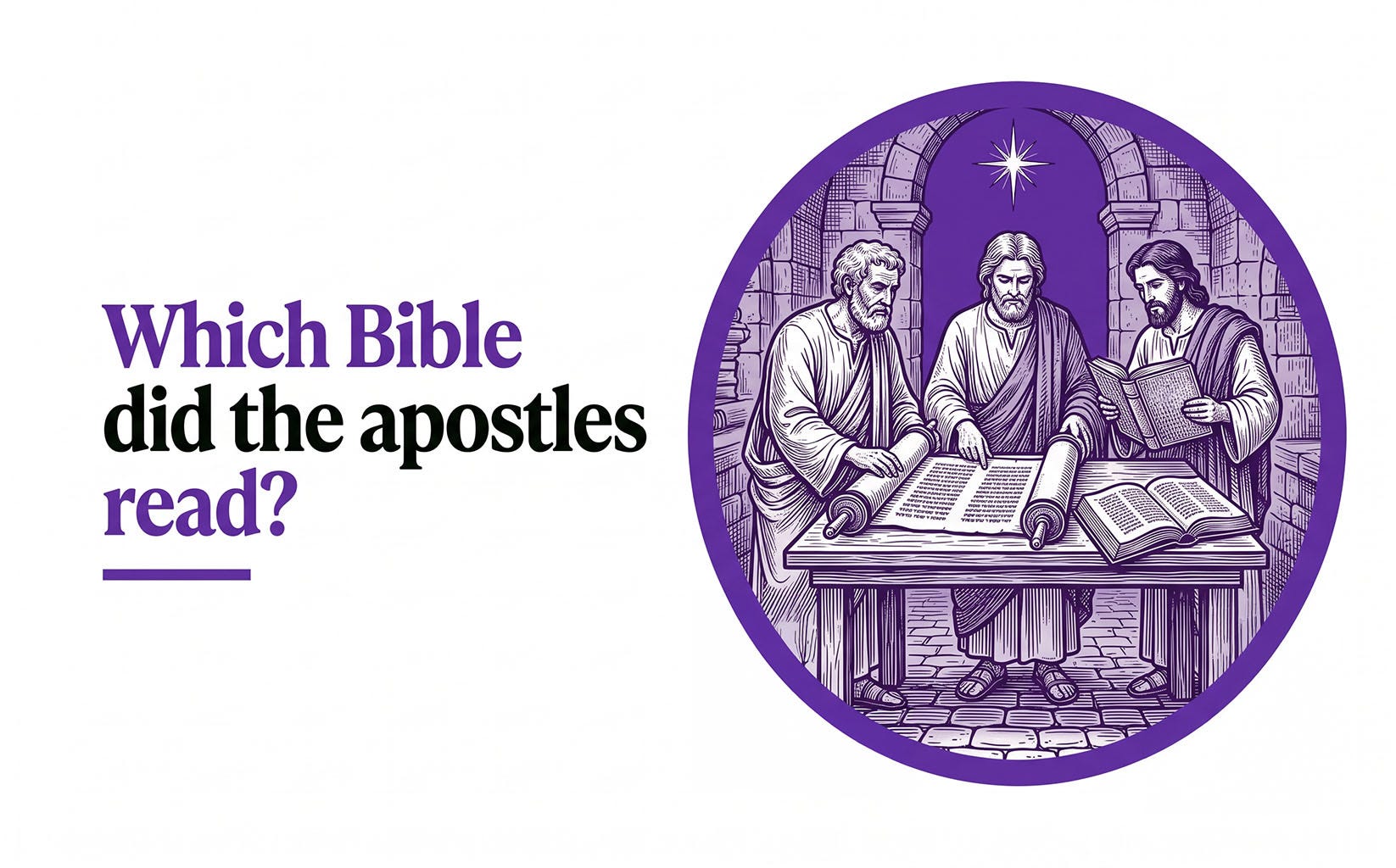
Which Version of the Bible Did the Apostles Read?
The obvious assumption says the scribes at Qumran should have produced a text that matches the medieval one almost word for word, since the medieval scribes are famous for their care. About 45 percent of the biblical scrolls do match it. Roughly another 45 percent match no single version at all, and the remaining handful line up with the Greek translation or with the Samaritan Torah. In the first century BCE there was no such thing as the Hebrew text of the Bible, only competing editions of it sitting on the same shelves.
The differences are more than simple spelling choices. In the story of David and Goliath, a Samuel scroll and the Greek translation both give Goliath’s height as four cubits and a span, about six feet nine, while the medieval Hebrew text makes him six cubits and a span, closer to ten feet. The same Samuel scroll has a paragraph about an Ammonite king gouging out the right eyes of the men of Gad, which the medieval text lacks and which some modern translations have since put back. Jeremiah circulated in a short edition and a long one, and a Qumran scroll of the book matches the short one that the Greek translators used.
Deuteronomy 32:8 shows what happened when a line made scribes nervous. The medieval version says God divided humanity according to the number of the sons of Israel. A Deuteronomy scroll, backed by the Greek, says the sons of God, which describes a world where the high god hands out nations to lesser divine beings and keeps Israel for himself. Somebody edited the polytheism out of the Hebrew text, and the scroll preserves the wording from before the edit.
Christians have a bigger stake in this than Jews do, because New Testament writers quote the Old Testament in ways that used to look like blunders. Hebrews 1:6 tells its readers that all God’s angels must worship the Son, a quotation of Deuteronomy 32:43 that appears nowhere in the medieval Hebrew. For centuries apologists and critics argued over whether the author had botched it or leaned on a faulty Greek translation. A Qumran scroll of Deuteronomy carries a form of that verse with the gods bowing down to him, so a Hebrew wording close to what the Greek translators used was in circulation before Hebrews was written. The scrolls cleared the author of sloppiness and, in the same stroke, left anyone who claims the Bible is perfectly preserved with an awkward question about which edition they mean.
When Enoch Sat Next to Isaiah
The library holds 25 copies of 1 Enoch, the book of fallen angels and giants that the New Testament letter of Jude quotes as prophecy, and 21 copies of Jubilees, a retelling of Genesis that rearranges the calendar. Someone kept these in the same caves as Psalms and Isaiah, with no sign of a second-class shelf. Christians later spent centuries fighting over which books counted, and the scrolls show that the first-century Jewish world they inherited the argument from had no list to settle it.
A Messiah Who Raises the Dead, Written Before Jesus Was Born
A Cave 4 fragment known as 4Q521 describes the Lord’s anointed and says “he will heal the badly wounded and he will make the dead live, he will proclaim good news to the poor.” In Luke 7:22, when John the Baptist’s disciples ask Jesus whether he’s the one who was expected, Jesus answers with a checklist that includes the dead being raised and good news being brought to the poor. The checklist comes out of Isaiah, and 4Q521 shows a Jewish author before Jesus’ time assembling the same Isaiah items into a job description for the messiah. The Gospel writer is drawing on an expectation that already existed.
Another Aramaic fragment, 4Q246, says of a coming figure that “he will be called son of God, and they will call him son of the Most High,” which is close to what Luke gives the angel Gabriel in the annunciation (Luke 1:32-35). Whoever the fragment’s figure is, the titles were already in use for him. The Community Rule from the first cave goes further and looks ahead to the messiahs of Aaron and Israel, plural, a priest and a king, which tells you how little agreement there was on what the position even involved.
Paul’s Phrase Finds Its Owner
A letter now called 4QMMT (the Hebrew title means roughly “some of the works of the Torah”) lists purity and temple rules that its authors say separate them from their rivals, and it closes by telling the recipient that keeping them “will be reckoned to you as righteousness.” Paul says in Galatians 2:16 that nobody is justified by works of the law, and in Galatians 3:6 he quotes Genesis on Abraham being reckoned righteous. For two thousand years readers heard “works of the law” as a general complaint about earning salvation by being good. The scrolls show that Jewish groups used the phrase for their own sectarian rule lists, which points Paul’s fight toward an argument over which Jewish rules non-Jews had to follow.
What the Scrolls Never Contained
They contain no Jesus, no John the Baptist and no early church. The tiny Cave 7 Greek fragment that a Spanish Jesuit, José O’Callaghan, read as a line of Mark’s Gospel has roughly twenty letters on it, and almost nobody outside a committed circle accepts the reading. The community at Qumran, which most scholars still link to the Essenes (a Jewish sect described by the first-century historian Josephus), was made up of celibate priests who thought the Jerusalem temple was run by frauds and the end was close.
Anyone hunting for a smoking gun has the wrong expectation of what a library like this can deliver. What the scrolls supply is the soil: a Judaism full of apocalyptic sects, rival calendars, argued-over books and several different messiahs, where a preacher announcing that the end was near and the temple was corrupt would have sounded like one voice in a crowd.
A Crowded Judaism and an Unfinished Bible
Christianity has always told itself that it arrived with a new message in a settled world, carrying a book that never changed. The scrolls leave a different picture, with an argumentative Judaism, a Bible still being edited when Jesus was born, and a stock of ideas about messiahs, sons of God and resurrection that the Gospel writers inherited and put to work. Believers who can live with a human history lose nothing they needed. The version of the faith that required a miracle of preservation and a clean break from its surroundings is the one that didn’t survive the discovery.
The scrolls also come with a scandal of their own. For 44 years a small team of mostly Christian scholars held most of the material, and the story of how it finally got out, including a library in California and an editor who lost his job over what he said about Judaism, is in the bonus section below. If you’re reading this as a free subscriber, upgrade to unlock it.
Paid Subscribers Only: Bonus Section
Forty-Four Years of Locked Drawers
The cover-up legend has a root, albeit not a very interesting one. In the 1950s the fragments from Cave 4…