


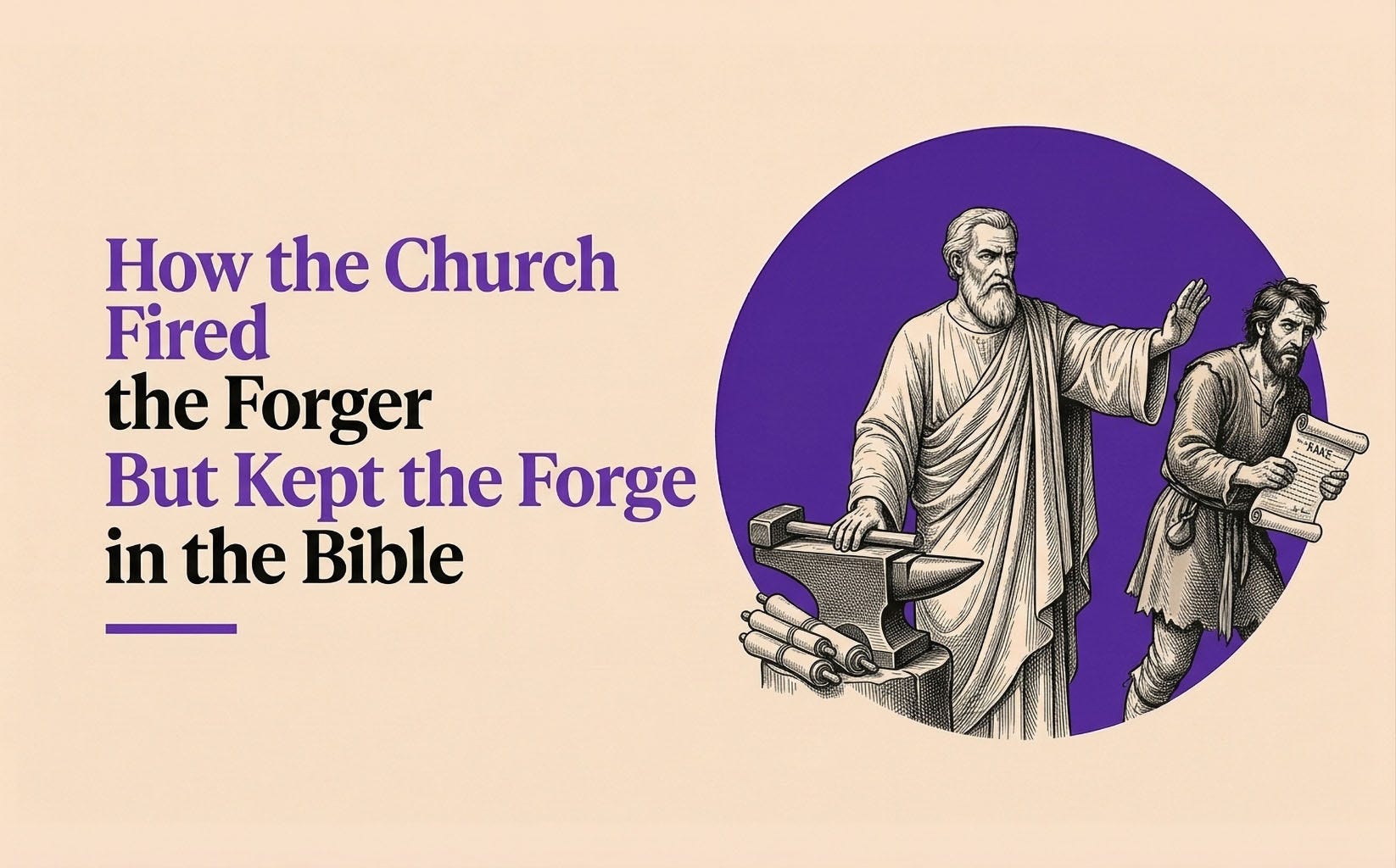
Around the year 200, Tertullian, a church writer in Carthage, told a story about an elder in Asia Minor who’d written a long adventure tale starring the apostle Paul and a young woman named Thecla. She listens to Paul preach through a window, breaks off her engagement, survives being burned at the stake and thrown to wild animals, baptizes herself in a pit full of seals, and gets sent off by Paul with orders to go and teach the word of God. The elder presented all of it as history. When he was caught, he confessed, explained that he’d done it out of love for Paul, and was removed from office anyway.
Tertullian cheered the firing, but his motive may not be so respectable. People were pointing to Thecla as proof that women could teach and baptize, and exposing the book’s author was the fastest way to kill that precedent. Church leaders had other reasons to hate forgeries too. Around the same time, Serapion, the bishop of Antioch, rejected a gospel circulating under Peter’s name by announcing that the church received Peter and the other apostles as it received Christ, and by refusing writings falsely attributed to them. Both men worked from the same test, which said that a book carrying an apostle’s name had to come from the apostle.
That test sounds awesome, but only as long as you don’t apply it to the New Testament.
One quick note before we begin: I touched on this topic previously in the bonus section, and I’d like to expand on it. What we’ll be discussing isn’t some conspiracy theory, personal opinion or a minority position among biblical scholars. I’m not uncovering anything that’s not covered in the first place.
The Letter That Warns You About Letters
2 Thessalonians tells its readers not to be rattled by a “letter seeming to be from us” claiming that the day of the Lord has already arrived. Near the end, the author says he’s writing the greeting “with my own hand” and calls that “the sign in every letter.” Romans, 2 Corinthians, Philippians and 1 Thessalonians carry no such sign (Romans was written down by a scribe named Tertius, who greets the readers in his own voice), so the claim gets Paul’s habits wrong, and pointing at your own handwriting as proof of who you are is what a forger does.
The letter also reads like a cover version of 1 Thessalonians, borrowing the opening, the thanksgiving and a good deal of the wording, then reverses the message. In 1 Thessalonians the day of the Lord arrives like a thief in the night with no warning, while 2 Thessalonians says calm down, because first a “man of lawlessness” has to show up and take his seat in God’s temple. Someone needed Paul to say the end wasn’t imminent, borrowed his voice to say it, and warned readers about forged letters in the same breath. The church has been reading that warning for nearly two thousand years without asking who delivered it.
The Letters to Timothy and Titus Come With a Coat and a Stomach Remedy
1 Timothy, 2 Timothy and Titus present themselves as Paul’s final instructions to two younger coworkers. They lay out qualifications for bishops and deacons, appointed elders in every town and an official roster of widows, a level of church organization that Paul’s own letters, which mention overseers and deacons only in passing, never come near. The Greek contains dozens of words Paul uses nowhere else, and it drops his favorites. The word “faith” slides from trusting Christ into a body of teaching to be guarded, and the whole arrangement addresses problems that belong to a church a generation or two down the road.
The letters aren’t without personal touches. 2 Timothy asks Timothy to bring the cloak Paul left with a man named Carpus at Troas, along with the books and “above all the parchments.” 1 Timothy tells Timothy to take a little wine for his stomach. These details do a job, because they make a letter that turns up decades after Paul’s death look like private mail between friends, and a reader who hears about Paul’s missing coat has one more reason to believe Paul wrote it.
Peter Reads Paul’s Mail and Calls It Scripture
2 Peter claims to come from Simon Peter, the fisherman turned apostle whom church tradition says the emperor Nero had executed in Rome in the 60s. The author says he stood on the mountain where Jesus’ appearance changed and heard the voice from heaven, which is the standard way to establish eyewitness credentials. Then chapter 3 praises “our beloved brother Paul,” whose letters contain things hard to understand that “the ignorant and unstable” twist “as they do the other scriptures.”
Paul’s letters had been gathered, passed around and ranked with scripture, which took decades after both apostles were dead. The letter also reworks most of the little letter of Jude into its second chapter, an odd habit for an eyewitness with firsthand authority. Jerome, the man who produced the Latin Bible around the year 400, reports that most people denied it was Peter’s because its style differs from 1 Peter. The ancient church knew about the doubt, and the letter went in anyway.
Two Forged Pauls Fight Over Whether Women Can Teach
In the story of Thecla, the elder’s Paul sends a woman out to teach. The Paul of 1 Timothy 2 says “I permit no woman to teach or to have authority over a man” and adds that women will be saved through childbearing. Both Pauls were written by men who weren’t Paul, within a few generations of his death, in the same corner of the Roman world, because the question was alive and each author wanted Paul’s voice on his side. One forger lost his job and saw his book pushed to the margins in the Latin West. The other forger’s work was copied into the Bible, where it’s been quoted for centuries to keep women out of pulpits.
Tertullian had the proof text ready, too. In the same passage he quotes “Let them be silent, and at home consult their own husbands” from 1 Corinthians. Those two verses wander around the manuscripts, sitting after verse 33 in most and after verse 40 in some Western copies, which is the pattern a note leaves when it slips from a margin into the text. So even Tertullian’s best verse may be a scribe’s addition wearing Paul’s name.
Stealing a Dead Man’s Pen
You may have already heard that, in ancient times, it was so common to sign papers with someone else’s name that what we’re talking about can’t be called forgery. That it was common back then could be a useful piece of information if we were assessing the morality of the people involved, which no one cares about. The point is, signing a document with someone else’s name didn’t have a different effect back then than signing a horror book you wrote with Stephen King’s name today. Impersonated people who were alive were deeply upset by it, and the dead couldn’t defend themselves.
The early church had a very simple, noble rule: if an apostle didn’t write it, it didn’t belong. It was a gold standard, right up until it collided with the messiness of human history. The result is one of the greatest ironies of the Western canon: a collection of books that fiercely condemned forged authority, preserved by leaders who zealously hunted down fake letters, and yet quietly built upon the very words of ghostwriters, scribes, and well-meaning impostors. The ancient fight over who got to speak for Paul came down to control of the room, and the ink on the parchment mattered only as a tool for getting it. And two thousand years later, we’re still living in the echoes of a debate where the most influential voices belonged to nameless writers who knew how to steal a dead man’s pen, and none of them were apostles.
In the bonus section: the forged letter to the Laodiceans that sat in Latin Bibles for nearly a thousand years after Jerome said everyone rejected it, and a second forged letter from the same book that got the elder fired, which churches in Syria and Armenia kept in their Bibles for centuries. Upgrade to read the bonus.
Exclusive Content for Paid Subscribers
Erasmus Doubted, Luther Rearranged, and Trent Cursed It
Erasmus, the Dutch scholar who published the first printed Greek New Testament in 1516, argued in his accompanying notes that Paul probably hadn’t written Hebrews and that 2 Peter…
Sources and Further Reading
Bart D. Ehrman, Forged: Writing in the Name of God (HarperOne, 2011).
Bart D. Ehrman, Forgery and Counterforgery: The Use of Literary Deceit in Early Christian Polemics (Oxford University Press, 2013).
Bart D. Ehrman, Lost Scriptures: Books That Did Not Make It into the New Testament (Oxford University Press, 2003).
Bruce M. Metzger, The Canon of the New Testament: Its Origin, Development, and Significance (Oxford University Press, 1987).
Lee Martin McDonald, The Biblical Canon: Its Origin, Transmission, and Authority (Hendrickson, 2007).
David Brakke, “Canon Formation and Social Conflict in Fourth-Century Egypt: Athanasius of Alexandria’s Thirty-Ninth Festal Letter,” Harvard Theological Review 87 (1994): 395-419.
Bruce M. Metzger, “Literary Forgeries and Canonical Pseudepigrapha,” Journal of Biblical Literature 91 (1972): 3-24.
Tertullian, On Baptism 17.
Eusebius, Church History 3.25 and 6.12.
Athanasius, Thirty-Ninth Festal Letter (367).
Jerome, On Illustrious Men 5.