


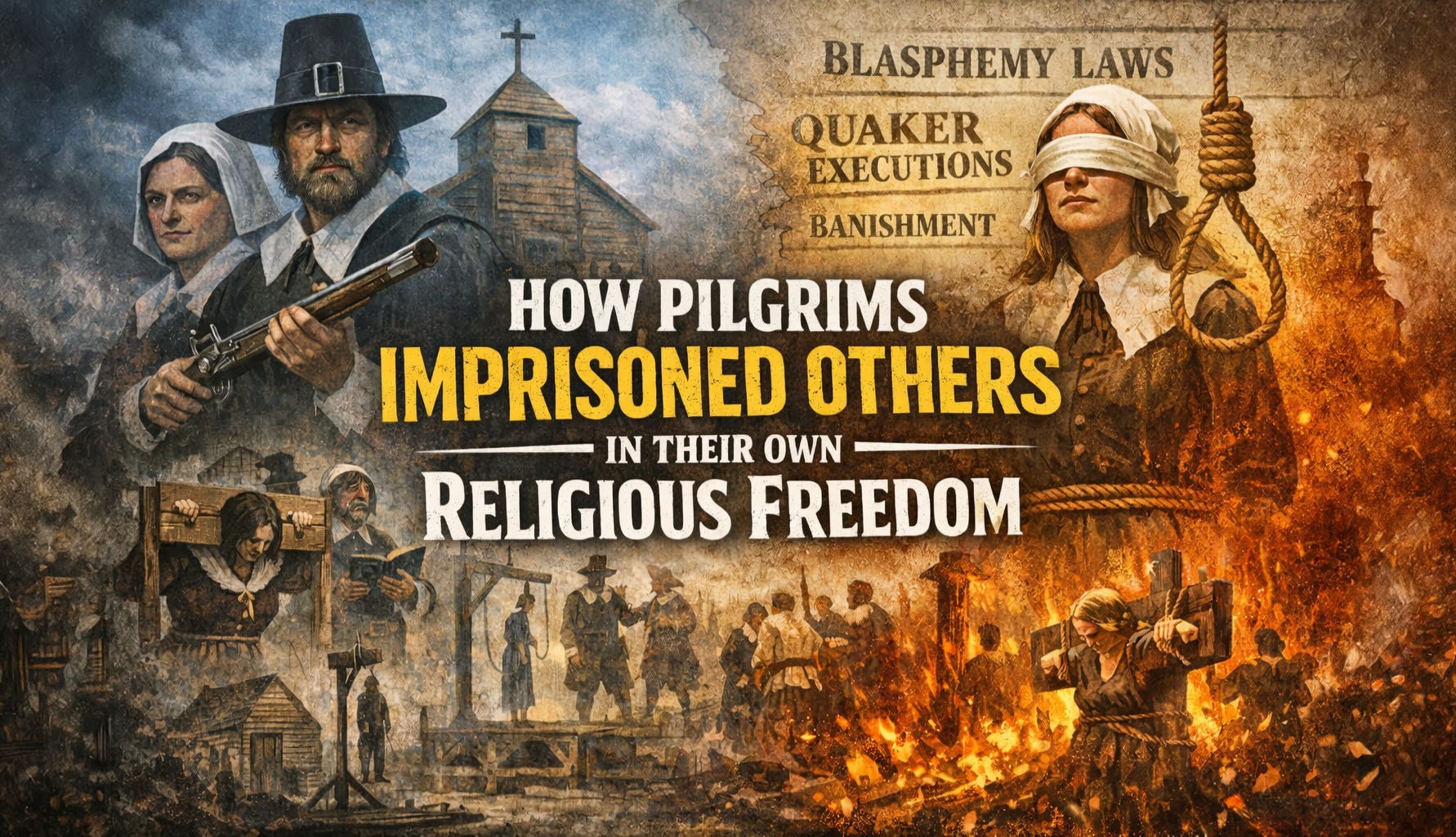
Countless Americans love the Pilgrim story. A group of devout Christians fled religious persecution in Europe, braved the Atlantic, and built a new world where people could worship freely. It’s the kind of origin myth that makes you feel good about your country before the turkey’s even carved.
History begs to differ.
The Pilgrims didn’t come to America to establish religious freedom. They came to establish their religious freedom — and then spent the next several decades making sure nobody else got any.
And the sooner Americans stop romanticizing it, the sooner they can actually understand how their country’s relationship with religion really works.
The Puritans did not come to America to establish religious liberty for all; they came to establish it for themselves... They sought to create a 'Bible Commonwealth' where their specific interpretation of Christianity was the law of the land.
— Dr. Frank Lambert, The Founding Fathers and the Place of Religion in America
Intolerably Tolerable Netherlands
The Pilgrims (technically the Separatists) had already escaped England by the time they boarded the Mayflower. They’d been living in Leiden, in the Netherlands, for over a decade (coincidentally, I worked in Leiden for a few years and studied Dutch at the University of Leiden). The Dutch Republic was one of the most religiously tolerant places in 17th-century Europe. Nobody was burning them at the stake, nobody was raiding their churches.
So why did they leave?
Because the Netherlands was too tolerant. Their children were assimilating into Dutch culture. They were learning Dutch, marrying Dutch people, picking up Dutch customs. Bradford himself admitted as much in Of Plymouth Plantation, lamenting that the colony's children were "drawn away by evil examples into extravagant and dangerous courses, getting the reins off their necks, and departing from their parents." The "evil examples" weren't crime or violence, but Dutch people being too Dutch for their taste. The Separatists were escaping the slow death of their religious identity in a society that didn't care enough to persecute them. Tolerance was the existential threat.
They crossed the Atlantic because they wanted a place where they could enforce their own religion without interference, and later called the entire journey a flight for freedom of religion in the abstract. They wanted a community where everyone believed the same things, followed the same rules, and answered to their version of God with no exceptions.
In the Netherlands, the problem was not persecution, but the lack of it. The Separatists feared that the 'great licentiousness of youth' in Holland and the 'manifold temptations' of the city would dissolve their congregation into the broader Dutch population.
— John G. Turner, They Knew They Were Pilgrims
The Theocracy Next Door - Massachusetts Bay
The Plymouth Colony was small and relatively contained. But the real engine of New England Puritanism was the Massachusetts Bay Colony, founded in 1630 by a much larger wave of Puritans under John Winthrop. And if you want to see what “religious freedom” looked like in practice, Massachusetts Bay is where the mask comes off.
Winthrop’s famous “city upon a hill” sermon had nothing to do with pluralism. He was declaring a divine mandate. The colony existed to glorify God according to Puritan theology, and everyone living there was expected to fall in line. Church attendance wasn’t optional. Civic participation was tied to church membership. And if you disagreed with the established order - theologically, politically, or even temperamentally - you were a problem that needed solving.
The tools of enforcement were fines, public humiliation, and banishment. And when banishment didn’t send a strong enough message, execution.
The colony’s legal code was inseparable from its religious code. Blasphemy was a crime. Sabbath-breaking was a crime. Being the wrong kind of Christian was, effectively, a crime. And the people running this system didn’t see any contradiction between their own flight from persecution and their willingness to persecute others. To them, there was no contradiction. They had the truth. Everyone else was wrong. And wrong people didn’t deserve the same freedoms as right ones.
Winthrop’s vision was of a community where ‘we must be knit together in this work as one man.’ To him, the 'liberty' of the colony was the liberty to do only that which is ‘good, just, and honest’ as defined by the Puritan covenant.
— Abram Van Engen, City on a Hill: A History of Ideas and Myths
Anne Hutchinson Knew Her Bible Too Well
If you want a single story that exposes the fraud of Puritan “religious freedom,” Anne Hutchinson’s is the one.
Hutchinson arrived in Massachusetts Bay in 1634 and quickly became one of the colony’s most popular theological voices. She hosted meetings in her home where she discussed sermons, interpreted scripture, and — critically — argued that salvation came through grace alone, not through the outward works and moral policing the Puritan clergy emphasized. This was called the Antinomian Controversy, and it terrified the colony’s leadership.
Not because her theology was heretical — what she was promoting had deep roots in Protestant thought, closer to what Luther himself had argued than what the Massachusetts clergy were preaching. What terrified them was that a woman was saying it, that people were listening, and that her popularity threatened the authority of the ministers and magistrates who ran the colony.
In 1637, Hutchinson was put on trial — first by the civil court, then by the church. Governor Winthrop himself presided. The charges were vague and shifting. She was accused of undermining the ministers, of holding unauthorized meetings, of stepping outside a woman’s proper role. When she defended herself with scripture — articulately, confidently, and without apology — the court didn’t engage her arguments. They couldn’t. She knew the Bible better than half of them. So they convicted her anyway.
She was excommunicated and banished. She moved to Rhode Island and eventually to the Dutch colony of New Netherland, where she and most of her family were killed in a conflict with the Siwanoy people in 1643. The Massachusetts clergy took this as divine confirmation that they’d been right to exile her.
That’s the punchline of Puritan religious freedom. A woman who read the Bible too well and talked about it too publicly was driven out, and when she died, her persecutors called it God’s judgment.
Hutchinson was a threat because she claimed a direct relationship with God that bypassed the ministers. In a society where the church was the state, a challenge to the minister’s authority was an act of sedition.
— Michael P. Winship, The Times and Trials of Anne Hutchinson
Roger Williams Got Exiled for Taking Freedom Seriously
Roger Williams is one of the most important figures in American religious history, and almost nobody knows his story. He was a Puritan minister who arrived in Massachusetts Bay in 1631 and almost immediately started making the authorities uncomfortable.
Williams argued that the civil government had no authority over matters of conscience. He insisted that forcing people to attend church or swear religious oaths was a violation of their relationship with God. He challenged the colony’s claim to Native lands, arguing that the king’s charter didn’t give the colonists the right to take land that belonged to indigenous peoples. And he rejected the very idea that a government could enforce religious uniformity. None of this went over well.
The Massachusetts General Court ordered Williams arrested in 1635 and deported back to England. He fled in the dead of winter, surviving only because the Narragansett people took him in. He eventually founded Providence, which became the colony of Rhode Island — the first government in American history to guarantee full religious liberty as a founding principle.
Rhode Island didn’t just tolerate different beliefs. It codified the separation of church and state decades before anyone else in the English-speaking world even considered the idea. Baptists, Quakers, Jews, and people with no religious affiliation at all could live, work, and worship — or not worship — without interference. Williams called forced religion “spiritual rape,” and he meant it.
The rest of New England considered Rhode Island a moral sewer. They called it “Rogue’s Island.” Cotton Mather dismissed it as a dumping ground for the refuse of other colonies. The man who built the only genuinely free society in colonial America was treated like a public nuisance by the people who claimed to have invented freedom.
Roger Williams was the most radical man of his age because he believed that 'forced worship stinks in God’s nostrils.' He understood, long before the Founders, that the state has no power to police the soul.
— John M. Barry, Roger Williams and the Creation of the American Soul
Quakers: Hanged for Existing
If the treatment of Hutchinson and Williams was ugly, what Massachusetts did to the Quakers was barbaric.
The Society of Friends — Quakers — began arriving in Massachusetts in the 1650s, and the colony’s reaction was immediate and vicious. Quakers rejected the authority of ordained ministers, refused to swear oaths, and believed in the direct experience of God without institutional mediation. Everything about them offended the Puritan establishment.
Massachusetts passed a series of laws specifically targeting Quakers. They were banned from the colony. Ship captains were fined for transporting them. Quakers who returned after banishment were stripped to the waist, tied to a cart, and whipped through town. Their ears were cut off. Their tongues were bored through with hot irons.
And when none of that worked, they were hanged.
Between 1659 and 1661, four Quakers were executed on Boston Common: William Robinson, Marmaduke Stephenson, William Leddra, and Mary Dyer. Dyer’s case is particularly haunting. She was reprieved once and banished, but returned to Massachusetts knowing full well what awaited her. She was hanged on June 1, 1660, for the crime of being a Quaker in a Puritan colony.
These weren’t rogue actions by frontier vigilantes. They were official sentences carried out by the colonial government — the same government that existed because its founders had fled persecution. But the Puritans didn’t stop at punishing people for the wrong theology. They also punished people for the wrong holidays.
The Puritans viewed the Quakers as spiritual terrorists. The escalating penalties—from ear-cropping to the gallows—were not just about punishment; they were a desperate attempt to protect a closed religious ecosystem from the 'contagion' of dissent.
— Carla Gardina Pestana, Quakers and Baptists in Colonial Massachusetts
They Banned Christmas, and They Were Right About It
Here’s where Puritan theocracy gets almost funny. Massachusetts outlawed the celebration of Christmas from 1659 to 1681. The penalty was a five-shilling fine for anyone caught observing it — feasting, not working, or doing anything that treated December 25 as special. The Puritans considered Christmas a pagan holiday dressed up in Christian clothing, and on that point, they were absolutely correct.
December 25 has no basis in scripture. The Bible doesn’t give a date for Jesus’s birth, and early Christians didn’t celebrate it. The date was almost certainly borrowed from Roman festivals — the Saturnalia and the birthday of Sol Invictus, the Unconquered Sun — and grafted onto Christian tradition centuries after Jesus lived. The Puritans, for all their cruelty, actually did their homework on this one.
Christmas didn’t become a federal holiday in the United States until 1870. For most of American history, nobody treated it as the universal cultural institution we know today. The Puritans were wrong about a lot of things, but their rejection of Christmas as a non-biblical pagan import is one of the rare cases where their theology and their history were actually aligned.
Of course, the same people who got Christmas right also got religious liberty catastrophically wrong. They could see the paganism in someone else’s holiday but couldn’t see the tyranny in their own legal code. They weren’t being rigorous — they were being selective, and the selection always landed in favor of their own power.
For the Puritans, Christmas was a 'human invention' with no scriptural basis. By banning it, they were attempting to purge the calendar of the rowdy, pagan-influenced 'misrule' that characterized the holiday in England.
— Stephen Nissenbaum, The Battle for Christmas
The True Legacy of Pilgrims
Contrary to the great American myth, the Puritans weren't the architects of American religious freedom. If anything, they were its most formidable opponents.
The irony of the colonial era is that the very liberty we celebrate today was born in the "moral sewers" of Rhode Island and the exiled fringes, not in the strictly ordered pews of Massachusetts Bay.
The Puritans gave us a cautionary tale of what happens when a society confuses "freedom" with "authority," and "the truth" with "a mandate." If we are to honor the real history of this country, we should stop worshipping the ones who policed the boundaries of the soul, and start celebrating the "Rogues" and "Heretics" who dared to prove that freedom is only real when it belongs to everyone - especially the people we disagree with.
This publication exists because readers like you choose to support it.
If you’re not already a paid subscriber and you’re finding value here, I’d love for you to consider becoming one to keep The Unholy Truth alive.
Sources & Further Reading
Barry, John M. Roger Williams and the Creation of the American Soul: Church, State, and the Birth of Liberty. New York: Viking, 2012.
Bradford, William. Of Plymouth Plantation, 1620–1647. Edited by Samuel Eliot Morison. New York: Knopf, 1952.
Lambert, Frank. The Founding Fathers and the Place of Religion in America. Princeton: Princeton University Press, 2003.
LaPlante, Eve. American Jezebel: The Uncommon Life of Anne Hutchinson, the Woman Who Defied the Puritans. San Francisco: HarperOne, 2004.
Morgan, Edmund S. The Puritan Dilemma: The Story of John Winthrop. Boston: Little, Brown, 1958.
Nissenbaum, Stephen. The Battle for Christmas. New York: Alfred A. Knopf, 1996.
Pestana, Carla Gardina. Quakers and Baptists in Colonial Massachusetts. Cambridge: Cambridge University Press, 1991.
Philbrick, Nathaniel. Mayflower: A Story of Courage, Community, and War. New York: Viking, 2006.
Turner, John G. They Knew They Were Pilgrims: Plymouth Colony and the Contest for American Liberty. New Haven: Yale University Press, 2020.
Van Engen, Abram C. City on a Hill: A History of American Exceptionalism. New Haven: Yale University Press, 2020.
Winship, Michael P. The Times and Trials of Anne Hutchinson: Puritans Divided. Lawrence: University Press of Kansas, 2005.
Bedankt Tanner. Jouw advies om Founding Member te worden, ben ik graag gevolgd. Jouw bijdragen bewaar ik; ik lees ze aandachtig en meervoudig. Die alleen zijn al meer dan voldoende reden! Inmiddels is mij veel duidelijk "hoe het zo geworden is". Ik verbaas me wel over jouw zeer grote output, maar heb er geen bezwaar tegen.
Bedankt Tanner. Dat is goed om te weten.