


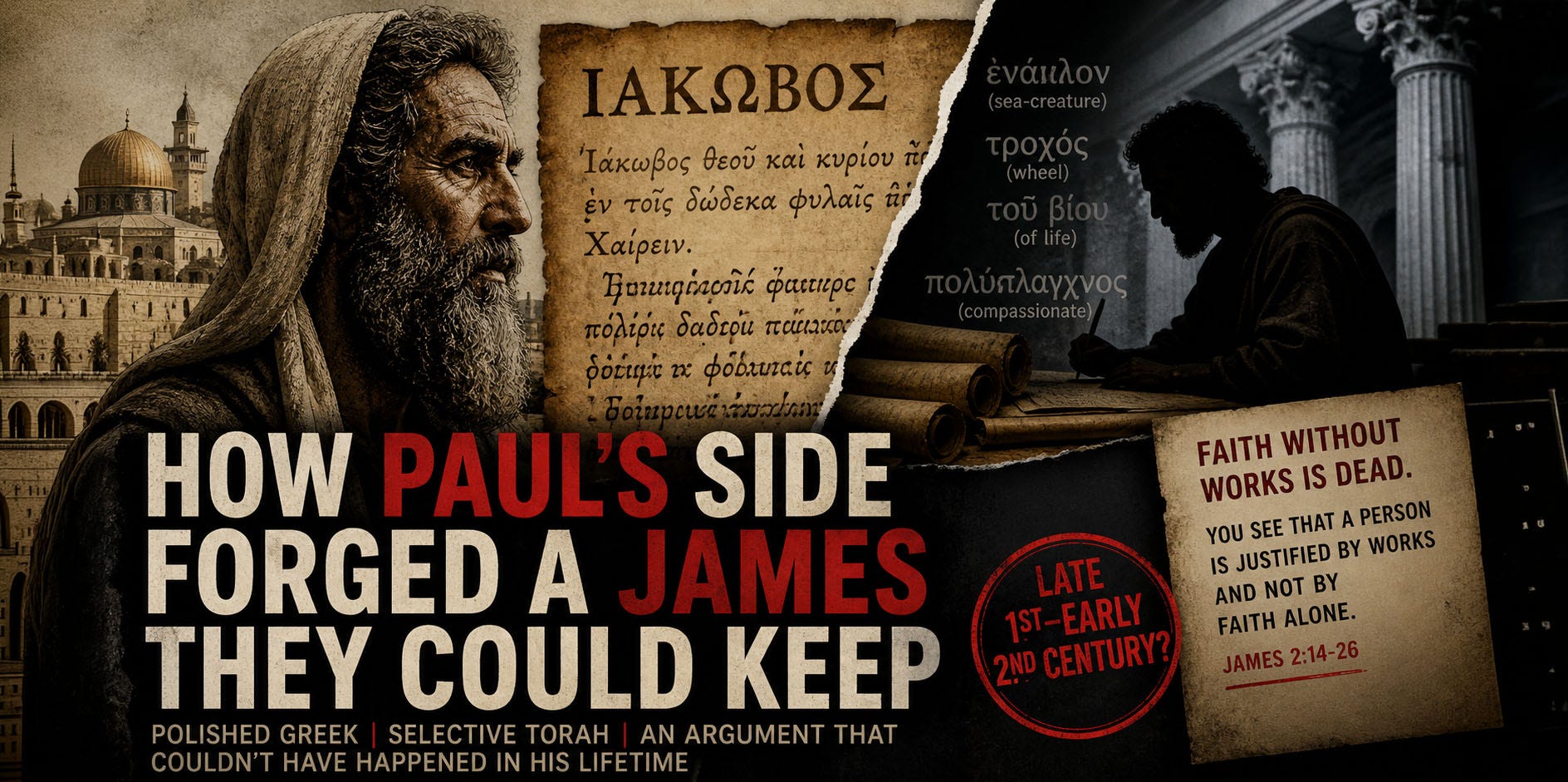
The letter sitting in the New Testament under the name of James didn’t come from the man it claims to be. The Greek runs too polished for a Galilean artisan, the Torah position has been pruned down to what a later catholicizing church could live with, and the argument with Paul tucked into chapter two reads like a response to a debate that hadn’t yet happened during the lifetime of Jesus’ brother.
Many scholars today treat pseudonymous authorship as the working position, including some who’d otherwise be sympathetic to traditional attribution. The evidence is hard to argue around once you sit with it. What’s more interesting is what the evidence reveals: a fight inside the earliest Jesus movement so serious that even decades later, somebody felt the need to put words in James’s mouth to tidy it up.
Who James Was
The arguments about Greek style and theological drift only make sense against the man the letter claims to represent.
The James in question is almost universally identified with James the Just, the brother of Jesus of Nazareth and the leading figure of the Jerusalem church in the earliest decades of the movement. Unlike later Christian leaders who operated in Greek-speaking urban networks, James belonged to the original Palestinian core: Aramaic-speaking, Torah-observant, and a practicing Second Temple Jew in full.
Our earliest and least edited source for him is Paul the Apostle. In Galatians, Paul names James as one of the “pillars” of the Jerusalem community, alongside Peter the Apostle and John. But Paul’s tone is not deferential. He depicts James as the representative of a wing of the movement that required Torah observance and maintained clear boundaries between Jewish and Gentile believers. The famous Antioch incident, where Peter withdraws from eating with Gentiles after “men from James” arrive, places James at the center of the earliest ideological conflict in Christianity.
Later sources add detail rather than revise it. The second-century writer Hegesippus, preserved by Eusebius of Caesarea, portrays James as an ascetic holy man: a Nazirite figure devoted to prayer, temple worship, and strict piety. The details are embellished, but the underlying memory is consistent with what Paul independently attests—He was not a theologian willing to dissolve the boundaries between Jew and Gentile. He was a rigorously observant Jew who believed Israel’s messiah had come in the person of his brother.
Even Acts of the Apostles, which tends to suppress early disputes, cannot entirely recast him. Its version of James presides over the Jerusalem council and still insists on a Torah-shaped framework for Gentile converts, however reduced. The effort to harmonize him with Paul is visible—but so is the historical memory underneath resisting it.
The man who ran the earliest Jesus movement was Jesus' brother, meaning he knew Jesus before any of this, before the baptism and the ministry and the arrest, when Jesus was still a carpenter's son from Nazareth. By the time Paul is writing his letters, James is the most Torah-conservative voice in the movement, rooted in Jerusalem, the figure the Jerusalem church answers to. He is not a marginal figure. He is, for a time, its dominant authority.
The Greek Problem
The author of James writes Hellenistic Greek with alliteration, assonance, deliberate wordplay, classical rhetorical figures, and a vocabulary that includes terms found nowhere else in the New Testament. Among the unusual vocabulary are enalion (sea-creature), trochos (wheel of life), and polusplagchnos (compassionate). The author quotes the Septuagint with a familiarity that suggests it was their working Bible, not a translation they were reaching for through Aramaic.
The man we’re told wrote this was a Galilean artisan’s son who grew up in Nazareth, a village so small and unremarkable that it doesn’t appear in any contemporary Jewish source outside the Gospels. His native language was Aramaic, and he likely had functional Hebrew for synagogue purposes. Whether he had any Greek at all is unclear; if he did, it would’ve been the rough kitchen Greek of someone doing trade in a bilingual region, far from the elevated rhetorical register of someone trained in composition.
The scribe defense doesn’t help. A scribe working on behalf of someone normally produces something close to dictation, capturing the speaker’s idiom, vocabulary, and theological habits. The letter of James reads like a single Hellenistic Jewish author thinking and composing in Greek from the start. The signs of a Galilean speaker working through an amanuensis are absent.
The letter’s handling of Hebrew Bible material confirms the same point. The Decalogue allusions and the citation of Leviticus 19:18 come through the Septuagint, not from independent translation of a Hebrew text, and the Greek of the citations matches the LXX exactly. Whoever wrote James was working from a Greek Bible, which fits a diaspora Hellenistic Jewish-Christian author and fits poorly with the elder of the Jerusalem church whose religious practice, by every other account we have of him, was organized around temple worship and Torah observance.
What the Real James Believed
To see what’s strange about the letter’s content, you have to set it against what we actually know about historical James from sources that don’t have an interest in suppressing the conflict—and the best of those is Paul.
In Galatians, Paul gives us the earliest portrait of James we have. He describes the “pillars” of the Jerusalem church: James, Cephas (Peter), and John. He recounts the agreement that he, Paul, would go to the Gentiles while the Jerusalem leaders would keep their mission to Jews. Then he describes what happened at Antioch: Peter was eating with Gentile believers until “certain men came from James,” at which point Peter pulled back from table fellowship out of fear of “the circumcision party” (Galatians 2:12).
Men were sent from James, and their arrival caused Peter to stop eating with Gentiles. Paul calls this hypocrisy and says he opposed Peter to his face. James represented a stricter Torah-observant position than Paul, one in which Jewish Christians shouldn’t be sharing meals with uncircumcised Gentiles even within the Jesus movement. Whatever the Jerusalem agreement had been on paper, in practice James’s people were enforcing Torah observance more strictly than Paul accepted.
Acts gives us a version of James with the conflict reframed: in Acts 15, Luke has James preside over a council that issues the famous Apostolic Decree: Gentiles need only abstain from food sacrificed to idols, blood, things strangled, and sexual immorality. In Acts 21, when Paul returns to Jerusalem, James suggests Paul join four men under a Nazirite vow and pay their expenses, to prove that Paul himself “lives in observance of the law.” Even Luke, who harmonizes Paul and James wherever he can, cannot eliminate the picture of a Jerusalem leader for whom Torah observance still mattered.
Outside the New Testament, Hegesippus (preserved in Eusebius) describes James as a lifelong Nazirite, drinking no wine, eating no meat, never cutting his hair, spending so much time praying in the temple that his knees grew calloused like a camel’s. Hegesippus’s account is hagiographic, but it corroborates what Paul’s testimony implies: James was a deeply pious Torah-observant Jew who happened to believe his executed brother was the messiah.
The camel-knees detail might not be literally true, but it tells us how James was remembered: as a Torah-observant Jew of the most pious kind, the sort of Jerusalem leader Hegesippus described and Paul fought with over circumcision and table fellowship. The Hellenistic Jewish-Christian author behind the letter’s elevated Greek is incompatible with the James every other source describes.
The Selective Torah of the Letter
The letter of James shows a Torah position carefully reduced to the maximum overlap with Pauline Christianity rather than the minimum.
The letter cites Leviticus 19:18 and calls it “the royal law”: love your neighbor as yourself. It mentions specific Decalogue prohibitions on adultery and murder, draws on prophetic material about caring for widows and orphans, and echoes wisdom literature on the dangers of the tongue.
There is no mention of circumcision anywhere in the letter. From the leader of the Jerusalem church, whose own emissaries were enforcing circumcision on Gentile converts according to Paul’s letters, this is remarkable. The single most contested issue between the Jerusalem and Pauline missions in the historical record doesn’t merit a sentence.
The letter is also silent on Sabbath observance, kosher food laws, ritual purity, and temple sacrifice. Hegesippus tells us James practically lived in the temple, and the letter attributed to him doesn’t refer to it once. The festivals (Passover, Pentecost, Sukkot) and tithing in the form Torah specifies all go unmentioned.
The result is a moral-ethical reading of Torah that emphasizes interpersonal righteousness and omits, without marking the omission, everything that distinguished Jews from Gentiles in the first-century Mediterranean. An early-second-century gentile-friendly editor could circulate this reading without controversy. Anyone familiar with the Jerusalem leadership of the 40s and 50s would have a hard time recognizing it as James’s voice.
The same pattern of omission shows up in Acts 15. The Apostolic Decree reduces Torah for Gentiles to four prohibitions, three of them food-related and drawn from what Leviticus 17-18 requires of “the resident alien.” It’s a Torah-shaped enough position to keep Jewish-Christian observers satisfied, but Torah-light enough that Gentile converts can accept it. The letter of James follows the same logic: it keeps Torah’s ethical core (love neighbor, don’t murder, don’t commit adultery) and omits everything that would’ve forced a Gentile reader to keep kosher, get circumcised, or stop working on Saturday.
The convergence is structural. Late-first-century catholicizing Christianity wanted James to sound this way. The author of the letter, whoever they were, was producing a James suited to a church that wanted unity between Jewish-Christian and Gentile-Christian wings without forcing Gentiles into full Torah observance. The historical James—who by Hegesippus’s account spent his life in the temple—would’ve been an obstacle to that project. The letter substitutes a usable James for the historical one.
No Room for the Faith vs. Works Argument
The clearest evidence, for many scholars, is James 2:14-26. The author insists that “faith without works is dead,” that Abraham was “justified by works when he offered his son Isaac on the altar,” and concludes: “You see that a person is justified by works and not by faith alone” (James 2:24).
Compare Romans 4 and Galatians 3, where Paul argues precisely the opposite: Abraham was justified by faith, not works. Paul cites Genesis 15:6 (”Abraham believed God, and it was reckoned to him as righteousness”) and builds a long argument that justification comes by faith apart from works of the law. James 2 cites the same Genesis verse and reaches the opposite conclusion, doubling down on the binding of Isaac as the kind of “work” that justified Abraham.
The author of James 2 is using Paul’s vocabulary, Paul’s prooftexts, and Paul’s structure of argument, and inverting them deliberately. Whoever wrote James 2 was familiar with Paul’s argumentation, either from reading Paul’s letters or from hearing the Pauline position circulating in Christian communities.
That creates a problem for traditional dating. Paul’s letter to the Romans is usually dated to the late 50s, Galatians earlier, perhaps mid-50s. Historical James was killed by the high priest Ananus around 62 CE according to Josephus. The window in which the historical James could’ve read Romans, processed its argument, and composed a literary Greek response is vanishingly small. And it would’ve made more sense for him to write to Paul directly, or to the churches Paul was in dispute with, than to write a general epistle to “the twelve tribes in the Dispersion.”
If the argument is responding to Paul’s letters circulating in Christian communities, the natural date is later, after Paul’s letters had become a small collection that Christians were reading and arguing about. That puts us in the 80s or 90s at the earliest, more likely the turn of the second century. By that point, both Paul and historical James were long dead, and the argument had passed into broader Christian discourse where each side was being claimed by partisans.
Some scholars try to rescue traditional authorship by arguing that James 2 isn’t responding to Paul but to a misread version of Paul circulating among Gentile converts who took “salvation by faith” as license for moral indifference. Even granting this, it requires Paul’s faith-language to have already spread widely enough through Christian communities that a misreading of it had become a recognizable problem. That picture matches the religious environment of the 90s. By then Paul’s letters had become received Christian property that any later author could engage as a known position. The early 50s, when Paul was still alive and arguing for his position in real time, was too early for that kind of literary engagement to develop.
The Earliest Movement Had Two Centers
Once you accept that the letter of James is pseudonymous, you can read it as evidence about how late-first-century Christianity was trying to reconstruct, edit, and reconcile a movement that started out divided—which is more useful than reading it as theology.
The earliest Jesus movement had at least two competing authorities from the start. One was the Jerusalem community led by James and the disciples who’d known Jesus, who saw the Jesus movement as a Jewish messianic renewal that required full Torah observance for Jewish members and at minimum significant Torah observance for any Gentile who wanted in. The other was the Pauline mission to the diaspora, which preached a Christ-event that put Jews and Gentiles on equal footing without requiring circumcision or kosher observance.
Paul’s own letters show how bitter the conflict was. He calls his opponents “false brothers,” says he opposed Peter to his face, and warns his churches about “another gospel” being preached, pronouncing anathemas on anyone who teaches it. The men from James in Antioch broke fellowship over food, and Paul’s letters preserve only one side of it. The reading of Paul and James as complementary rather than opposed came later, after both sides were dead and the church had decided that retroactive harmony was more useful than honesty about the original conflict.
The Jerusalem church had history on its side: it was led by Jesus’ blood relatives, including James and later other relatives of the family, but it had geography against it: Jerusalem was destroyed in 70 CE, the Jerusalem church scattered, and some refugees went to Pella across the Jordan. Their descendants survive in the historical record as the Ebionites and the Nazoreans, Torah-observant Jewish Christians who rejected Paul as an apostate, kept circumcision and Sabbath, and were eventually classified as heretics by the Pauline-descended catholic church that became the dominant form of Christianity.
The letter of James as we have it represents a different outcome of the same conflict. Rather than becoming the founding document of an Ebionite-style Torah-observant Jewish Christianity, it became a document the catholic church could keep. The way it was made usable was by omitting its Torah requirements, reducing its Jewishness to the ethical core, and inserting a faith-versus-works argument that could be read as compatible—with effort—with Paul’s. Luther famously called it “an epistle of straw” because he identified the incompatibility between James 2 and his Pauline soteriology, but the church before him had decided the incompatibility was tolerable.
The actual voice of the Jerusalem church mostly didn’t survive. We get glimpses of it through Paul’s hostile descriptions and through later heresiological reports about the Ebionites, but nothing direct from James himself. Whatever sermons he preached, whatever letters he might have written, whatever halakhic decisions he handed down to his community, all of that was lost when his community lost. The letter under his name is a compromise document produced by people who came after him and wanted to keep something of his name in the canon without keeping his actual position.
The Voice That Didn’t Survive
The canonical New Testament is a curated selection produced by the wing of the movement that won. The Pauline-influenced catholic church of the late first and second centuries decided which texts to keep, which to suppress, and which to edit. The historical James lost, along with his community, and his perspective survived only in the form of a letter someone else wrote in his name, with most of his actual concerns deleted.
This matters for how we read the New Testament, because the harmony you find when you read James and Paul side by side was engineered by editors a generation or two later, working to make a divided movement look like it had been one thing all along. The original was more contentious, more Jewish, more divided. There were people preaching a Jesus you had to keep Torah for, and people preaching a Jesus who’d freed you from Torah, and they were calling each other liars and counterfeits.
The actual history runs in the other direction from how it gets told in popular Christian writing. An originally diverse and contested movement gradually had its diversity suppressed, its competing voices labeled as heretics, and its winning faction’s account written up as the original. Catholic orthodoxy is what survived that suppression—the winning faction’s account after the alternatives had been silenced. The Ebionites were one of the most direct descendants of primitive Christianity, just on the losing side of the destruction of Jerusalem and the demographic dominance of the Pauline diaspora mission.
The letter is better read as evidence of the canon formation process than as James’s theology. It tells us that even decades after the conflict, the question of how to handle James was still unresolved, and the answer the church arrived at was to give him a letter that didn’t sound much like him.
The pseudonymous authorship itself is the evidence. If the catholic church had been comfortable with the historical James, his actual sermons and letters would’ve been preserved. The fact that someone went to the trouble of producing a literary James in elevated Greek, with the Torah requirements omitted and the faith-versus-works argument inserted, tells us the historical James was someone the church couldn’t use as he was. Whoever wrote the letter knew what they were producing and why they were producing it.
What survives in the canon is a literary stand-in produced by the Hellenistic gentile-friendly wing of the movement at a moment when the original Jerusalem church and its Torah-observant Jewish messianism were either dead or being declared heretical. Reading James now means reading past that stand-in and trying to recover the figure underneath: the camel-kneed Nazirite who sent men to Antioch to break Peter’s fellowship with Gentiles, who enforced circumcision and Torah observance as the terms of membership in the Jesus movement. The epistle bearing his name represents what the later church needed him to look like, after the historical James’s position had become incompatible with what the church was becoming. Recovering him means working backward through the pseudonymous authorship and canon formation, using Paul’s hostile descriptions and the heresiological reports about the Ebionites as starting points, and accepting that most of what he actually taught is permanently lost.
This publication exists because readers like you choose to support it.
If you’re already a paid subscriber, thank you. If not, and you’re finding value here, I’d love for you to consider becoming one.
The Question Isn’t Whether James Wrote the Letter
When the subject is religion, the standards of proof tend to loosen without anyone quite noticing. Claims that would be pressed hard in any other historical context are given a kind of inherited deference, as if tradition itself counts as evidence.
But here the situation is unusually clear. The debate in scholarship is not “Did James write this?” with two evenly matched sides. It’s a spectrum that runs from “almost certainly not” to “theoretically possible.” The old assumption of direct authorship survives more out of habit than argument.
Once you see it that way, the letter stops being a straightforward window into the mind of Jesus’ brother. It becomes evidence of a later attempt to stabilize a divided tradition, to put a recognizable authority behind a version of the faith that could hold together what had once been in open conflict.
There’s no evidence James wrote the letter but plenty of it why he isn’t the likely suspect.
The real question isn’t authorship but construction.
Sources and Further Reading
Martin Dibelius, James: A Commentary on the Epistle of James (Hermeneia, 1976)
Luke Timothy Johnson, The Letter of James (Anchor Bible, 1995)
Sophie Laws, A Commentary on the Epistle of James (Harper & Row, 1980)
Richard Bauckham, James: Wisdom of James, Disciple of Jesus the Sage (Routledge, 1999)
Richard Bauckham, Jude and the Relatives of Jesus in the Early Church (T&T Clark, 1990)
John Painter, Just James: The Brother of Jesus in History and Tradition (University of South Carolina Press, 1997)
James D.G. Dunn, The Epistle of James (New International Greek Testament Commentary, 2000)
F.C. Baur, Paul the Apostle of Jesus Christ (1845, ET 1876)
Oskar Skarsaune and Reidar Hvalvik, eds., Jewish Believers in Jesus: The Early Centuries (Hendrickson, 2007)
David Meade, Pseudonymity and Canon (Eerdmans, 1987)
Thanks much for this, it is a topic I am extremely interested in.
Are any of your sources fairly short, and a good read for non-academics?
An open question which I think you allude to, are there any echos in the letter of the historical James, or is it 100% fiction?
Sorry for a second question. Have scholars been able to come up with a probable date for James?