


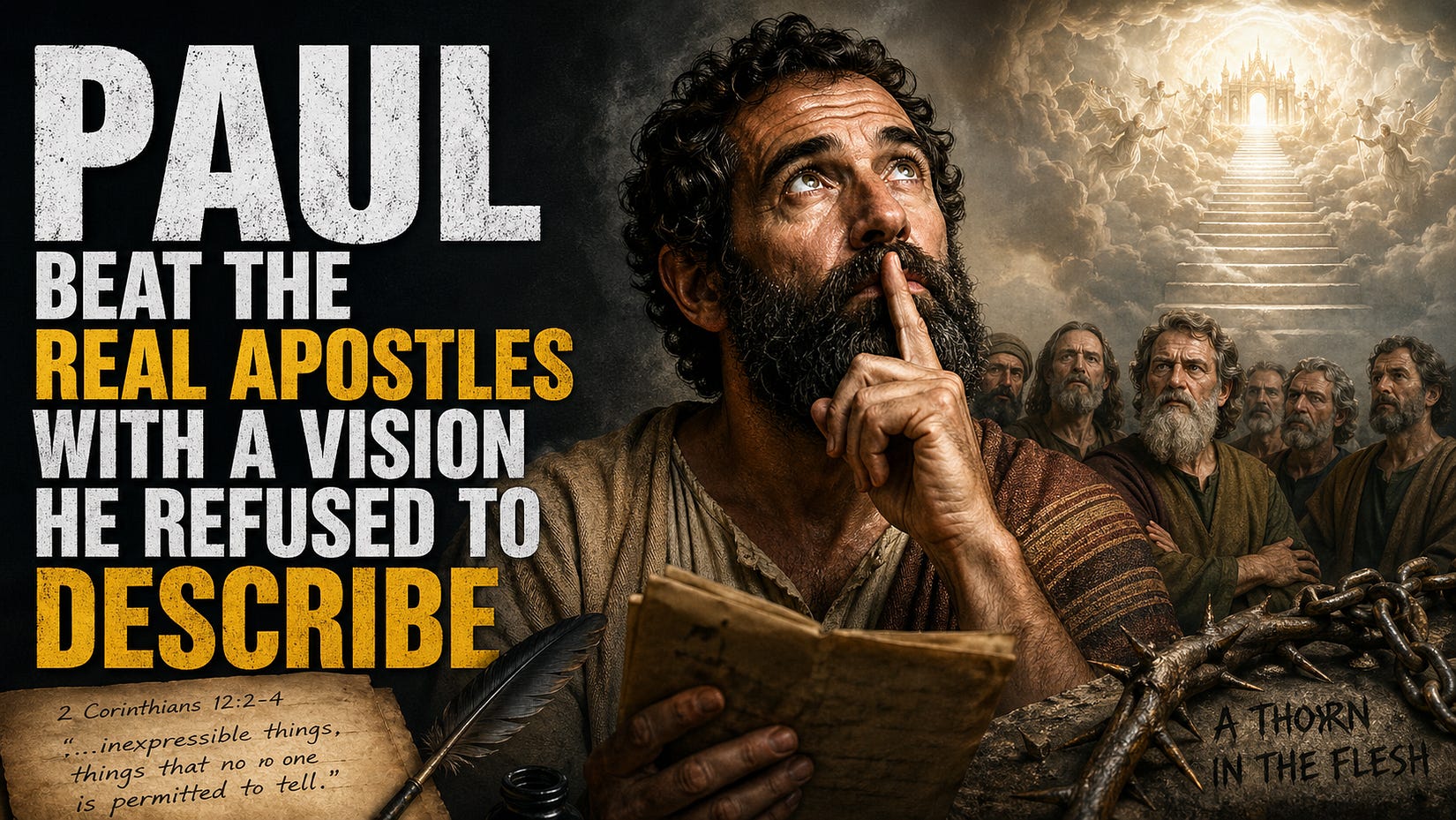
Paul once told the Corinthians that he’d been hauled into the third heaven, heard things so divine he wasn’t allowed to repeat them, and then sat on the secret for the rest of his life without ever elaborating on it.
He floats it once in a defensive letter to make an impression and never brings it up again. No details, no follow-up, no “let me explain what I learned.” Just a vague reference to a sacred experience too holy for human ears, conveniently delivered to him alone and left completely undescribed.
It’s one of the strangest moments in the New Testament. It’s also one of the most revealing, because it shows you exactly how Paul built an authority that ended up overshadowing the men who’d actually walked with Jesus.
The Argument He Was Trying to Win
The third-heaven story shows up in 2 Corinthians 12, written from a defensive crouch. The Corinthian church had been a project Paul started himself — he’d founded the community, taught them, written them, kept tabs on them through letters and middlemen. Then other Christian leaders showed up while Paul was elsewhere, and the Corinthians liked them better.
Paul mockingly calls these rivals “super-apostles.” We don’t know exactly who they were, but the most likely answer is that they were either members of, or aligned with, the Jerusalem church — the original disciples and their associates. Men with actual receipts. People who could say, with no exaggeration, that they’d eaten with Jesus, watched him preach, and stood near the cross.
Paul couldn’t match that. He never met Jesus during his earthly life. His whole claim rested on a single dramatic moment on the road to Damascus — which had no independent witnesses he could name — and on whatever happened during the years he spent off-grid in Arabia after his conversion. Compared to a guy who could tell you what Jesus’s sense of humor was like, Paul was working with a thinner résumé.
Worse, the super-apostles were charging for their services. They’d taken patronage from wealthy Corinthians, which Paul had always refused to do, and his refusal was being read against him. In the ancient Mediterranean world, a teacher who didn’t accept patronage looked second-rate — like a vendor who couldn’t command full price. Paul’s competitors were marketing themselves as the premium product, and Paul, the founder of the church, was getting outsold in the building he’d put up.
So when his audience drifts toward the people with the better credentials, Paul does what any smart rhetorician backed into a corner does. He changes the rules of the game. He stops competing on what they have, and starts competing on something they can’t see.
A Vision Without Pictures
Paul writes that “a man in Christ” was caught up to the third heaven fourteen years earlier. He calls this man someone other than himself, which is a transparent dodge that nobody, ancient or modern, takes seriously. The man is Paul. Everyone knows it. He’s just trying to look modest while bragging.
The phrase “third heaven” matters. In Jewish apocalyptic literature of Paul’s era, the cosmos was layered. Different writers gave different counts — three heavens, seven heavens, ten heavens — but the general idea was that the divine throne sat at the top, with progressively holier territory the higher you went. Texts like 2 Enoch, the Apocalypse of Abraham, and the later 3 Baruch describe heavenly tours in elaborate detail, naming what each level contained: storehouses for snow, ranks of angels, the souls of the unborn, the punishments of the damned. Visionaries who claimed they’d been up there came back with travelogues. They had things to say. They named angels. They drew maps.
Paul says he hit the third heaven and heard “inexpressible things, things that no one is permitted to tell.”
That’s the whole vision. That’s what he came back with.
Compare it to any other recorded vision in the Bible. Ezekiel sees wheels within wheels, four-faced creatures with the heads of a man, lion, ox, and eagle, and a moving sapphire throne — and he spends entire chapters describing them. Daniel describes beasts with iron teeth, ten horns, and a little horn that uproots the others, the kind of imagery that has kept commentators busy for two thousand years. John of Patmos delivers the most fever-dream-soaked book in the canon, complete with seven-headed dragons, a woman clothed in the sun, locusts with human faces and scorpion tails, and a city of pure gold descending out of heaven. Even prophets who claimed sacred encounters wrote like screenwriters working on commission.
Paul gives you nothing. The vision arrives in his letter as a sealed envelope marked “trust me,” empty of theology and stripped of any detail anyone could verify or argue with.
The Loophole Hidden in the Story
The trick is that an undescribed vision can’t be argued with. There’s nothing to challenge — no theology to dispute, no claim to verify, no imagery to compare against scripture. It’s the religious equivalent of a teenager saying, “I have a girlfriend, but she goes to a different school.”
You can’t disprove what you can’t engage with.
This is why the silence is the move. If Paul had described what he saw, every detail would be open to argument. Other Christian leaders could’ve nitpicked the cosmology. Rival apostles could’ve said his vision contradicted teachings of Jesus they remembered firsthand. The Jerusalem people, who’d known Jesus’s actual views on Torah, on the Temple, on Gentile inclusion, would’ve had a target to aim at.
By saying he can’t share what he saw, Paul moved the argument off the page entirely. He’s the only one who knows, and he’s the only one who can know. The reason he can’t share it, he says, is that God forbids it. The censorship is divine. Anyone who questions Paul questions God.
It’s a brilliant move, and it works exactly because it can’t be tested. If you’re inclined to trust Paul, the silence reads as awe. If you’re not inclined to trust Paul, you’ve got nothing to grab onto. He hasn’t given you a target. The same principle still works today — modern religious leaders who claim private revelations always describe them just enough to sound impressive, and never enough to be checked. Paul wrote the playbook.
The Pattern Was Already in His Playbook
The third-heaven story wasn’t the first time Paul leaned on private revelation to settle an argument. It was the polished version of a technique he’d been using for years.
Read Galatians 1. Paul tells the Galatians, in writing, that the gospel he preaches isn’t of human origin and that he didn’t get it from any person. He got it through a revelation of Jesus Christ — directly, with no human intermediary. Then he goes further. After his conversion, he didn’t consult any human being, and he didn’t go up to Jerusalem to meet the apostles who’d come before him. He went into the desert in Arabia for three years instead. Whatever he came back with, he came back with alone.
That second part is the key one. He’s openly admitting that he didn’t check his theology with the people who’d actually known Jesus. He’s saying it like it’s a credential. A normal theologian, or a normal anything, would treat avoiding the eyewitnesses as a problem. Paul treats it as evidence of legitimacy. They got their information from a guy. He got his directly from God.
By the time he writes about the third heaven, he’s been running this play for at least a decade. Every time someone challenges his teachings, he points to a private experience nobody else witnessed. Every time someone says “but Peter and James say otherwise,” Paul says, in effect, “and yet I have seen what you haven’t.”
It’s a closed loop. The eyewitnesses can never out-eyewitness him, because he’s playing on a different field. They saw a man named Jesus who walked, ate, told stories, got tired, and eventually got executed. He saw the cosmic Christ in glory, ascended to the throne. They quote what Jesus said over breakfast. He delivers messages from heaven that can’t be repeated. There’s no version of this debate Paul can lose, because the debate has been moved somewhere they can’t follow him.
The Thorn That Conveniently Followed
Right after the vision, Paul mentions a “thorn in the flesh.” He says God gave it to him to keep him humble, because the revelations were so spectacular he might’ve gotten a big head otherwise.
Once again, the details are missing. Scholars have spent two thousand years guessing — was it epilepsy, an eye condition, recurring depression, a speech impediment, malaria, chronic migraines, or some kind of skin disease? Take your pick. Paul tells us nothing. He just says it tormented him, that he prayed three times for God to remove it, and that God said no.
Notice what the thorn does for the argument. It anchors the vision in his lived experience without requiring him to describe either one. The vision is real because he’s still suffering for it. The suffering is meaningful because it stems from the vision. Each undescribed thing props up the other, and the whole structure floats on Paul’s say-so.
The thorn also makes him unfalsifiable in a different way. If he’s frail, that’s God keeping him humble. If he’s strong, that’s God working through his weakness. There’s no version of Paul’s body that doesn’t confirm the story. Whatever shape he’s in, he’s that way because of the vision he can’t tell you about. The wound is its own evidence, and the wound is invisible.
He even works in a direct quote from God: “My grace is sufficient for you, for my power is made perfect in weakness.” The line is so good it became a Christian inspirational poster centuries later, turning a private conversation with the Almighty into quotable theology that other Christians could neither verify nor improve on. God didn’t say it to Peter, or James, or John. God said it to Paul, in private, about a wound nobody else could see, in connection with a vision nobody else heard.
The whole passage reads like a man building a fortress out of fog. Every brick is something you can’t touch.
Why It Worked Better Than Eyewitness Stories
Paul’s letters became the backbone of Christian theology — not the recorded teachings of Jesus, not the firsthand accounts of the Twelve, but Paul. A man who never met Jesus alive, who clashed with Peter publicly in Antioch, and who wrote about a vision he refused to describe. His letters became the blueprint for what Christians would believe about salvation, sin, grace, faith, the nature of Christ, and the structure of the church.
The Gospels themselves came later than most of his letters. By the time Mark was written, Paul’s theology had already been circulating for decades. The Jesus of the New Testament arrived in the mail with a Pauline cover letter explaining what he meant.
Why did people choose to believe that Paul offered the latest updates, effectively rendering what Jesus personally taught his handpicked disciples outdated? And why didn’t anyone treat that as a problem?
Two reasons.
First, Paul wasn’t trying to build a religion. He thought the world was about to end. He thought Jesus would return any day, and he wasn’t worried about institutional design or two-thousand-year theology. He was running emergency triage. He wanted Gentiles to follow the skeleton laws — don’t kill each other, don’t worship idols, hold the line until the Lord arrives — and he wasn’t going to slow them down with circumcision and dietary law because, in his head, the clock was almost out. The eyewitnesses were stuck with what Jesus had actually said. Paul could shape his theology to whatever audience he was pitching, because his authority was based on private revelations nobody could double-check.
Second, his approach traveled. The eyewitness apostles were tied to Jerusalem and to the memory of a specific man. Paul could ride into a new city, claim direct access to the divine, and no one local could contradict him. His theology was portable; theirs wasn’t. His authority was something he carried with him, while theirs was anchored to a place and a community that other people would have to visit if they wanted to verify anything.
When Christianity needed to spread across the empire — across languages, across cultures, across imperial borders — Paul’s version was already built for it. The eyewitness version stayed home and got destroyed.
The Real Apostles Lost
What happened to the people Paul was competing against?
James, the brother of Jesus and head of the Jerusalem church, was killed by stoning in 62 CE on the orders of the high priest Ananus. Josephus mentions it. Whatever James had taught about Jesus, his line of authority ended in a courtyard before the Romans even arrived.
Peter probably died in Rome in the mid-60s, though the documentation is later and traditional. Whatever theology he carried in his head, he didn’t write much of it down — or whatever he wrote didn’t survive intact. Two letters in the New Testament are attributed to him, and most scholars think both are pseudepigraphal, written by someone else using his name decades after he was gone. The Peter who shows up in those letters sounds suspiciously Pauline. By the time anyone bothered to ghostwrite his thoughts, Paul’s voice was the only one that scanned as authoritative.
The Jerusalem church itself was destroyed in 70 CE when Rome leveled the city and burned the Temple. The Christian community there scattered, regrouped in places like Pella across the Jordan, and never recovered its central role. The branch of Christianity that came from people who’d actually known Jesus lost its institutional spine in a single decade. The branch that came from a man who’d seen a vision he wouldn’t describe was already in dozens of cities by then, with letters circulating between them, building a network that didn’t need a home base.
The Jewish-Christian groups that survived — the Ebionites, the Nazarenes — held onto Torah observance and rejected Paul outright as a false apostle. They were the ones still running the religion of the original disciples, the version that hadn’t dropped the dietary laws or the circumcision requirement. By the fourth century, they’d been declared heretics by the church Paul’s letters helped build. The eyewitness branch of Christianity got pruned out of the family tree by people whose theology came from a man who’d never met Jesus and refused to describe his vision.
History didn’t pick the winner here. The winner picked itself, by being more portable, more flexible, and harder to contradict. Paul’s silence about what he saw in the third heaven turned out to be load-bearing. Anything he’d described could’ve been taken away from him. Everything he refused to describe became the foundation of the largest religion on Earth.
This publication exists because readers like you choose to support it.
If you’re already a paid subscriber, thank you. If not, and you’re finding value here, I’d love for you to consider becoming one.
Was Paul Lying?
Was Paul lying? We can’t actually know. The more useful question is what would’ve been different if he had been.
If a guy today told you he’d been to the third heaven, heard things he couldn’t repeat, and that this experience entitled him to overrule the people who’d known the founder of his religion personally, you’d ask for evidence. You wouldn’t get any. You’d notice that. You’d update accordingly. The fact that we don’t apply the same standard to a man who lived two thousand years ago says more about the laundering effect of time than it does about Paul.
Why should I take Paul’s word at face value but reject Joseph Smith’s? What criteria do I have to sort the real deals from the charlatans? Both claimed private revelations. Both built theologies nobody else could verify. Both founded religious traditions that long outlived them. Both had thorns of one kind or another that anchored their stories. The main difference is that one of them lived in a world where most people couldn’t read, and time has a way of laundering a sales pitch into a sacred truth.
If God really does communicate by giving secret visions to handpicked individuals — visions the rest of us are forbidden to question or check — then he’s set up a system where the people best positioned to deceive us are the ones we’re supposed to trust most. The convincing prophet and the convincing fraud are doing the same job with the same tools. The honest mystic has no way to prove he’s not the other one. And the rest of us, watching from outside, have no reliable method for telling them apart.
Paul knew that. The whole structure of 2 Corinthians 12 says he knew it. He picked a vision he wouldn’t have to describe, paired it with a wound nobody could see, and quoted a private message from God that nobody else heard. Then he handed the package to the Corinthians and dared them to take the super-apostles’ word over his.
The Corinthians didn’t take that bet, and neither did the church that grew up around Paul’s letters in the centuries after. Two thousand years on, most Christians don’t realize that’s still the bet they’re being asked to make — to trust a private vision they have no way of checking, delivered by a man who explicitly refused to describe what he saw.
Sources and Further Reading
2 Corinthians 12 (NRSVUE)
Galatians 1:11–2:16 (NRSVUE)
Victor Paul Furnish, II Corinthians, Anchor Bible Commentary, 1984
Alan F. Segal, Paul the Convert: The Apostolate and Apostasy of Saul the Pharisee, 1990
Martha Himmelfarb, Ascent to Heaven in Jewish and Christian Apocalypses, 1993
Paula Fredriksen, Paul: The Pagans’ Apostle, 2017
Bart D. Ehrman, Lost Christianities: The Battles for Scripture and the Faiths We Never Knew, 2003
Didn't Mohammed gain his credibility through visions as well? So much so he started having them on demand? As you say, it's a great technique.