


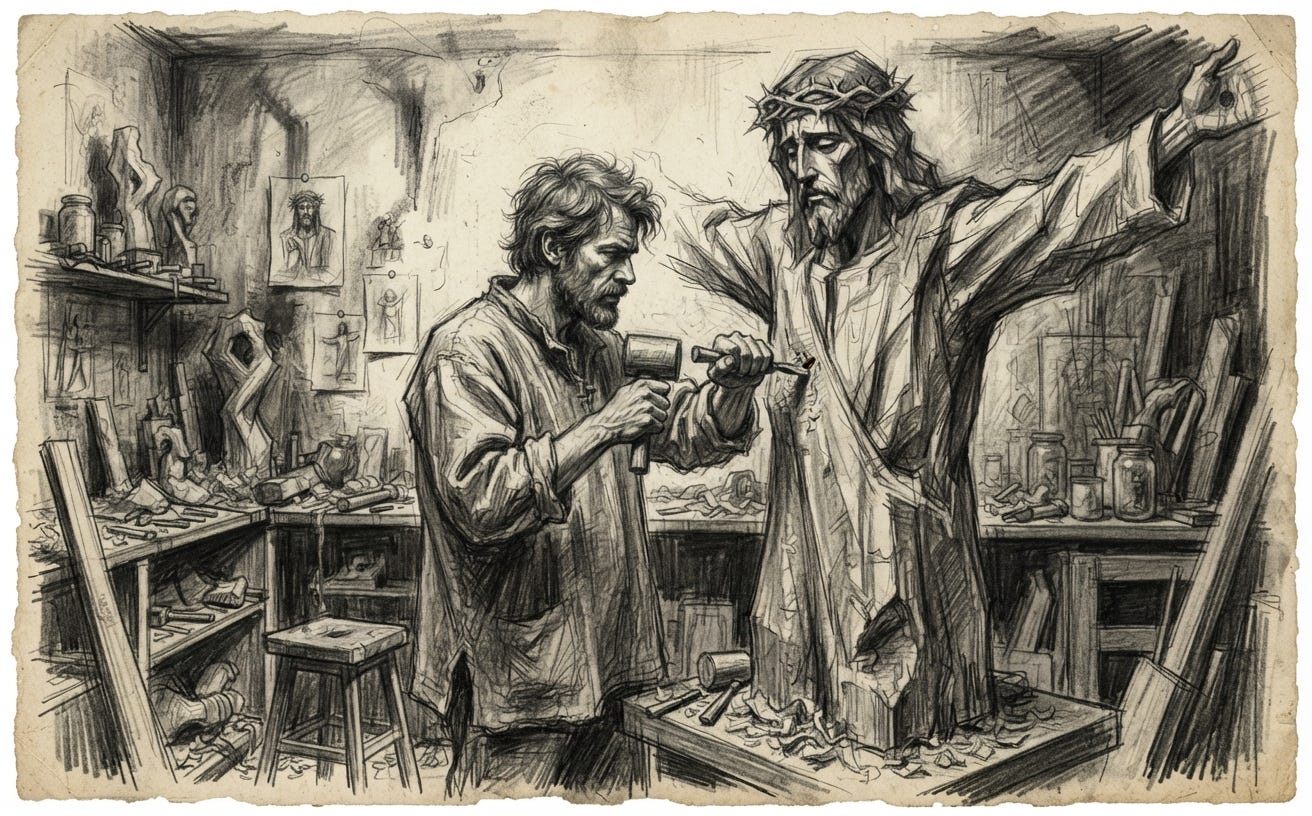
Twenty years after Rome nailed a Galilean preacher to a cross, a Jewish apostle named Paul sat down to write letters to the churches he had founded and somehow left out the birth, the miracles, and the parables. Within sixty years, the Jesus of the Gospels was being described as the divine agent behind the creation of the universe.
Between those two moments lies a mystery that has divided historians, bishops, and emperors for nearly two thousand years: Who turned a crucified peasant into God, and when did it happen?
If you disagree with any of the arguments in this article, the comments are open to everyone. I’m wholeheartedly interested in hearing different perspectives and engaging with thoughtful criticism.
Subscribe for free to get the next origin story in your inbox, and upgrade whenever you want the bonus sections.
Either way, thank you for being here.
The Apostle Who Forgot Christmas
The earliest Christian writings are the letters of Paul, written in the 50s CE, about twenty years after the crucifixion, and they read as if Paul never heard the birth story found in the later Gospels.
In Galatians 4:4, Paul says only that Jesus was “born of a woman, born under the law,” and that’s the whole birth account, with no Bethlehem, no star, no virgin birth, no shepherds, and no King Herod. He never mentions Nazareth, repeats none of Jesus’ parables, and describes none of his miracles. When churches in Corinth or Galatia argue over important issues, Paul doesn’t quote a saying of Jesus that could have settled the dispute. Instead, he sticks to a few key points: Jesus was crucified, Jesus was raised from the dead, several people saw him alive afterward (1 Corinthians 15:3-7), and Jesus shared a final meal with his followers (1 Corinthians 11:23-26).
When Paul does say where Jesus came from, in Romans 1:3-4, he calls him a descendant of David “according to the flesh” who was “declared to be the Son of God in power” through the resurrection. In the ancient Mediterranean world, descent ran through the father, since the man supplied the seed, the woman was the soil, and the crop reflected whatever had been planted. A descendant of David “according to the flesh” therefore meant a father who descended from David, and Paul gives no hint that Jesus’ father was anyone other than a human man. A writer who believed in a virgin birth would have needed to explain how Jesus counted as David’s descendant without a biological father, yet Paul offers no explanation, and the virgin birth appears nowhere in his letters.
Mark Gives Him a Baptism and a Voice From the Sky
Around 70 CE, as the Romans were razing Jerusalem and putting its temple to the torch, an author whose name is lost to history wrote the first Gospel, which we later came to know as Mark. The book has no genealogy and no birth story and opens with a grown man coming to the Jordan River to be baptized by John, where a voice proclaims, “You are my Son” (Mark 1:11). In this telling, divine sonship comes upon him in adulthood, and the man who receives it shows clear human limitations: in his hometown he “could do no deed of power” (6:5), his own family tries to rein him in because people are saying he’s lost his senses (3:21), and when a stranger calls him “good teacher,” he shoots back, “Why do you call me good? No one is good but God alone” (10:18). His final words from the cross are a cry of abandonment, “My God, my God, why have you forsaken me?” (15:34), and the oldest manuscripts end with the women running from the empty tomb, too frightened to breathe a word to anyone about what they’d seen (16:8).
Later scribes found Mark’s ending so unsatisfying that they wrote in resurrection appearances he never included, a problem Bruce Metzger, the late Princeton scholar of New Testament manuscripts, laid out in his commentary on the Greek text.
By the time Mark put pen to paper, roughly forty years had passed since the crucifixion. During those decades, the stories were passed from mouth to mouth across the cities of the Roman world by preachers trying to win converts and answer questions from audiences who had never met the man, and with each retelling they drifted a little toward whatever the listeners needed or wanted to hear. Mark is the first place where anyone set that material down in a connected narrative, and even he was working with traditions that had already been shaped, polished, and worn smooth by years of repeated use.
Matthew and Luke Mark Up Their Copy
The next two Gospel writers, working around 80 to 90 CE, had Mark in front of them. Mark was almost certainly written by someone who spoke Greek as a second language, and Matthew and Luke each polish that Greek in their own way, though the language isn’t the only thing they change. Matthew recasts the “good teacher” exchange into “Why do you ask me about what is good?” (19:17), which smooths away the awkward denial. Mark’s “could do no deed of power” becomes “did not do many” (13:58). The family trying to rein him in vanishes from both books, and Luke swaps out the cry of abandonment for a calm “Father, into your hands I commit my spirit” (23:46). The two also share around 230 verses of teaching that Mark doesn’t have, which scholars trace either to a lost collection of sayings or to Luke borrowing from Matthew, and either way the portrait kept filling out.
Matthew and Luke also open with birth stories that push divine sonship back from the Jordan to the womb, yet the two accounts don’t align. In Matthew, Joseph and Mary already live in Bethlehem, flee to Egypt to escape Herod, and settle in Nazareth afterward. In Luke, they live in Nazareth, travel to Bethlehem for a census under Quirinius, the Roman governor of Syria, and then make their way back to Nazareth with no Egypt anywhere to be found. Herod died in 4 BCE, while Quirinius didn’t take over Syria until 6 CE, leaving a gap of ten years, and no Roman census ever ordered people to return to their ancestral hometowns. The genealogies fare no better: Matthew names Joseph’s father as Jacob, Luke names him Heli, and both trace the line through Joseph, the one person in the story who, according to those same two books, had no hand in the conception.
Ironically, both authors went to great lengths to land Jesus in Bethlehem, the town of David and the setting of Micah 5:2, though the credential that counted in Jewish expectation was descent from David, and most surviving messianic texts from the period never mention a birthplace at all. Jewish tradition today still puts the weight on David’s line.
John Starts Before the Beginning
Around 90 to 100 CE, John pushes the clock all the way back. His Gospel opens with a poem about the Word who was with God, was God, and made everything that exists (John 1:1-3), so a birth story would be redundant for a character who never started. The Jesus of John also talks about himself constantly (”I am the bread of life,” “Before Abraham was, I am” in 8:58) while the Jesus of the first three Gospels barely discusses who he is and teaches in parables, a form John doesn’t contain at all. When soldiers arrive to arrest him in John, they fall to the ground at his answer (18:6), and his last words are “It is finished” (19:30), spoken by a man running his own execution. Mark’s Jesus died with a cry of abandonment, and John’s died on schedule.
Mark ends with an empty tomb and a terrified silence, and each Gospel after him fills that silence with a new scene. Matthew adds guards, an earthquake, and a bribery story in which the priests pay off the soldiers, a tale he says was still circulating “to this day” (28:15). Luke adds a walk to Emmaus and a Jesus who eats broiled fish to prove he isn’t a ghost (24:36-43), and John adds Thomas, who gets to put his hand in the wound (20:24-29). Each scene answers an objection that must have been floating around by then: that the body was stolen, that the disciples saw a ghost, that nobody could check anything. The story kept getting amended in response to the people arguing with it.
Living Rooms, Basilicas, and the Fight Over Statues
The first Christians were Jews, and for a time they continued worshipping as Jews. Acts 2:46 has Jesus’ followers meeting daily in the Temple and breaking bread in private homes, and Paul greets churches that gathered in houses, including the one in the home of Prisca and Aquila (Romans 16:3-5). Homes remained the heart of Christian worship for roughly two centuries. The oldest Christian building known, uncovered at Dura-Europos in modern Syria and dated to around 240 CE, is an ordinary house with a wall knocked through to create a meeting room and a small chamber fitted with a baptismal pool.
That changed after the emperor Constantine legalized Christianity in 313 and began footing the bill for church buildings. The church borrowed the basilica, a Roman hall built for law courts and public business, and placed an altar at the far end with priests performing before a crowd. Worship shifted from a dining table among neighbors to a stage, and the largest of these halls, Old St. Peter’s in Rome, was built over the supposed grave of the apostle Peter.
Larry Hurtado’s research on the earliest Christian groups shows them praying to God while singing hymns to Christ and baptizing in his name, and Pliny the Younger reported around 112 CE that they sang to Christ “as to a god.” Nicaea in 325 declared the Son identical with the Father, and the Council of Constantinople in 381 granted the Holy Spirit the same status. The Council of Ephesus in 431 then approved the title Theotokos, “God-bearer,” for Mary, by which time believers were already praying at martyrs’ tombs and asking dead saints for help, while churches were springing up over their graves.
The first Christians inherited the Jewish ban on carved figures (Exodus 20:4) and spent plenty of energy mocking pagan statues. Tertullian, a North African writer around 200 CE, wrote an entire treatise against idolatry that urged Christian sculptors to give up the trade, and a church council at Elvira in Spain around 305 forbade painting what the congregation worshipped on church walls. Meanwhile, Christians were already decorating catacombs and house churches with a shepherd carrying a lamb, a fish, and Jonah, and within two centuries church walls were covered from top to bottom with saints.
By the 500s and 600s, painted icons of Christ, Mary, and the saints were being kissed, lit with candles, and carried through the streets during sieges. The Byzantine emperor Leo III turned against them around 730, and the Eastern Empire spent most of the next century locked in a struggle over whether they were idols, with soldiers smashing panels and monks who defended them tortured and exiled. The Second Council of Nicaea in 787 settled the matter by drawing a line between veneration (bowing and kissing) and worship (reserved for God), and icons came back for good in 843.
The Reformation threw the issue wide open again in the West. Huldrych Zwingli, the Zurich reformer, had images stripped from the city’s churches in 1524, and in 1566 mobs in the Low Countries tore through statues and altarpieces in what the Dutch call the Beeldenstorm, the “statue storm.” The same verse in Exodus has been read as a ban on all images, as a ban on worshipping them, and as a rule that applied only to pagans, and each reading has a church somewhere that was built around it.
What Happened to the Jewish Followers of Jesus
The first Christians were Aramaic-speaking Jews, and their leader in Jerusalem was James, Jesus’ brother, who kept the Torah and expected converts to keep it too. Paul fought with that church over circumcision and food laws (Galatians 2), and his version won, carried by Gentile converts across the Roman world. The Jerusalem followers lost twice. Rome crushed the Jewish revolts of 66-70 and 132-135, and the Gentile bishops who inherited the movement later filed the survivors under heresy. Groups like the Ebionites (”the poor”) and the Nazarenes kept the Torah, rejected Paul, and held that Jesus was a human Messiah born to Joseph and Mary, according to Irenaeus, and fourth-century writers such as Epiphanius still describe them living in Syria and across the Jordan.
That Jesus turns up again in the seventh century, in a new religion, which you know as Islam. The Muslim scripture has him born to the virgin Mary, calls him the Messiah and a word from God, and credits him with healing the sick and raising the dead, yet he’s a human messenger who never claimed to be God’s son, and the book scolds Christians for the Trinity (4:171, 5:73). It also keeps what Gentile Christianity dropped: strict one-God worship, a ban on images, circumcision, no pork, ritual washing before prayer, and fasting. Its Jesus makes birds out of clay and brings them to life (3:49), a story that comes from the Infancy Gospel of Thomas, the same book that has him striking a child dead. It has Mary raised in the temple (3:35-44), which comes from the Gospel of James, and the baby Jesus speaking from the cradle (19:29-33), which comes from the infancy Gospels. Even the Arabic word for Christians looks like a descendant of “Nazarenes.”
Fred Donner, the University of Chicago historian, argues in Muhammad and the Believers (2010) that the movement started as a community of monotheists that included Jews and Christians and only later hardened into a separate religion. Shlomo Pines and Patricia Crone went further and argued that Jewish Christian groups fed directly into Islam, while others trace the overlaps to Syriac Christian and Jewish texts circulating in Arabia, and that debate is still open. What isn’t open is the overlap itself, which means the human, Torah-keeping Jesus the Gentile church pushed out of its creeds never disappeared. The Jesus of Mark, who has limits and says only God is good, sits closer to the Jesus of the Muslim scripture than to the Jesus of Nicaea.
Paid subscribers get the bonus section on how believing scholars explain away every gap in these accounts and the one argument they fall back on when the others fail. It’s right after the Sources and Further Reading section.
The Unholy Truth is a full-time commitment, made possible directly by readers like you. If you find value in these deep dives, consider upgrading your subscription to keep the work going and unlock all exclusive content on the site.
Sources and Further Reading
Bart D. Ehrman, How Jesus Became God (HarperOne, 2014)
Bart D. Ehrman, Jesus, Interrupted (HarperOne, 2009)
Bart D. Ehrman, Misquoting Jesus (HarperSanFrancisco, 2005)
Bruce M. Metzger, A Textual Commentary on the Greek New Testament, 2nd ed. (United Bible Societies, 1994)
Bruce M. Metzger, The Canon of the New Testament (Oxford University Press, 1987)
Raymond E. Brown, The Birth of the Messiah (Doubleday, 1977; updated 1993)
Larry W. Hurtado, Lord Jesus Christ: Devotion to Jesus in Earliest Christianity (Eerdmans, 2003)
Paula Fredriksen, From Jesus to Christ (Yale University Press, 1988)
Richard E. Rubenstein, When Jesus Became God (Harcourt, 1999)
Craig L. Blomberg, The Historical Reliability of the Gospels (InterVarsity Press, 1987)
Richard Bauckham, Jesus and the Eyewitnesses (Eerdmans, 2006)
Exclusive Content for Paid Subscribers
How Some Christian Scholars Explain the Gaps
If you bring up any of these points with a Christian biblical scholar, they won’t necessarily remain silent. Seminaries have spent centuries developing answers to every tension in the text, and most of those answers rest on a few standard arguments…
The John section got me thinking. The gospel that pushes Jesus furthest toward divinity is also the one that sounds most like a Dionysian text: Cana as the very first sign, and "I am the true vine". Bultmann thought Cana borrowed a Dionysian motif. Pausanias has a festival at Elis where empty jars sealed in the temple overnight are full of wine by morning.
Would love to see you do a post on the pagan parallels one day, and where scholarship has landed since Bultmann. It usually gets either overhyped or waved away.