


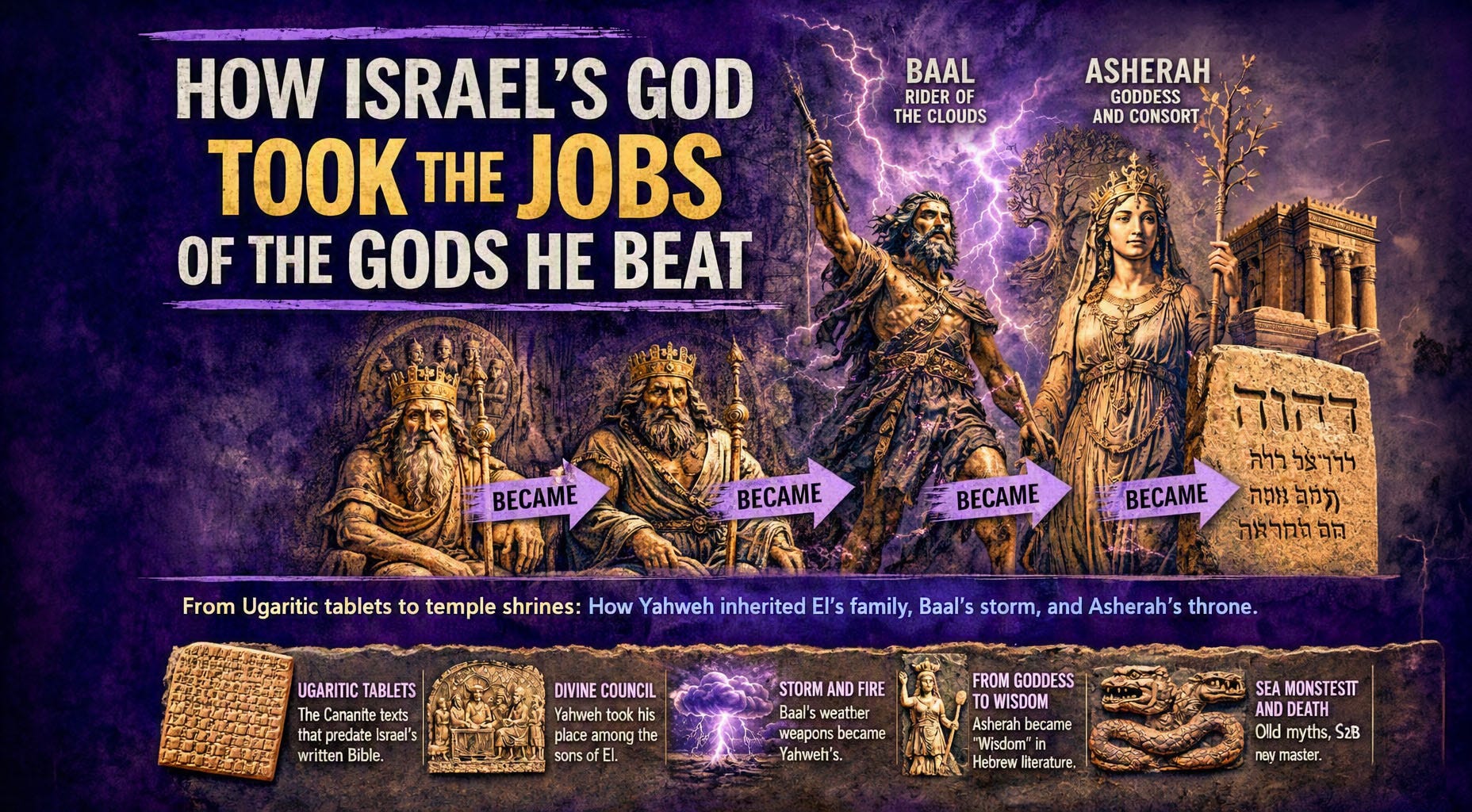
Everybody knows the Bible hates other gods. Smash the altars, burn the poles, kill the prophets of Baal on the mountain and don’t leave one standing. What gets overlooked is how much of those gods ended up inside the God who beat them. Israel’s deity rose in a crowded room, and when the room cleared he was wearing everyone else’s clothes.
The Ugaritic tablets dug up at Ras Shamra in 1929 gave us the Canaanite side of the story in its own language, written down before Israel had much of a literature at all.
The scholars who worked most of this out teach at seminaries and divinity schools, and plenty of them are practicing Christians. What follows is where critical scholarship sits. In the bonus section, supporters get what the different camps of Christian scholars say about all of it, including the ones who read the same evidence and reach the opposite conclusion, so you finish with the full picture.
El Handed Over the Throne and the Family Name
At the top of the Canaanite pantheon sat El, the old father god with a divine council and seventy sons. Israel is named after him. So is Bethel, Elijah, Ezekiel, Michael, and the plain word for God that runs through Genesis. Nobody in the Hebrew Bible ever treats El as a foreign god to be destroyed, which is strange treatment for the head of the neighbors’ pantheon.
The reason is that Yahweh took the office rather than fighting the occupant. You can watch the transfer happen in Deuteronomy 32:8-9. In the version preserved at Qumran and in the old Greek translation, the Most High divides humanity according to the number of the sons of God, and Yahweh receives Jacob as his allotted share. That’s a junior deity getting one nation out of the family estate. The Masoretic text later changed the line to read “sons of Israel,” which fixed the theology and left the seam visible.
Psalm 82 keeps the council intact. God stands in the assembly of the gods and puts them on trial for running the world badly, then sentences them to die like men. Whoever wrote that wasn’t denying the other gods existed. He was firing them.
Baal Lost the Storm
Baal was the storm god of the Canaanites, and his standing title in the Ugaritic texts is “rider of the clouds.” Psalm 68:4 hands that exact title to Yahweh. When God shows up in Hebrew poetry he arrives the way Baal arrives, in thunder, on cloud, with lightning as ammo and the mountains melting like wax underneath him.
Elijah’s contest on Carmel reads differently once you know this. It’s a fight over which storm god ends a drought, held on Baal’s home turf, decided by fire from the sky and then rain. The winner takes the job description with him.
The Sea Monster Was a Rerun
Baal’s great achievement was killing Yam, the Sea, and the seven-headed serpent Lotan. A Ugaritic tablet describes Lotan as the fleeing serpent, the twisting serpent, the mighty one with seven heads.
Isaiah 27:1 promises that Yahweh will punish Leviathan the fleeing serpent, Leviathan the twisting serpent, and kill the dragon that’s in the sea. Same monster, same two adjectives, different killer. Psalm 74:13-14 remembers God splitting the sea and crushing the heads of Leviathan, plural, because the thing had more than one. Job 41 gets the beast after the domestication, reduced to a crocodile with attitude that God likes to show off.
In Genesis 1, the sea is still there in verse 2, dark and formless, but nobody has to fight it. God speaks and it moves. That’s a war story rewritten by the side that already won.
Asherah Went From Wife to Firewood
At Kuntillet Ajrud in the Sinai, on storage jars from around 800 BCE, someone wrote a blessing “by Yahweh of Samaria and by his asherah.” A tomb inscription at Khirbet el-Qom says something close. These are ordinary Israelites, blessing each other in the ordinary way, and Yahweh comes with a consort.
The Bible confirms it by complaining. Josiah has to haul the Asherah out of the Jerusalem temple and burn it in the Kidron valley, along with vessels made for Baal and for all the host of heaven, and he has to tear down the quarters where women wove hangings for her (2 Kings 23:4-7). You don’t remove furniture from your own temple unless somebody put it there and kept it there for generations.
She doesn’t vanish so much as get respectable. Proverbs 8 has a female figure who was beside God at creation, delighting in him daily, calling to men from the city gates. Her name is Wisdom now, and she’s an attribute instead of a wife.
Death Got Demoted Into a Common Noun
Mot was the Canaanite god of death, and his defining move was swallowing. He swallows Baal whole and the world dries up. Isaiah 25:8 says God will swallow up death forever, which flips the myth by giving Yahweh the appetite. Hosea 13:14 taunts the same figure by name, asking where his plagues and his destruction are.
Two more gods survive in Hebrew as staff. Habakkuk 3:5 has plague going before Yahweh and pestilence following at his feet, and both words are the names of deities in Canaanite texts. Deber and Resheph used to have altars. In Habakkuk they’re walking behind the chariot like servants who lost a war.
The Morning Star Fell Into Somebody Else’s Story
Isaiah 14 mocks the king of Babylon by calling him Helel ben Shahar, Day Star son of Dawn, the one who said he’d raise his throne above the stars of God and got thrown down to the pit instead. Dawn was a god. So was the morning star, and Canaanite myth has a lesser deity trying to occupy the high throne and failing.
Jerome translated Helel into Latin as Lucifer, and the church read the passage as the fall of Satan, which is a promotion the text never offered. A dead Canaanite god became the devil by way of a joke about a Babylonian king.
Scribes Went Back and Edited the Names
The clearest evidence for how problematic all this got is the names. Saul’s son appears as Eshbaal in Chronicles and Ishbosheth in Samuel. Jonathan’s son is Merib-baal in one place and Mephibosheth in another. Gideon’s other name is Jerubbaal, and one verse in Samuel calls him Jerubbesheth.
Bosheth means shame. Israelite parents were naming their sons after Baal, and later scribes went through the text swapping the god’s name for an insult. They caught most of them. The ones they missed are still sitting there in Chronicles, which is how we know what the originals said.
That’s the pattern from Genesis to Isaiah. The gods of Canaan weren’t argued out of existence but dismantled, and the parts were kept, and the God who ended up holding all the parts is the one that three religions inherited.
In the exclusive section of this piece, we will explore how Christian scholars from various theological factions respond to this history. I have deliberately laid out these facts with absolute honesty, even when doing so appears to undermine my own argument.
If even a small fraction of regular readers became supporters, I’d spend less time running the business side of this publication and more time in the archives doing the research this work demands.
If you’re getting something out of these pieces, consider supporting The Unholy Truth. Supporters get the bonus sections, the Friday Editions, and the full archive.
Support the work and unlock exclusive content for the full story.
Sources and Further Reading
Mark S. Smith, The Early History of God: Yahweh and the Other Deities in Ancient Israel
Mark S. Smith, The Origins of Biblical Monotheism
Frank Moore Cross, Canaanite Myth and Hebrew Epic
Francesca Stavrakopoulou, God: An Anatomy
John Day, Yahweh and the Gods and Goddesses of Canaan
William G. Dever, Did God Have a Wife? Archaeology and Folk Religion in Ancient Israel
Karel van der Toorn, Bob Becking, Pieter W. van der Horst, eds., Dictionary of Deities and Demons in the Bible
Simon B. Parker, ed., Ugaritic Narrative Poetry (translations of the Baal Cycle)
Indeed, Tanner, you never disappoint! Your ingenious presentation lacks nothing! All the facts associated with a countless succession of gods, goddesses, rituals, beliefs, stories immersed in utter nonsense, all flow from your analysis with truth not to be minimized, misinterpreted, or denied. And where would it all land without your input of humor! No one does it better, and I always, always, can’t get through it all without a chuckle or two, and many more.
Anyway, to get to the serious stuff of the matter, it must be emphasized that Judaism does not hide, cover-up, or attempt to deny in any way the pagan roots that weave their way through the fabric of the Jewish religion. On the contrary Israel’s transformation from a cult of polytheistic worship to a monotheistic religion is prominently displayed throughout the Hebrew Scriptures, and no King, Judge, Prophet, Proverb, Psalm, or, above all, Torah, will ever dispute the facts therein.
The one God emerged from a pantheon, but crucial to understand is that He did so because He was the authentic and only true Deity from the very beginning, just difficult to recognize in a culture rampant with a motley-crew of pre-Judaic pagan worshippers fixated on the gods of the culture from where they roamed and eventually settled. The Scriptures detail this transformation, and does so without embarrassment or apology, tracing its evolution from belief in the many, culminating to a belief in the One.
So be it, I guess. Let the history stand as is. Paganism served its intended purpose, a preparation for the next and final chapter on the long journey forward in a steadfast and unyielding search for the one true God, eventually found.