


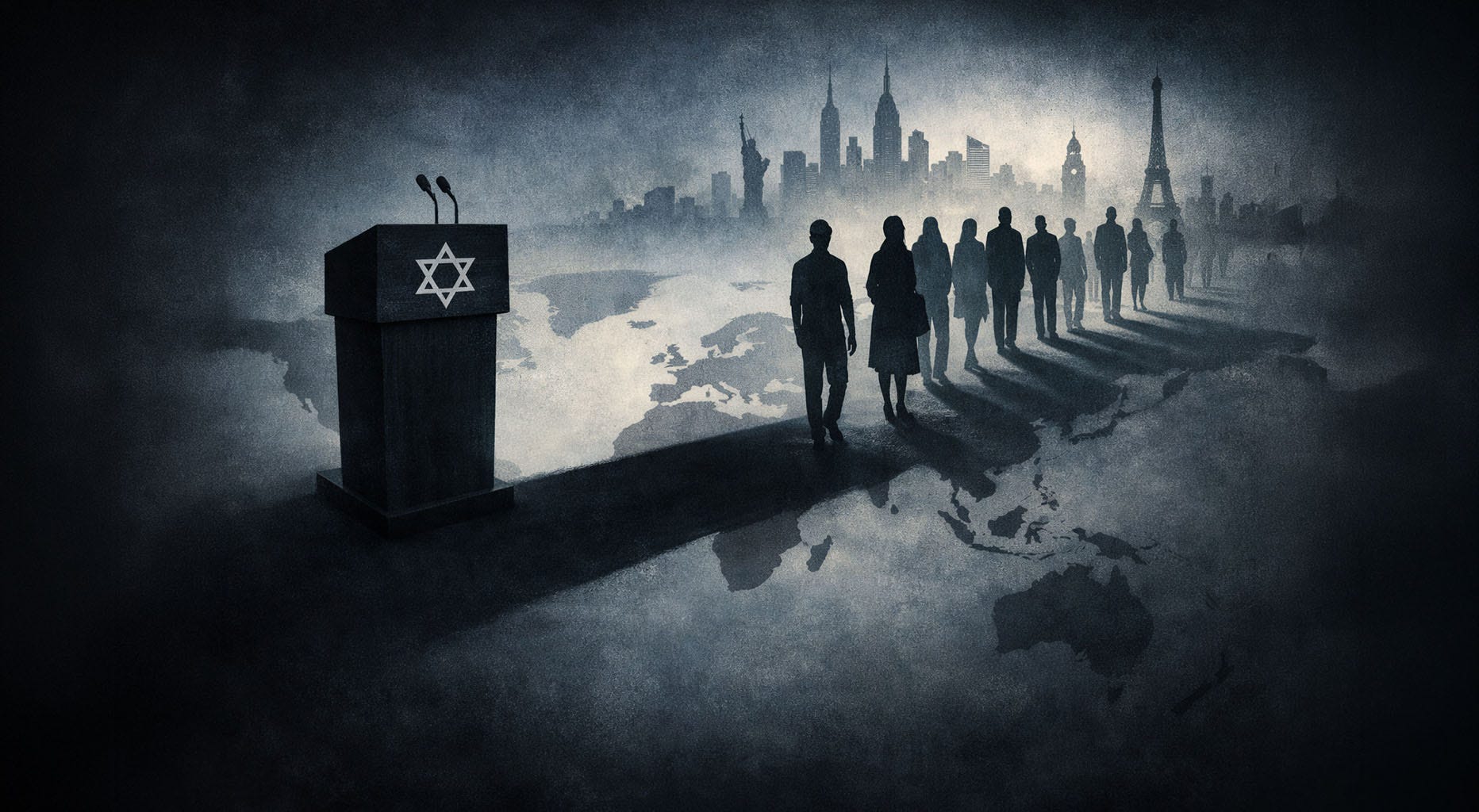
This essay isn’t about defending or condemning Israel’s current government for its controversial actions. That debate turns into a moral cage match within seconds, and I’m not here for it. More than enough people are already doing that, and the last thing the world needs is another comment designed to win applause from one side and frustration from the other.
What I want to do instead is lay out, plainly and without the comfort of false balance, how Israel’s political leadership—especially its revolving door of populist, right-wing governments—has helped build the conditions that fuel twenty-first-century antisemitism.
This is about understanding the machinery that makes their jobs easier, and how the state of Israel has, through its own arrogance and cynicism, helped grease the gears.
One clarification before we go further: “Israel” here means its government and political elites—the same people many Israelis themselves can’t stand for their corruption and incompetence. This is certainly not an attack on Israelis as a people, or on Jews as a group. It’s a critique of how the state apparatus, through its rhetoric and policies, has blurred the lines between government, religion, and ethnicity in ways that have made life more dangerous for Jews everywhere. The distinction matters, even if Israel’s own leadership works overtime to erase it.
I am also keeping outside my jurisdiction those Israelis who wholeheartedly support their sitting government. Tribalism is a natural human instinct we’ve evolved to have for survival, not a moral failing. I can also relate to the dissonance they must feel between how right they believe Israel is in its actions and how the rest of the world reacts. Except for the US, perhaps, which seems to have abandoned the international legal architecture it largely built after World War II.
Let’s begin.
When a State Claims to Speak for All Jews
The gravest mistake Israel’s leaders keep making is their insistence that they speak for every Jew on the planet. Whenever the Israeli government faces international criticism, the playbook is the same: “That’s antisemitism.” As if the state of Israel is Judaism itself. As if critiquing Netanyahu or his cabinet is the same as attacking the sanctity of Jewish existence.
This is political cowardice, which they want us to believe is ethnic solidarity. It’s a deliberate conflation, and it’s as dangerous as dangerous can get. When the state makes itself the avatar of an entire people, every action it takes—no matter how ugly—gets mapped onto Jews everywhere. If Israel bombs a hospital, or bulldozes a village, or passes a law denying basic rights, it’s not just the government that faces the backlash. It’s the Jewish kid at school in Marseille. The owner of the corner deli in Queens. The rabbi walking down the street in Manchester. These are people who have zero say in Israeli policy, zero connection to the decisions being made in Jerusalem, and yet they bear the consequences because a government 5,000 miles away decided to make itself their spokesperson.
This is how modern antisemitism is manufactured. The government builds the road and then feigns shock when people follow it all the way to the doorsteps of ordinary Jews.
As Peter Beinart put it in The Crisis of Zionism: when you conflate a government with an entire people, you don’t shield the government from criticism—you put a target on the people’s back.
And I’m not talking about something abstract and hypothetical. Every time headlines about Israeli military actions hit, attacks on Jewish communities in Paris, London, and New York follow. The state’s insistence on being “the representative of the Jewish people” is more than hubris—it’s a calculated shield that, in practice, turns ordinary Jews into collateral damage.
Political Loyalty Tests and the Collapse of Credibility
The United States, Israel’s most uncritical ally, has bought into this false equivalency wholesale. Remember the hospital bombing in Gaza? Israel denied responsibility immediately—no evidence, no investigation, just a flat denial. Joe Biden, instead of demanding answers—the bare minimum any ally should expect—parroted the Israeli line. “We’ll take Israel at its word.”
A superpower, faced with mass civilian casualties, deciding that the word of the accused is sufficient. No forensic analysis, no independent inquiry, no due diligence of any kind.
In any other context, if the accused’s word was treated as gospel and the victims were dismissed without a second thought, people would riot. But when it comes to Israel, the usual standards evaporate. The state has built a political apparatus where criticism is synonymous with bigotry, and where loyalty to the government is a litmus test for moral legitimacy.
Perhaps, the biggest tragedy of all is that the very official Biden trusted had a suspended conviction for corruption and was fighting to avoid jail time. Yet the world was expected to take his word as unassailable truth. This is what happens when politics replaces principle, and a state’s narrative is treated as scripture by foreign powers terrified of the “antisemite” label. The credibility of the entire Western alliance gets tied to the credibility of one government’s talking points—and when those talking points crack, so does trust in every institution that repeated them.
This isn’t to say Israel was lying. I don’t know any more than you do. But the attitude speaks volumes. It sends a clear message to Arabs that this is not about right or wrong. It is like a football match: we picked our side, and we will support it no matter what it takes. We do not even care enough to give the impression that morality matters.
The Holocaust as Political Shield
One of the most cynical moves in modern politics is Israel’s constant invocation of the Holocaust. The Holocaust was real, horrifying, and a tragedy that must never be forgotten. But Israel’s leadership has turned remembrance into a weapon—an emotional bludgeon to silence dissent and deflect accountability. Every time someone pushes back against Israeli policies, the accusation drops: “You’re minimizing Jewish suffering,” or “You’re enabling another genocide.”
This is emotional blackmail. It’s not about honoring the dead; it’s about shielding the living from scrutiny. And over time, it breeds resentment. People start to see Holocaust memory not as sacred, but as manipulative. The ones who suffer aren’t the politicians in Jerusalem—they’re Jews in the diaspora who had nothing to do with any of it, but who now carry the burden of a weaponized tragedy.
Norman Finkelstein nailed it in The Holocaust Industry: the Holocaust is not a moral trump card to silence criticism of a modern nation-state. And yet that’s exactly what it’s become—a rhetorical grenade lobbed at anyone who dares question the gap between what Israel says and what Israel does. The tragedy isn’t just the cynicism. It’s that this strategy corrodes the very memory it claims to protect.
If you plant the Holocaust between your critics and your government, you shouldn't be surprised when populist politicians and movements start working to devalue it. In their calculations, tearing down the shield would expose Israel to the criticism they twant to land. In other words, The Holocaust doesn't get cheapened by accident. It gets cheapened because Israel made it load-bearing — and now every bad-faith actor with a political axe to grind knows exactly which wall to chip at.
Weaponizing Antisemitism—And Draining It of Meaning
“Antisemitism” used to mean something specific: hatred of Jews for being Jews. Today, thanks to Israel’s relentless messaging apparatus, the term has been stretched to the point of meaninglessness. Criticize a bombing? Antisemitism. Question a land grab? Antisemitism. Boycott Israeli goods? Nazi.
This is reckless to say the least. By weaponizing the term against all critics, Israel has trained the world to tune out legitimate warnings. When actual antisemitism surfaces—when synagogues are attacked, when Jewish communities are scapegoated, when conspiracy theories about Jewish power circulate on social media—the world shrugs, assuming it’s just another political spat. Real antisemites slip through the cracks while the state’s defenders keep crying wolf. The boy who cried antisemitism has made it harder to hear the real screams.
Kenneth Stern, who helped draft the original IHRA definition of antisemitism, warned it himself: if everything is antisemitism, then nothing is. The man who literally wrote the definition is telling you it’s being abused. When the author of the standard says you’ve broken it, maybe it’s time to listen.
Diaspora Jews: Unwilling Pawns
Most Jews don’t live in Israel. They don’t vote in its elections, they don’t shape its policies, and many are openly critical of its government. Yet Israeli leaders insist on speaking in their name, drafting them into a political project they never signed up for. Outreach groups bombard American and European Jews with propaganda, demanding loyalty and defense of Israeli policies. The message: to be a good Jew, you must be a good Zionist.
This sets up diaspora Jews as targets for backlash whenever Israel acts. When protesters march against Israeli military actions, they end up outside synagogues and Jewish community centers. Why? Because Israel has gone out of its way to erase any daylight between its government and Jews everywhere.
Tony Judt laid it out in Israel: The Alternative: Israel insists on being the “Jewish state,” then complains when Jews everywhere are seen as answerable for its actions. A state that wraps itself in the identity of a global people acts surprised when that global people catches the blowback. This is the predictable outcome of a deliberate strategy, nothing to be shocked by.
Nationalism as Religion, Criticism as Heresy
Modern Israeli politics—especially on the right—treats nationalism not as a political stance but as a sacred creed. Zionism has morphed from a movement for Jewish self-determination into a quasi-religious dogma. The state is holy, its leaders are prophets, doubters are heretics.
This has poisoned public discourse. Jews who criticize Israel are slandered as “self-hating.” Non-Jews who do so are labeled antisemites. Organizations that advocate for Palestinian rights are smeared as hate groups. The result is a suffocating attitude where only a safe opinion is uncritical support. This isn’t about anything but protecting Jews—it’s about stifling dissent and consolidating power. The conflation of political criticism with ethnic hatred serves exactly one constituency: the people in charge.
Amira Hass, writing for Haaretz, observed that Zionism once sought refuge from antisemitism—and now, in its worst forms, manufactures it. That’s not the verdict of an outsider with an axe to grind. It’s the assessment of an Israeli journalist writing from inside the system. When your own press is sounding the alarm, the problem isn’t the critics. It’s the policy.
Predictable—and Preventable—Consequences
Antisemitism remains a potent and real threat. Attacks on Jewish people and institutions, conspiracy theories about Jewish power, political scapegoating—these are facts, and they predate the state of Israel by centuries. But a significant portion of the antisemitism that flares up around Israeli military operations isn’t the product of ancient hatreds or irrational bigotry. It’s the direct result of a decades-long campaign to fuse Jewish identity with the Israeli state. When Israel acts badly, the world sees “the Jews” acting badly. The government set up the dominoes and then feigns surprise when they fall.
Miko Peled put it starkly in The General’s Son: when people say “Israel makes me hate Jews,” they’re reacting to a system that trained them to see no daylight between the two. That’s not a justification for antisemitism. It’s a diagnosis of a toxic dynamic that the Israeli state itself engineered.
The people who suffer most aren’t Israeli politicians or generals. They’re the Jews living in Brooklyn, Berlin, Buenos Aires—people with no power over Israeli policy, but who are held accountable for it nonetheless.
So, Was It Always Israel’s Destiny?
This isn’t about whether the sitting Israeli government is right or wrong in its actions. Israel will have good governments and bad governments — that’s how democracy works. And the question is why, when a bad government makes bad decisions, Jews worldwide pay the price, and how that dynamic keeps getting brushed aside.
The conversation is so consumed by whether Israel is right or wrong that it misses something obvious: the sitting government couldn’t care less about Israel’s reputation worldwide. It doesn’t need to. It needs votes. And those votes come from a domestic base that’s ready to blame every diplomatic fallout on the countries pulling away, conveniently forgetting that maintaining alliances and protecting Israel’s standing abroad is the government’s job — not everyone else’s.
Even if every single Israeli military action were justified, the strategy is failing on its own terms. When your allies are dropping away, when your international standing is in freefall, when your name has become synonymous with controversy in every capital that used to back you — that’s not the world’s failure. That’s a leadership failure.
Think of it this way: would you keep a CEO who started suing competitors left and right, despite the customer backlash and the company’s cratering reputation? You’d fire him. Even if the company was right in every single case. Because being right doesn’t matter if your strategy is burning down every relationship you need to survive. The CEO’s job isn’t just to win court cases — it’s to protect the company’s position in the market. You don’t get to be right and ruined and call it a victory.
But somehow, when it’s a country, the expectation flips. Suddenly, it’s everyone else’s job to see how right Israel is and magically keep supporting it. And if they don’t? Their fault. Their antisemitism. Their problem.
Everybody is responsible for their own racism. . But it is the government’s job to foresee which actions fuel racism and which ones help contain it. Blaming everything on racists doesn’t make them disappear. It just means you don’t care enough about the cost to the victims — the Jews in Brooklyn, Berlin, and Buenos Aires who never asked to be conscripted into this fight, and who keep paying for decisions they had no part in making.
I can agree with everything you say here. But as someone who was raised Jewish, I can add a bit of nuance. The actions of Israel (which I most definitely oppose - their actions in Gaza erased any sympathy I once had) definitely ramp up antisemitism. But it by no means manufactures it. There is always a deep reservoir to draw upon.
A decent analogy is 1930s Germany. Hitler whipped up anti Jewish sentiment. But that sentiment had a very long history in Germany, going back at least as far as Martin Luther's virulent polemics in the 16th century.
This is not in any way a criticism of the piece, just wanted to add a bit of context.
Every article I read from you Tanner makes me more aware and gives me hope. The way you see the world opens minds. Thanks so much.