


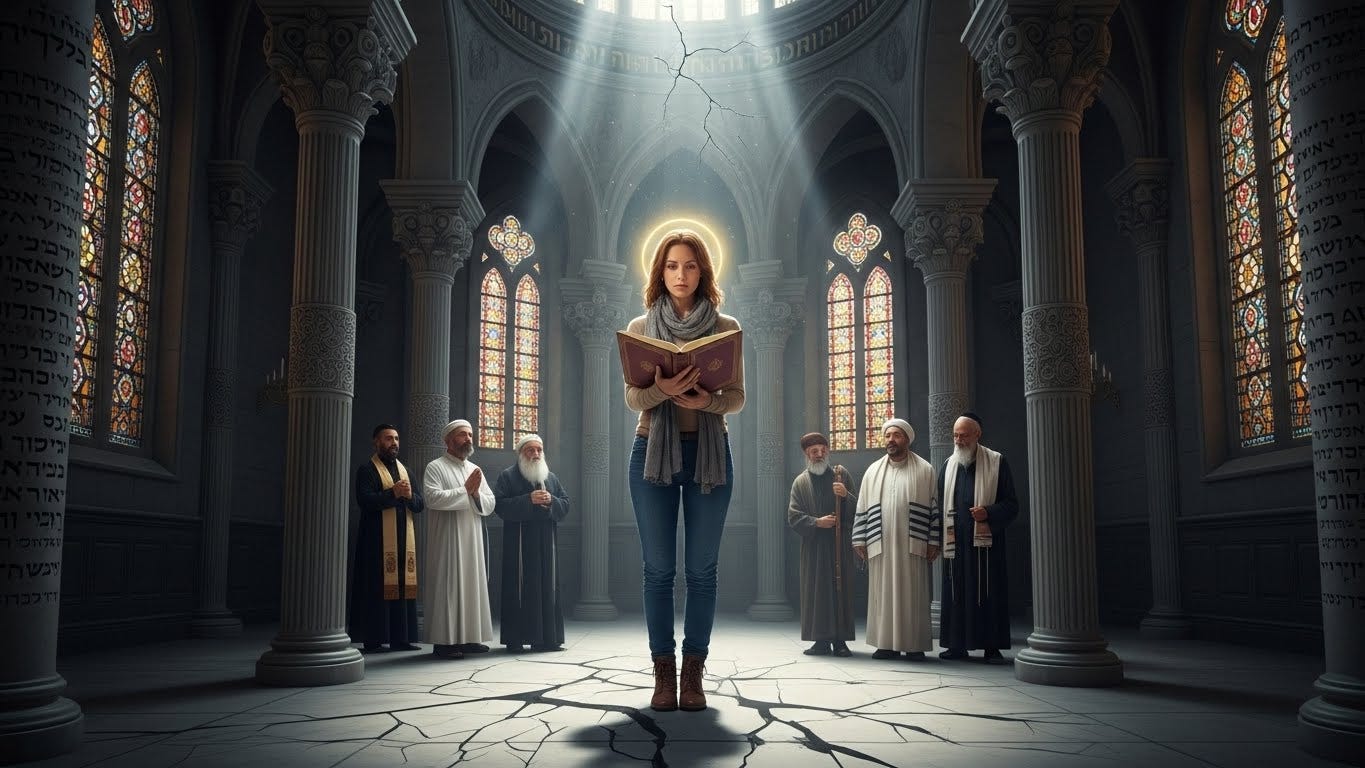
When men tell you a story over and over again for 2,000 years, they get to shape how it’s remembered. And when that story is called “holy,” suddenly questioning it makes you evil, unfaithful, or dangerous. Now toss in feminism. A movement where women stopped waiting for permission. And instead of letting popes, priests, rabbis, or imams read the holy books for them, they opened the damn books themselves. What they found wasn’t divine. It was political. And the whole house of cards started shaking.
The Holy Books Were Written by Men for Men.
Let’s start with what should be obvious. The people who wrote, edited, copied, translated, and interpreted the Bible, the Quran, the Torah, and just about every so-called holy text were men. And not just any men—men with power. Kings, priests, scribes, scholars, tribal chiefs, warlords. Women weren’t at the table. Most weren’t even taught how to read, let alone write scripture.
So what do you think happens when a bunch of powerful men get to decide what God says? Spoiler: God ends up sounding a lot like them. He’s obsessed with obedience, obsessed with control, obsessed with women staying quiet, modest, and in their place. And the person never in the driver’s seat? Women.
God’s audience in these texts is almost never women—not even a mixed crowd. The commandments, the warnings, the praise, the punishments—nearly all aimed at men. Women barely show up, and when they do, it’s as wives, mothers, temptresses, or victims. And never as the ones being spoken to. Only the ones being spoken about.
Sacred texts are male-centered not because God is male, but because men wrote them— Elizabeth Schüssler Fiorenza, theologian
Eve, the Scapegoat of the Species
From the very start, the Bible throws women under the bus. Eve eats the fruit, Eve ruins paradise, Eve gets blamed for the whole downfall of humanity. Adam? Poor guy was just standing there. This isn’t a harmless story. It’s a setup for centuries of women being told they’re the root of all sin. That they’re temptresses. That their very bodies are dangerous.
Never mind that the story doesn’t even say “apple.” Never mind that the snake talks to Eve like she’s smart enough to hold a theological debate. The message was clear: trust women, and the world burns.
Eve’s story has been used to justify the control of women’s bodies and voices for millennia— Phyllis Trible, biblical scholar
The Virgin Complex: Are You Holy or a Whore?
Religions love dividing women into two camps: the pure and the impure. The virgin and the whore. Mary, mother of Jesus? Untouchable, sacred, perfect because she was a virgin. Mary Magdalene? A sinner who had to be cleansed. (Even though the “prostitute” label slapped on her came centuries later and isn’t in the Bible.)
This binary doesn’t come from God. It comes from a culture obsessed with controlling female sexuality. Because if you can’t control women’s minds, you control their bodies. And if you can’t do that, you shame them for existing.
The invention of Mary Magdalene as a prostitute was a deliberate move to diminish the power of a prominent female follower of Jesus— Karen King, Harvard Divinity School
Silence the Women, Amplify the Men
In Christian churches, women are told to keep silent. Literally. That’s in 1 Corinthians. “Let your women keep silence in the churches: for it is not permitted unto them to speak.” Funny thing is, Paul didn’t even write that part. Scholars widely agree it was added later by churchmen who didn’t like how many women were preaching in early Christianity.
Islam isn’t much different. Many imams have interpreted the Quran to mean women can’t lead prayer, speak too loudly, or travel alone. But when Muslim feminists read the same Quran, they find something else. Verses about equality, partnership, mutual respect. So who’s right? The guy with the mic or the woman with the book?
There is nothing in the Qur’an that forbids women from being religious leaders. These bans come from cultural practices, not divine revelation— Amina Wadud, Islamic feminist scholar
The Fear of Women Who Interpret
The biggest threat to any religious hierarchy isn’t atheism. It’s women who read. Women who ask questions. Women who say, “Wait a minute… why is God always male? Why is punishment harsher for women? Why is modesty only for one gender? Who benefits from these rules?”
Feminist theologians didn’t just challenge sexism. They revealed how religion has always been a political tool. Used to justify war. Used to control sexuality. Used to keep men in charge. The moment women pick up the text and start asking their own questions, the curtain drops and the wizard behind it gets real nervous.
Theology is not neutral. It reflects structures of power. Feminism exposes this by asking who is included and who is silenced— Rosemary Radford Ruether, feminist theologian
How Feminism Flips the Script
Feminism isn’t about throwing out religion. It’s about reclaiming it. About peeling away the layers of politics, tribalism, and patriarchy that got baked into the cake. When women read the Bible and the Quran for themselves, they don’t just look for female prophets or heroines. They ask: what does justice look like? What does equality mean when God supposedly loves all his creation?
Some reinterpret Eve as the first theologian. Some see Mary Magdalene as the first apostle. Some read the Quran’s creation story and realize both man and woman were created from the same soul. Equal. Not rib and sidekick.
Feminist readings aren’t distortions. They’re recoveries of voices deliberately buried— Letty Russell, feminist biblical scholar
When Men Panic
You want to see religion get defensive really fast? Let a woman question it publicly. Suddenly, you’re told you’re emotional. Angry. Misguided. Rebellious. You’re “reading too much into it.” Or worse, “You don’t understand scripture the right way.”
Translation: You’re threatening the power structure.
That’s why the church slammed the door shut on ordaining women. That’s why mosques keep women in separate prayer rooms or behind curtains. That’s why ultra-Orthodox Jews burn feminist prayer books. Because when you open the door to women interpreting holy texts, you open the door to admitting those texts have always been interpreted, twisted, and selectively applied by men.
The fear is not that women will misunderstand scripture. The fear is that they will understand it too well— Nawal El Saadawi, Egyptian feminist and author
When Women’s Lives on the Line
This isn’t just theory. Religious texts, interpreted through a patriarchal lens, shape real-world policies. Women denied abortions because of scripture. Girls forced into marriages. Rape victims punished. Wives told to “submit” to abusive husbands because “the Bible says so.” That’s not God. That’s men weaponizing God.
And when women push back, they’re accused of “destroying the family” or “attacking religion.” But maybe religion needs attacking when it’s being used as a cover for injustice.
Patriarchy has not been eliminated by religion. It has been sanctified by it— Fatema Mernissi, Moroccan sociologist
What’s Left of Religion After Feminism?
You know what’s left? A version of religion that’s harder to control, but way more honest. A faith where women are prophets, teachers, leaders, writers. A God who doesn’t play favorites based on genitals. A spirituality that uplifts rather than suppresses.
This kind of religion won’t fill stadiums. It won’t win elections. It won’t fund billion-dollar televangelists. But it might actually do what religion was supposed to do in the first place: teach compassion, justice, and humility.
When women read scripture for themselves, they don’t just find God. They find themselves— Judith Plaskow, Jewish theologian
Last Thoughts
If you take nothing else from this, take this: open the book. Read it yourself. Don’t wait for some dude in a robe to tell you what God says about you. Don’t let ancient priests or modern politicians decide how much of your voice is allowed. Whether you’re a believer or not, feminism showed us something crucial:
When women read scripture without asking permission, the divine voice stops sounding like a drill sergeant. And starts sounding like something worth listening to.
To be honest, only a small portion of subscribers are paid—most of my posts are free for everyone to read, with some exclusives. But reader support buys something priceless: time. Time to research, question power, and hold the powerful accountable. If you can afford it, your support helps keep this work alive.
Sources and Further Reading
In Memory of Her (Elizabeth Schüssler Fiorenza, 1983)
Texts of Terror (Phyllis Trible, 1984)
The Gospel of Mary of Magdala (Karen King, 2003)
Qur’an and Woman (Amina Wadud, 1999)
Sexism and God-Talk (Rosemary Radford Ruether, 1983)
The Coming of Lilith (Judith Plaskow, 1981)
Beyond the Veil (Fatema Mernissi, 1985)
Women and Redemption (Rosemary Radford Ruether, 1998)
The Hidden Face of Eve (Nawal El Saadawi, 1980)
Church in the Round (Letty Russell, 1993)
Excellent. I saw the patriarchy 5 decades age, when I thought of becoming a minister. Min-existent in evangelical churches.
However, advise not just to read the books. The Bible at least did not include many books the power brokers didn’t want to deal with: topics like reincarnation (who needs a priest, a church?) and Old Testament stories actually being visitations by extraterrestrials.
...and yet, go to any Christian church and most of the attendees are female. They even refer to many husbands as "drag-alongs" brought to the church by their wives or girlfriends.
Weird .