


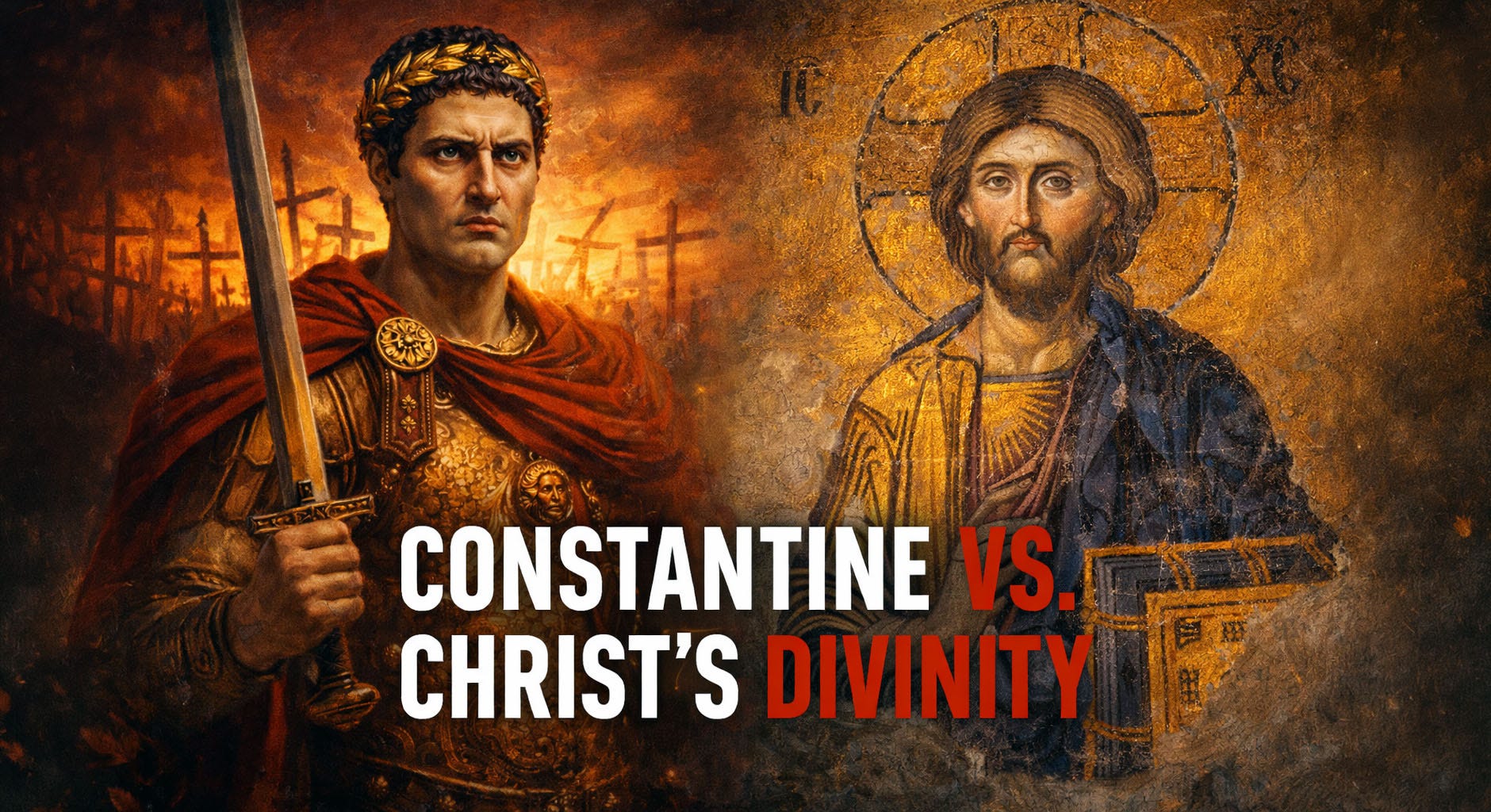
The last few posts centered around politics with religion as the sidekick. Today we’re going back to Christian history all the way— and of course, the politics come with it.
Here’s a story Christian sources aren’t too keen on telling you.
In 325 AD, Emperor Constantine gathered over 300 bishops in the city of Nicaea to settle the biggest theological question in the history of the faith: Was Jesus God — or wasn’t he?
The council voted, the answer was yes, and just like that, Jesus was “of one substance with the Father” — co-eternal, co-equal, fully divine, and indisputable, of course.
Out of roughly 300 bishops, only two refused to sign the creed. Arius — the priest who’d argued that Jesus was a created being, subordinate to God — was condemned as a heretic and exiled. His books were ordered to be burned, and Constantine even issued a death penalty for anyone caught hiding Arian writings.
And to top it all off, Constantine — the hero who once saw a cross in the sky and conquered in its name — got baptized on his deathbed. Snif, snif.
Case closed, right?
Not even a little bit.
Because the man who called that council — the man who supposedly championed the divinity of Christ — spent the rest of his life quietly dismantling the very decision he’d presided over.
And when he finally died twelve years later, he was baptized on his deathbed by an Arian bishop — one who rejected the idea that the Father and Son were both equally God.
The Setup
To understand what Constantine actually did, you have to understand what he actually cared about. And it was unity, not necessarily the theology to secure it.
Constantine had just finished consolidating control over the entire Roman Empire. He’d fought a civil war to get there and the last thing he needed was his newly legalized religion tearing itself apart over metaphysics. Mind you, the Arian controversy wasn’t a polite academic debate — it was a full-blown political crisis. Riots in Alexandria, bishops excommunicating each other, congregations splitting down the middle.
So Constantine stepped in, but not because he had a deep conviction about the relationship between the Father and the Son. He simply needed the fighting to stop. At that his letter to both Arius and Bishop Alexander is revealing. He basically told them to knock it off, calling their dispute a trivial philosophical disagreement that nobody should care about.
That's the context people miss, willfully or not. Constantine convened Nicaea because he needed a decision — any decision — that everyone could sign onto and shut up about for good. He believed that for the sake of unity, truth must be decided once and for all — not pursued.
The Vote That Didn’t Stick
The Council of Nicaea produced the Nicene Creed, and on paper, it was a landslide. The Arian position — that Jesus was a created being, the “first and greatest” creation of God but not God himself — was overwhelmingly rejected. The creed declared that the Son was homoousios with the Father: “of the same substance.” Not similar, not comparable, the same. What these bishops knew that the others didn’t is anyone’s guess.
But here’s the thing about landslides at gunpoint: they don’t always reflect what people actually think.
Constantine was physically present at the council, personally opening it with a speech. He participated in the debates, and, according to his biographer, Eusebius of Caesarea, Constantine himself suggested the key term homoousios. The emperor — who hadn’t even been baptized yet — was drafting Christological language for the bishops to vote on.
And the bishops were more than aware which way the wind was blowing. Of the roughly 300 in attendance, many were Arian sympathizers who signed the creed anyway because the alternative was exile. Eusebius of Nicomedia — one of the most powerful Arian bishops in the empire and a relative of the imperial family — signed the creed but refused to sign the condemnation of Arius. For that, Constantine exiled him too.
So the “overwhelming consensus” at Nicaea was really an overwhelming reading of the room. The emperor wanted a result, and he got one. What he did with it afterward tells you everything.
The Slow Reversal
Within three years of the council, Constantine began walking it all back.
First, he recalled the exiled Arian bishops. Eusebius of Nicomedia was brought back from exile by 329 — just four years after Nicaea — and quickly became one of the most influential figures in Constantine’s court. He subsequently got a promotion and eventually became the bishop of Constantinople itself, the seat of imperial power.
Then Constantine turned on the man who’d championed the Nicene position. Athanasius of Alexandria — the most forceful defender of Christ’s full divinity — was condemned at the Synod of Tyre in 335 and exiled by Constantine.
Let me repeat that: the emperor exiled the champion of the very creed his own council had produced.
Meanwhile, Arius himself was rehabilitated. Constantine permitted him to return from exile after Arius submitted a carefully worded statement that technically didn’t contradict Nicaea but conveniently avoided the word homoousios. The Synod of Jerusalem in 336 formally restored Arius to communion. The man the church had declared a heretic was welcomed back in — with the emperor’s full support.
By the mid-330s, the political landscape of the church had been completely inverted. The Arians were in. The Nicene defenders were out. And Constantine was the one flipping the board.
Why of It All
The standard explanation is that Constantine was just trying to keep the peace. The Nicene decision didn’t settle anything — it made things worse. The Eastern bishops resisted the creed because they felt the word homoousios had been forced on them. The controversy kept spreading. So Constantine, ever the pragmatist, began accommodating the Arian side to ease tensions.
That was a charitable reading.
Here’s a less charitable one.
Constantine was never a committed Trinitarian. He didn’t understand the theology, didn’t care about the theology, and chose whichever side seemed most politically useful at any given moment. Early on, when he needed a decisive council to project imperial authority, he backed the Nicene faction. Later, when the Arian bishops proved more pliable and more useful as political allies, he backed them instead.
The evidence supports the less charitable reading. Constantine’s own son and successor, Constantius II, was openly Arian. Under Constantius, Arianism became the effective state religion of the Eastern Empire. The Council of Ariminum in 359 nearly reversed Nicaea entirely. Arian bishops dominated the major sees. Athanasius was exiled five separate times over the course of his career — a record that tells you exactly how contested the “settled” question of Jesus’ divinity really was.
In short, Constantine built the infrastructure for it, elevated Arian bishops to positions of power, marginalized their opponents, and treated the question of Christ’s nature as a political lever rather than a theological truth, all of which reflect the church he left behind.
The Deathbed
And then there’s the ending.
On May 22, 337, Constantine was baptized on his deathbed. He’d delayed baptism his entire life — a common practice at the time, since people believed post-baptismal sin couldn’t be forgiven. He wanted to die clean - and God loved smart people who could rig the system.
The man who performed the baptism was Eusebius of Nicomedia — the Arian bishop who’d defended Arius at Nicaea, who’d been exiled for it, who’d clawed his way back into imperial favor and spent a decade reshaping the church in Arius’s image.
This was so embarrassing to later Christians that a legend was invented — entirely fabricated — claiming that Pope Sylvester I had actually baptized Constantine years earlier in Rome. Scholars dismiss it as a forgery designed to scrub the Arian baptism from the historical record.
Think about what that means. The man who supposedly settled the question of Jesus’ divinity forever was baptized into a version of Christianity that denied it. And the church was so uncomfortable with that fact that they made up a different story.
The Real Legacy
The doctrine that Jesus is God — co-eternal, co-equal, of the same substance as the Father — won because Christians centuries later all agreed on it, not because any of them had access to some truth the others didn't.
And contrary to popular belief, it didn't win at Nicaea, either. It won because, decades later, Emperor Theodosius I made it the law.
In 380 AD — fifty-five years after Nicaea — Theodosius backtracked on the backtracked position and issued the Edict of Thessalonica, which made Nicene Christianity the official state religion of the Roman Empire. Not Arianism, not any of the dozen other Christological positions that had been floating around for centuries, but the Trinitarian formula — and not because a council voted on it, but because an emperor decreed it and enforced it with state power.
The Council of Constantinople in 381 reaffirmed the Nicene Creed. By that point, with the emperor’s full backing and legal penalties for dissent, the debate was effectively over. Arianism was pushed out of the empire — though it survived for centuries among the Gothic tribes that Arian missionaries had converted.
So the story of Jesus' divinity isn't a story about theological truth winning out through careful scholarship and spiritual discernment. It's a story about emperors — what they needed, who they backed, and which bishops they were willing to exile.
Constantine started the process, convened the council, got the vote, and then spent twelve years undermining it because unity mattered more to him than doctrine. His successors finished the job — some on the Arian side, some on the Nicene side — until one emperor finally picked a winner and made it illegal to disagree.
Yes, Christianity rose from being the religion of the poor and disadvantaged to the top — but "at what cost" isn't a question Christianity likes to ask, and who can blame it?
This publication exists because readers like you choose to support it.
If you’re not already a paid subscriber and you’re finding value here, I’d love for you to consider becoming one to keep The Unholy Truth alive.
Sources and Further Reading
R.P.C. Hanson, The Search for the Christian Doctrine of God: The Arian Controversy 318–381 (T. & T. Clark, 1988)
Timothy D. Barnes, Constantine and Eusebius (Harvard University Press, 1981)
Rowan Williams, Arius: Heresy and Tradition (2nd ed., 2002)
Lewis Ayres, Nicaea and Its Legacy: An Approach to Fourth-Century Trinitarian Theology (Oxford University Press, 2004)
Henry Chadwick, The Early Church (Penguin, 1967)
Britannica, “Arianism” and “Christology: The Arian Controversy”
Eusebius of Caesarea, Life of Constantine (4th century)