


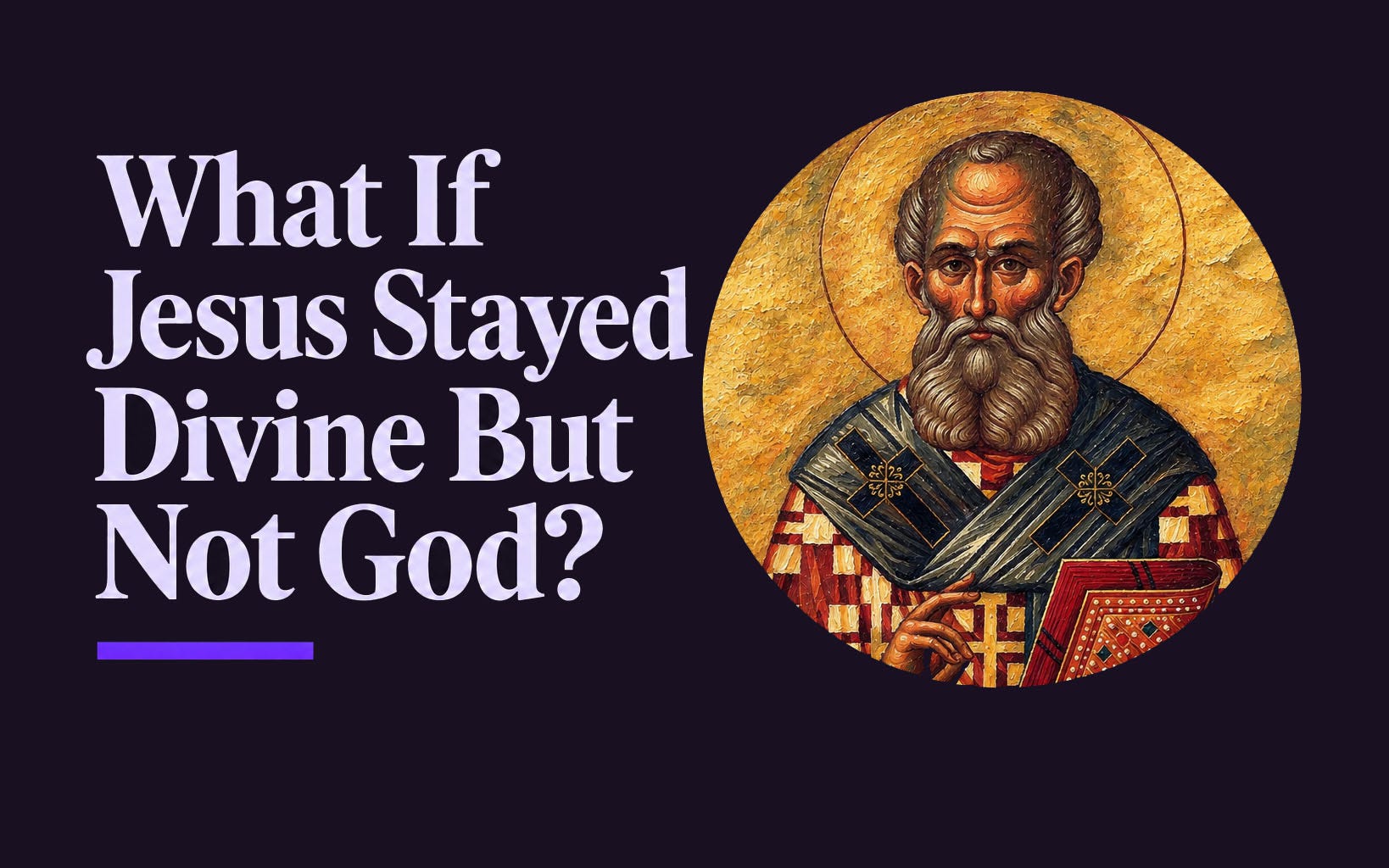
The doctors in Constantinople couldn’t name what was killing the emperor. Constantine had fallen ill after Easter in 337, and his household carried him to the hot springs near Helenopolis, his mother’s old city, where the water did nothing for him. Somewhere on that road, having worked out that he wouldn’t make it home, he ordered that he be taken to a villa outside Nicomedia and sent for the bishops. He was in his sixties yet unbaptized, a delay common among emperors of his day, who wanted their sins wiped out in one lump as late as possible, because, you know, God is a slave to his own rules, rendering him helpless against his subjects who cheated the system thanks to a loophole.
The bishop who answered the summons and poured the water over him was Eusebius of Nicomedia, the head of the church in the city where the emperor lay dying, and the most prominent supporter of Arius, an Alexandrian priest who taught that the Son of God was a created being and not eternal alongside the Father. Twelve years earlier, Constantine had called the Council of Nicaea to crush that teaching and tie the empire to a single creed, and Eusebius had been exiled for refusing to join in condemning Arius. The emperor who had enforced the Nicene Creed with the full weight of the state went to his grave cleansed of his sins by a bishop who rejected it.
Today’s exclusive content begins after the Sources and Further Reading section and gives an alternative timeline of events in a universe where Arianism won.
What Arius Taught
In the early fourth century, Arius, an Alexandrian priest, started teaching that the Father created the Son before time began, making him the first and greatest of God’s creations but a creation all the same, which meant there was a time when the Son didn’t exist. According to Athanasius, who was no neutral witness, Arius set the idea to catchy tunes for sailors, millers, and travelers, which suggests the Arian cause had better marketing than its reputation.
The Bible backed his position irrefutably.
Proverbs 8:22 in the Greek Old Testament has Wisdom saying the Lord created her at the start of his ways, and early Christians read Wisdom as Christ. Jesus says in John 14:28 that the Father is greater than he is, and in Mark 13:32 that even the Son doesn’t know the day of the end. The Trinity1 side had to read every one of these as a statement about Jesus’ human nature, which works fine until someone asks which nature was talking in Proverbs, centuries before Mary.
Arius wasn’t an outlier in his day, either. Christian writers for the first three centuries mostly ranked the Son below the Father, and nobody found that alarming until Alexandria’s bishop did around 318, which makes Nicaea the innovation and Arius the traditionalist. Nobody at the time called himself an Arian, for that matter. If anything, the label was an insult.
Councils the Church Wouldn’t Have Needed to Hold
Once the Son is declared equal to the Father, the next problem that arises, of course, is: how can one person be fully God and fully human at the same time? Answering that took the council at Chalcedon in 451, and the answer split the eastern church so badly that the Coptic, Armenian, and Syriac churches still aren’t in full communion with Rome or Constantinople over the wording. An Arian Jesus skips all of it. He’s a created being of enormous rank who took a body and obeyed the Father, so there’s no puzzle about two natures sharing one mind and no century of wording fights, riots, and exiles to fuel.
Athanasius’ best argument against Arius was that only God could save humanity, so a Jesus who was made could never do it, and that Arians committed idolatry by praying to a creature. The second charge landed, because Arians did pray to Jesus while insisting he was made. A church that won with Arian logic would have turned Jesus into the model of perfect obedience that believers are meant to copy, with salvation built on imitation and adoption instead of rescue by a divine person, and the medieval question of why God became man dissolves, since in this church he didn’t.
Chains of Command in Heaven and in Milan
A Son who ranks under the Father matches the Roman system of one supreme power and a delegate who carries out his will, and emperors noticed. Constantius treated doctrine as a department of his government, and the bishops at Rimini signed what the palace handed them. The Trinity side learned something different during its years of exile, which is that a church could say no to an emperor, and the lesson stuck.
In Milan in the 380s, Bishop Ambrose refused the teenage emperor’s mother, Justina, a church building for Arian worship, and his congregation camped inside the basilica to back him. In 390 he forced Theodosius into public penance for ordering a massacre in Thessalonica. Medieval popes had a model in that story, and anyone who prizes a church independent of the state has the Trinity party to thank for the first working example. An Arian victory leaves it unwritten, with bishops adjusting doctrine to the throne the way the crowd at Rimini did.
Clovis, the Goths, and Ravenna’s Arian Mosaics
The Goths became Christian in the fourth century through a missionary who translated the Bible into Gothic and preached the Arian creed. The Vandals, Burgundians, and Lombards followed, so when these peoples took over the western empire, kings and Roman subjects prayed in different churches under different clergy, and that wall kept the two populations apart for generations. Theodoric, the Gothic king of Italy, built Arian churches in Ravenna, and the mosaics in Sant’Apollinare Nuovo and the Arian Baptistery are still there to look at.
Then Clovis, king of the Franks, took Nicene baptism around 500, and the Roman bishops of Gaul backed him because he shared their faith. His kingdom became the base for Charlemagne three centuries later. With the Trinity lost, no Catholic king gets the Gallic bishops as allies against Arian rivals, because there are no Arian rivals to be allied against. The Emperor Justinian’s wars of the 530s against the Vandals and Ostrogoths, sold in Constantinople partly as a rescue of Nicene Christians from Arian kings, lose that pretext as well.
The Unholy Truth is a full-time job that’s burning cash at the moment, and paid subscribers are the only reason the research and writing get done. Upgrading keeps it going and opens the bonus section at the end of each post.
Son of God in the Hebrew Bible
Making Jesus God’s equal solved one problem and complicated Christian theology in every direction. If the Son had a beginning, he was a creature and Arius was right. If he never had one, the Father loses the one job his title describes, and the creed’s answer is that the Son was “begotten” from eternity, which asks readers to picture a son as old as his father.
The Bible never says God has only one son, either. In the Hebrew Bible the “sons of God” are members of his heavenly court, divine beings who present themselves before him in Job 1:6 and shout for joy at creation in Job 38:7. Psalm 82 has God standing in the divine assembly to judge the “gods,” whom he calls sons of the Most High, and Genesis 6 has sons of God marrying human women. The title also goes to Israel as a nation (Exodus 4:22) and to its kings (Psalm 2:7). Son of God was a job title in a crowded divine family long before it was a claim about substance, so Arius could read it as a high rank, while the Nicene side needed it to mean the one member of the Godhead who differs in kind from every other son in scripture.
In Gethsemane Jesus asks the Father to take the cup away and then submits his own will to the Father’s (Mark 14:36), which has God deferring to God. On the cross he cries out asking why God has abandoned him (Mark 15:34), which has God complaining to himself. When a man calls him “good teacher” in Mark 10:18, Jesus asks why he’s being called good when only God is, a line the Trinity side had to explain away as a test.
If Jesus is fully God and he died, then God died, and the church spent centuries working out how to say that without saying it, which ended with the claim that only his human half died.
The sacrifice question has no clean answer. For centuries a popular view held that the price was paid to the devil, until a fourth-century bishop pointed out how grotesque it was to say the devil was owed God as ransom. The alternative is that the payment went to the Father, which has God paying God to satisfy God, a debt moved from one pocket to the other.
The Arian Jesus escapes every one of these. A created Son who prays to a greater Father, obeys him, and dies for him raises no puzzle at all.
🔒 EXCLUSIVE: What would the world look like today if Nicaea failed? In the bonus breakdown below, we explore how an Arian Europe alters the rise of Islam, prevents the Crusades, and shifts modern Western individualism.
PAID SUBSCRIBER EXCLUSIVE
What If Nicaea Failed? The Arian Alternate Timeline
If the council of 325 had collapsed into a stalemate and Arianism had become the settled belief of the Mediterranean world, the change would have reached well beyond fine points of doctrine. It would reshape the Church’s institutional power, the nature of kingship, and the clashes that defined the second millennium.
Who Appoints the Bishops in an Arian Europe
In our timeline, the Nicene Creed handed the Church a weapon against…
Strictly speaking, Nicaea settled only the full godhood of the Son. The Trinity in its finished form, with the Holy Spirit as an equal third, came at Constantinople in 381, since the creed of 325 says only that Christians believe in the Spirit. I call Arius’ opponents the Trinity side throughout because the label is shorter than any accurate one, and the shorthand holds up, since the Son’s status was the issue everyone fought over.
Makes a lot of sense to me. Your description of the situation and the reasons for the responses are logical. I'm not sure the ensuing divide between Arab and Christian is quite that simple, since there were economic and societal factors at work, that, of course, are beyond this short essay.
Good structure. It will definitely help my research.
I would be interested in your response the to two comments so far. They seem pretty esoteric to me, but maybe not to you.
Tanner, I read this with growing disbelief, my eyebrows hitting the ceiling at how you managed to rewrite 2000 years of church history and theological development in one sweep.
Where the heck did you get all this?
Let me just take on a few things:
Constantine could not be baptised and stay as the head of the army given ecclesiastical conclusions at the time.
What Christians believed the feminine Wisdom in Proverbs was Christ?
Athanasius refuted Arianism using ὁμοούσιον as the basis of his argument, not topics around atonement
And that’s just a start
What were you smoking when you wrote this?