


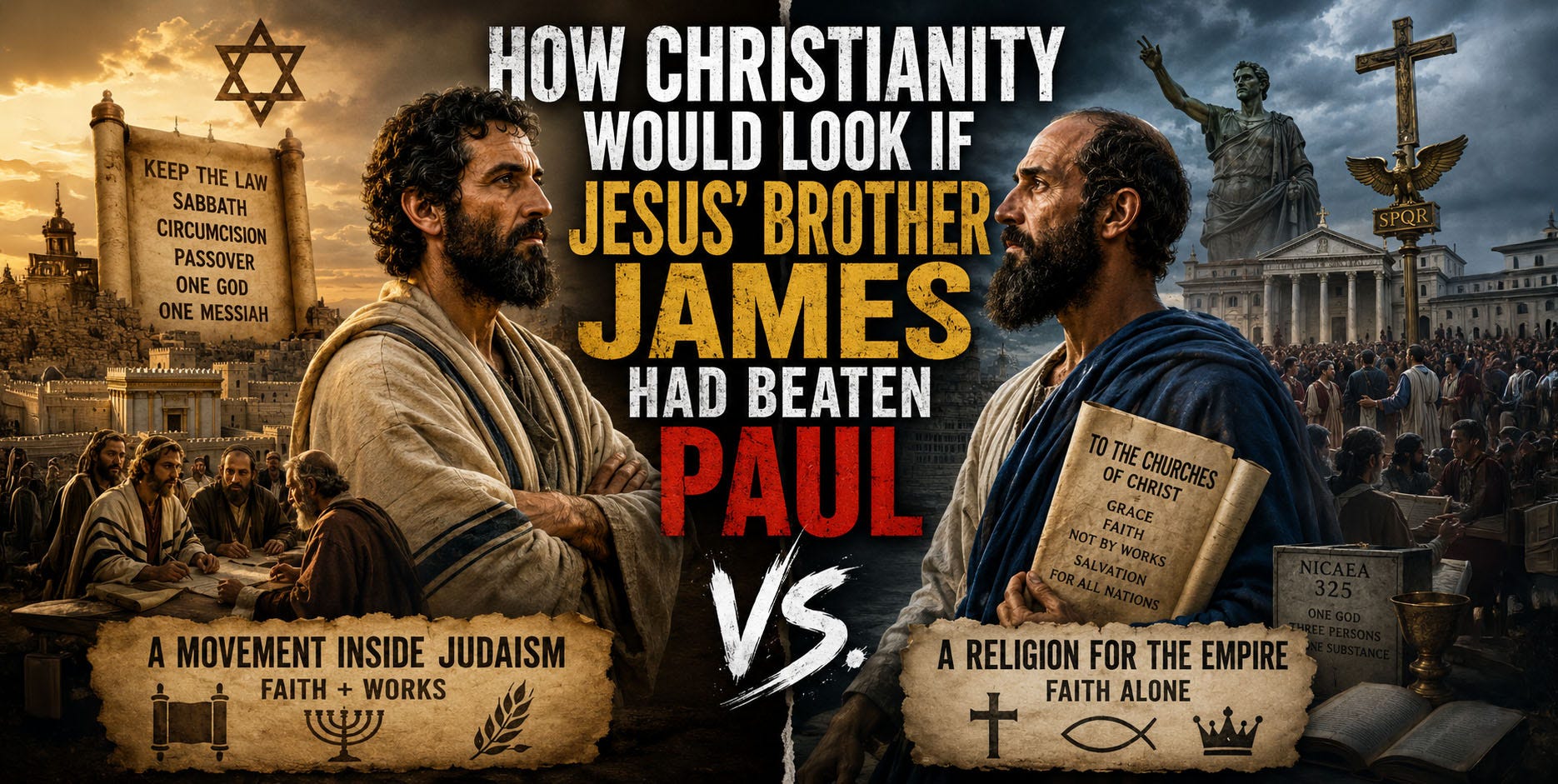
There’s a fight at the heart of the New Testament that most Christians never hear about, and the people who do hear about it usually get a sanitized version where the two sides reconcile by Acts 15. But according to the Bible itself the fight was real, it was bitter, and the loser was Jesus’ own brother.
James, called “the brother of the Lord” by Paul himself in Galatians 1:19, ran the Jerusalem church after Jesus died. He was seen as the natural leader of the movement after Jesus was gone. He’d known Jesus since they were both kids in Nazareth. He prayed in the Temple, kept kosher, observed the Sabbath, and expected every follower of Jesus to do the same. Paul, who never met Jesus, who persecuted the movement before joining it, who built his theology on a vision he had on a road, showed up in Jerusalem and told James that Gentile converts didn’t need any of that.
Paul won, not in his lifetime but three centuries later, when Constantine needed a state religion that worked across an empire of pork-eating Greeks and Romans. James lost so completely that most modern Christians don’t even know he existed, and the ones who do are told he was a cousin or a stepbrother or anything except what Paul plainly called him.
So let’s run the counterfactual. What if James had won? What if the Jerusalem church had kept its authority, kept its hold on doctrine, and Paul’s letters had been shelved as the rantings of a maverick who never got Peter’s seal of approval? What would the religion called Christianity look like in 2026?
A Movement Inside Judaism, Not Against It
James didn’t think he was founding a new religion, and neither did Peter, John, or any of the other people who’d known Jesus. They thought they were Jews who’d recognized the Messiah, and they expected other Jews to recognize him too. The Book of Acts, even after centuries of editing, still preserves scenes where the Jerusalem leadership goes to the Temple to pray. Acts 21 has James telling Paul to prove he’s still a good Jew by sponsoring a Temple sacrifice, and Paul agrees, performs the ritual, and gets arrested anyway.
In a James-wins world, that scene isn’t an embarrassment to be explained away, but the template. The movement remains within Judaism, and followers of Jesus attend synagogue on Saturday, observe Passover, circumcise their sons, and keep the dietary laws. The break with Judaism that defined the second and third centuries never happens, because there’s nothing to break from. You have a Jewish sect, the way the Pharisees and Sadducees were Jewish sects, that holds Jesus was the Messiah and is waiting for him to come back.
Some of this happened, and the Ebionites are the evidence. Their survival for four centuries after Paul’s death was a small loss for the Pauline side, a piece of the original Jewish-Christian movement that refused to die on schedule.
The Ebionites were Jewish Christians who survived into the fourth and fifth centuries, hated Paul, considered him an apostate, and held that Jesus was a human prophet who fulfilled the Law rather than abolishing it. Bart Ehrman has written about them at length, and the early heresiologists like Epiphanius spent a lot of energy denouncing them, which tells you they were still around and still a threat. In the James-wins scenario, the Ebionites aren’t a surviving remnant on the margins, they’re the mainstream, and the Pauline Gentile churches are the heresy.
No Virgin Birth, No Trinity, No Incarnation
Without Paul there is no theology that became Christian orthodoxy. Paul gave you the cosmic Christ, the pre-existent divine being who emptied himself and took human form, and if you read Philippians 2 you can see the theology Nicaea would formalize three hundred years later already in seed form. The Gospel of John, written decades after Paul and steeped in his categories, gave you “the Word was God” and the incarnation framed in Greek philosophical terms.
James didn’t think any of that. The Letter of James, whether you think the brother of Jesus wrote it or someone speaking in his name did, mentions Jesus exactly twice in the whole letter. It’s a sermon on practical ethics, on the dangers of wealth, on the necessity of works alongside faith, and Jesus barely comes up. Compare that to any Pauline letter, where Christ is the subject, the object, the means, and the end of every other sentence.
In a James-wins Christianity, Jesus is the Messiah and not God. He’s a human being chosen by God, possibly adopted at his baptism, possibly designated from birth, but not a second person of a trinity that nobody in first-century Palestine understands. The virgin birth stories in Matthew and Luke never enter the canon, because they’re built on a mistranslation of Isaiah 7:14 where the Hebrew “almah” meaning young woman got rendered as the Greek “parthenos” meaning virgin in the Septuagint. Jewish Christians reading their own scriptures don’t make that mistake. They know Isaiah was talking about a young woman in his own time and not predicting anything seven hundred years out.
The Trinity doesn’t exist. There’s God the Father, who’s the God of Abraham, Isaac, and Jacob, and there’s Jesus, his Messiah and prophet. The Holy Spirit is what it was in the Hebrew Bible, God’s presence and power, not a separate person. The councils of Nicaea and Chalcedon, where bishops argued about the relationship between the Father and the Son and got people exiled or killed over points of Greek grammar, none of that happens because there’s nothing to argue about.
The Law Stays
Paul’s central innovation, the one that made Gentile Christianity possible, was the argument that the Law of Moses had been superseded: justification by faith and not by works of the Law, Christ as the end of the Law for everyone who believes. Read Galatians and you can feel Paul straining to make this argument against opponents who were winning the rhetorical battle on the ground. He calls them “false brothers” and accuses them of preaching a different gospel, and those “false brothers” were James’ people.
In a James-wins world, the Law stays. Gentile converts become full Jews who get circumcised, keep kosher, and observe the Sabbath. The theological apparatus Paul built to argue that none of that was necessary gets forgotten, because nobody needed it.
This change cascades through everything. The dietary laws become Christian dietary laws, which means no Christmas ham, no Easter bacon, no shellfish at the church potluck. Sunday isn’t the Christian day of worship, because Sabbath observance means Saturday, and the move to Sunday in the second century was partly an anti-Jewish gesture and partly an accommodation to Roman pagans who already kept that day for the sun god. James’ followers keep Saturday.
Circumcision stays a requirement, and that alone stunts the spread of the movement. Adult Gentile men in the Greco-Roman world were not lining up to get circumcised, which is why Paul’s no-circumcision policy worked so well as a recruiting tool. Without it, the religion grows slowly, mostly through Jewish communities in the diaspora, and stays small.
No Easter as You Know It
The death and resurrection of Jesus is at the center of Pauline Christianity. “If Christ has not been raised, your faith is in vain,” Paul says in 1 Corinthians 15, and the entire structure of salvation rests on the resurrection as a cosmic event that defeats death and reconciles humanity to God.
James’ Christianity includes the resurrection, since Paul says James saw the risen Jesus and the Jerusalem community believed Jesus had been vindicated by God. But the theology around it is different. The resurrection isn’t a cosmic atonement transaction, it’s God’s vindication of his Messiah, a sign that this man was who he claimed to be, and a promise that he’ll come back to set things right.
The atonement theology, the idea that Jesus’ death paid for human sin, is largely Paul. James’ letter doesn’t mention it, the Sermon on the Mount doesn’t mention it, and the synoptic gospels mention it in a few places that are later editorial insertions designed to bring the Jesus tradition in line with Pauline theology after the fact. In James’ Christianity, Jesus dies as a martyr, the way prophets often died, and God raises him to vindicate him. His death doesn’t pay for anyone’s sins, and people still have to repent, keep the Law, and do good works, the same way Judaism has always handled the problem of sin.
Easter gets folded into Passover. The Last Supper was a Passover meal and Jesus died during Passover, so the story makes sense as a Passover story, with Jesus as a kind of paschal figure whose death and vindication happen during the Jewish festival of liberation. You don’t get a separate Christian holiday with bunnies and eggs, both of which came in from pagan European spring festivals once the religion had moved far enough from its Jewish roots to take on that material without anyone noticing.
A Much Smaller Religion
James’ Christianity is tiny, and barely exists at all today.
Paul’s gift, which I mean in the same sense as the gift of a man who can sell anything to anyone, was figuring out how to make a Jewish messianic movement palatable to non-Jews. Drop the circumcision, drop the dietary laws, drop the Sabbath observance, and reframe everything in categories Greeks and Romans already understood, with a dying-and-rising god, a mystery religion structure, sacramental meals, and a cosmic redemption myth. Suddenly you’ve got something that can compete with the cult of Isis, with Mithraism, with the imperial cult itself, and it has the advantage of an exclusive truth claim that the others don’t.
Without that, the Jesus movement stays a Jewish sect and gets caught up in the catastrophes of Jewish history. The destruction of the Temple in 70 CE devastates the Jerusalem church, though James himself was already dead by then, stoned to death around 62 CE on the orders of the High Priest Ananus, an event Josephus records and that even the heavily edited Christian sources couldn’t fully suppress. The Bar Kokhba revolt in 132-135 CE wipes out most of the remaining Jewish Christian communities in Palestine, and the diaspora communities, cut off from the homeland, get reabsorbed into mainstream Judaism over the next few centuries, the way most messianic Jewish movements do.
A small Jewish Christian community survives somewhere today, a few thousand people, who hold that Jesus was the Messiah and are still waiting for him to return. They’re a curiosity, like the Samaritans or the Mandaeans, a tiny religious community most people have never heard of. Two billion Christians worldwide? That number requires Paul.
No Christendom, no Constantine
Without a Christianity that could take over the Roman Empire, the history of the West gets rewritten. Constantine doesn’t convert, because there’s nothing to convert to that would offer him political utility. The Roman Empire stays officially pagan into the fifth century and then gets converted by something else, possibly a more militant form of Mithraism, possibly an early version of what would later become Manichaeism, possibly nothing at all before the Germanic invasions break the western empire apart.
No Christendom means no Christian Middle Ages and no Crusades. The relationship between Europe and Islam plays out on entirely different terms, because Islam itself emerges in a world without a Christian Byzantium to push against and a Christian Latin West to oppose it. Muhammad in the seventh century is reacting to a world where Arabian Jews are a major presence, where Christianity exists as a small Jewish sect in Palestine and Mesopotamia, where religion in late antiquity looks unrecognizable.
The Reformation doesn’t happen because there’s no Catholic Church to reform, the Wars of Religion don’t happen, and the divide between secular and religious that shaped the modern West, with the Enlightenment defining itself against Christian orthodoxy, gets replaced by something we can’t guess at, because the orthodoxy the Enlightenment fought against was built on Pauline foundations.
The United States doesn’t get founded by Puritans fleeing the Church of England, because the Church of England isn’t a thing. It gets founded by Jews fleeing pogroms, or by some other religious minority entirely, or it stays a Spanish or French colony that wins independence and becomes a Catholic country in the way Mexico did.
Christian Nationalism in 2026 America isn’t a force in politics because there’s no Christianity to be nationalist about in the form we have it. The evangelical Protestant political machine, which depends on Pauline soteriology and a specific reading of Romans about government authority, has no foundation to stand on.
How About Women?
One area where the James-wins world is worse is the position of women. Paul’s letters contain some of the most misogynistic passages in the New Testament, the ones about women keeping silent in church and submitting to their husbands and not having authority over men. This is also thanks to forged letters of Paul that ended up in the Bible.
But Paul also wrote Galatians 3:28, which is undisputed for ownership, where there’s no male or female in Christ, and he names women as coworkers and apostles in his ministry, and the misogynist passages are later forgeries inserted into Paul’s letters to bring them in line with developing church patriarchy.
James’ Christianity, embedded inside Second Temple Judaism, is patriarchal in the way Second Temple Judaism was patriarchal. Women have a defined role in the household, in religious observance, in the rituals of the Sabbath and the festivals, and they don’t preach or teach. The slow expansion of women’s roles in some Pauline communities, the deaconesses and prophetesses you can see in the early second century, never happens.
Slavery is another mixed case. Paul tells slaves to obey their masters and he sends Onesimus back to Philemon, which Christians have used to justify slavery for two thousand years, but Paul also frames the relationship in ways that destabilize it later. James doesn’t take up the issue at all. Greco-Roman slavery in the James-wins world continues without any Christian critique, because there are no Christian institutions in Greco-Roman society to do the critiquing.
A Religion of Works, Not Faith
The deepest theological shift between James and Paul is on faith and works. Paul: “a person is justified by faith apart from the works of the law” (Romans 3:28). James: “a person is justified by works and not by faith alone” (James 2:24). Luther noticed this contradiction and tried to throw the Letter of James out of the canon, calling it “an epistle of straw,” and he didn’t get his way but he was right about the contradiction. The two are not saying the same thing.
In a James-wins Christianity, you’re saved by what you do. You feed the hungry, you clothe the naked, you visit the sick, you care for the widows and orphans, you keep the Law, you repent when you fail, because faith without works is dead. This is what Jesus taught in the synoptic gospels, in the parable of the sheep and the goats in Matthew 25, where the criterion for salvation is what you did for the hungry and the prisoner and the stranger, not what you believed but what you did.
The evangelical Protestant emphasis on faith alone, on being saved by accepting Jesus as your personal Lord and Savior, on the moment of conversion as the thing that matters more than the life that follows, none of that exists. James’ religion is a religion of practice, and you live it or you don’t. Saying the right words about Jesus while ignoring the poor doesn’t save you, it damns you.
This is the shift that matters most for a reader today. The American evangelical movement, which produces megachurches full of people who think a sinner’s prayer in 1987 covers them for life regardless of how they treat their employees or vote on healthcare policy, doesn’t exist, and the prosperity gospel industry, where Joel Osteen tells you God wants you to be rich, doesn’t exist either. The Christianity that survived is one where you’d better be doing something with your life rather than reciting the right phrase.
There Is No Islam
The biggest casualty of a James-wins world isn’t Christianity, it’s Islam, which doesn’t exist at all.
Muhammad in seventh-century Arabia was responding to a specific religious environment that included Arabian Jews, Arabian Christians, and the dominant Christian empires pressing on Arabia from the north and west. Byzantine Christianity to the northwest, Ethiopian Christianity to the south, Syriac Christianity in the trading networks that ran through Mecca and Medina. Muhammad’s Qur’an argues with these Christians constantly. The Trinity gets rejected by name, the divinity of Jesus gets rejected, the crucifixion gets rejected, Mary gets defended against charges Muhammad heard Christians making against her, and the Christological doctrines that Nicaea and Chalcedon built get taken apart.
Take Paul out of the equation and none of those arguments need to happen, because none of those doctrines exist for Muhammad to argue against. There’s no Trinity to reject, no divine Christ to deny, no crucifixion-as-atonement to replace with the reading the Qur’an gives, where Jesus only appears to die. Everything Islam pushes against in its founding documents is Pauline, and without Paul, it’s gone.
Muhammad in a James-wins world is reacting to a small Jewish Christian sect that held Jesus was the human Messiah, kept the Law, and was waiting for him to return. That’s not a theology you need to launch a new prophetic movement against, it’s a theology close to what Muhammad himself was preaching. Strict monotheism, no incarnation, no Trinity, salvation through submission to God and obedience to his law, prophets as human messengers rather than divine beings. The Jewish-Christian Ebionites and the early Muslim community would have had more in common with each other than either had with Pauline Christianity.
Patricia Crone and Michael Cook argued in the 1970s that early Islam emerged out of contact with surviving Jewish-Christian groups in the Arabian peninsula. Their specific claims got heavily criticized, but the observation that Muhammad’s environment included Jewish Christians who held positions close to early Islamic ones has held up. Fred Donner’s more recent work on the early “Believers’ movement” describes a community that included Jews, Christians, and Muhammad’s followers under a loose monotheistic umbrella, with the hard sectarian boundaries coming later.
In a James-wins world, that movement is all there is. Muhammad still emerges as a prophetic figure in seventh-century Arabia, since the conditions that produced him don’t depend on Paul. The political fragmentation of the peninsula, the trade routes, the Byzantine-Sasanian wars, all of that happens regardless. But what he preaches looks different, because what he’s correcting looks different. The Qur’an’s anti-Trinitarian polemic disappears, because there’s no Trinity. The insistence on Jesus as a human prophet who didn’t die on the cross becomes pointless, because the Jewish Christians of his world already believe Jesus was a human prophet, and the cross has nowhere near the doctrinal load it carries in Pauline Christianity. Muhammad still gets a revelation, still founds a community, still spreads a message of strict monotheism and submission to God, but his message is a reform of existing Jewish Christianity rather than a replacement for it.
He may never separate at all. The early followers of Muhammad get received as another Jewish-Christian sect, one more variation on a theme that already has room for variations. The split between Islam and Christianity that defined fourteen centuries doesn’t happen, because there’s no Pauline Christianity for Islam to break from. The two billion Christians and two billion Muslims who divide the world’s religious population today don’t exist as separate categories. Whatever exists looks more like a family of related monotheisms rooted in the Hebrew Bible, with different emphases and prophets but a shared baseline.
The Arab conquests still happen. Politics and economics drive those, not theology. But what spreads with them isn’t a religion built on rejecting the divinity of Christ, because nobody made Christ divine. The expansion of Arab power across North Africa and into Spain doesn’t carry the same religious cargo. The Reconquista doesn’t happen because there’s nothing to reconquer in religious terms. The Crusades don’t happen. Jerusalem doesn’t become the contested holy city of three competing faiths fighting over which one God really chose, because those faiths don’t exist in the form we got them. The religious history of the Mediterranean, North Africa, the Middle East, and South Asia gets rewritten, because the two religions doing the writing don’t exist as such.
This is the part of the counterfactual that matters most for the world we’re living in. Take Paul out and you don’t just lose Christmas and Easter, you lose the medieval and early modern struggle between Christendom and Islam, the religious shape of European colonial expansion, the Ottoman wars, and the long aftermath that still drives political conflict from Israel-Palestine to the Balkans to the war on terror. Paul didn’t intend any of that. His theology made it possible. James’ theology doesn’t.
This publication runs on your support. If you’re not yet a paid subscriber and you find value in what you read here, consider joining to help keep The Unholy Truth alive and independent.
The Winner v. The Loser
The version of Christianity that became the dominant religion of Europe and then of the world is one outcome of one history. It’s not the only version that could have existed, and it’s not the version Jesus’ own brother believed in. James thought his brother was a Jewish Messiah who’d come to fulfill the Law, Paul thought his Christ was a cosmic being who’d come to end the Law, and those aren’t compatible visions. One of them won.
If you’re a Christian reading this, you’re a Pauline Christian. The Trinity, the incarnation, the atonement, the resurrection as cosmic event, the gospel as good news for all nations, the structure of what you call your faith, all of it comes from Paul. James lost, and his brother Jesus, whatever he taught in the dusty villages of Galilee, lost too, because the religion that bears his name in 2026 has very little to do with what he or his brother believed.
Christians spend a lot of energy not thinking about that.
Sources and Further Reading
Bart D. Ehrman, Lost Christianities: The Battles for Scripture and the Faiths We Never Knew (Oxford University Press, 2003)
James D. Tabor, The Jesus Dynasty: The Hidden History of Jesus, His Royal Family, and the Birth of Christianity (Simon & Schuster, 2006)
Robert Eisenman, James the Brother of Jesus: The Key to Unlocking the Secrets of Early Christianity and the Dead Sea Scrolls (Viking, 1997)
Paula Fredriksen, Paul: The Pagans’ Apostle (Yale University Press, 2017)
Geza Vermes, The Changing Faces of Jesus (Penguin, 2000)
Fred M. Donner, Muhammad and the Believers: At the Origins of Islam (Belknap/Harvard, 2010)
Patricia Crone and Michael Cook, Hagarism: The Making of the Islamic World (Cambridge University Press, 1977)
nice well written
Thanks much for this, it is a topic that I have given a lot of thought to of late.
Regarding the Jamesian attitude towards the resurrection, looking at the Ebionites, there doesn't seem to be any single agreed upon belief, which is not surprising as we only know of the Ebionites from their detractors. That Jesus appeared to the apostles in visions seems the most likely to me.
I also wonder whether someone like Paul was bound to come along regardless, or was he a completely unique individual, and no other person could take his place. Certainly just pure speculation at this point.