


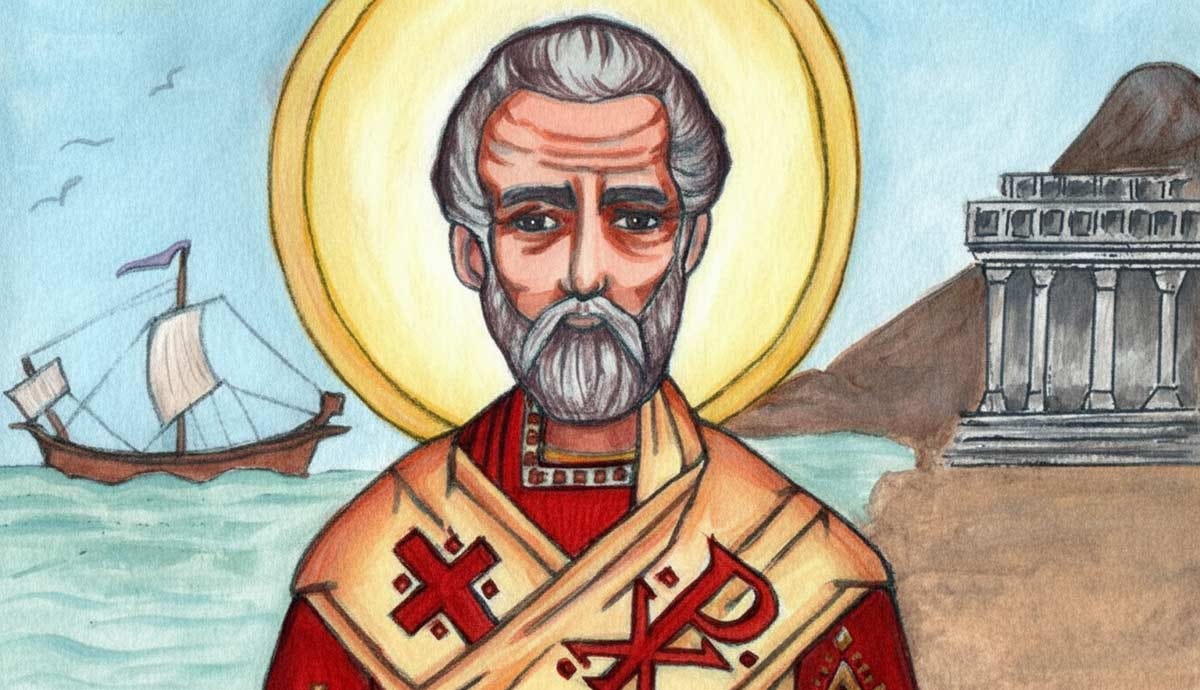
Around the year 144, a wealthy shipowner from Sinope stood before the presbyters of the Roman church and laid out a reading of the faith so radical that they expelled him and handed back the enormous donation he’d made when he first arrived. His name was Marcion, and he’d just assembled the first Christian Bible anyone had ever seen. The church threw him out, argued with him for the better part of two centuries, and eventually built its own canon largely in reaction to his. Most Christians today have never heard his name, which is its own kind of win for the people who beat him.
Marcion’s idea was simple as well as devastating. He read Paul, really read him, and decided the God Paul preached, the God of grace and the crucified Christ, couldn’t be the same deity who drowned the world in Genesis, hardened Pharaoh’s heart so he could punish him for it, and ordered the slaughter of Amalekite infants in 1 Samuel 15. So there had to be two Gods. The lower one, the Demiurge, made the material world and handed Israel its Law. The higher one, a stranger God of pure love who’d never once been named in Jewish scripture, sent Jesus to rescue humanity from the Creator’s botched handiwork.
The church that survived called this the worst heresy of the age.
And as always, don’t just read this in your inbox and leave me in the void. Like it, comment, criticize it, help shape The Unholy Truth.
The Bible Becomes a Short Book About Paul
Marcion’s Bible came in two parts, the Evangelion and the Apostolikon, and that was the whole thing. The Evangelion was a version of what we’d call the Gospel of Luke, stripped of the birth narrative and the Jewish framing. The Apostolikon was ten letters of Paul, also edited. No Matthew, no Mark, no John, no Acts, no Revelation, no Hebrew Bible bound in front of it as an Old Testament. The Jewish scriptures stayed real to Marcion, he just thought they belonged to the other God and had nothing to teach a Christian about salvation.
In a Marcion-wins world, that’s the Bible. Christians in 2026 grow up with a sacred text you could read in an afternoon, centered entirely on Paul and a single gospel that reads like Paul’s theology turned into narrative. There’s no Genesis, no Exodus, no Psalms, no prophets. A Christian child never hears about Noah’s ark, never colors in a picture of David and Goliath, never learns the Ten Commandments as a religious obligation, because the Law came from a God this religion exists to escape.
The whole architecture of Christian reading changes. The actual church spent centuries developing typology, the practice of reading the Hebrew Bible as a coded forecast of Christ, where Isaac carrying the wood for his own sacrifice prefigures Jesus carrying the cross, where the Passover lamb points forward to Calvary. None of that exists for Marcion. There’s nothing to prefigure anything, because the old book belongs to a different deity and the connection orthodoxy worked so hard to build is exactly the connection Marcion denied. Christian art loses half its subject matter. The Sistine Chapel ceiling, if it gets painted at all, has no Creation of Adam, because the creation of Adam was the Demiurge’s work and no Christian would put it on a church.
Two Gods, and the Good One Is a Stranger
The center of Marcion’s theology is the split between the Creator and the Father. The God of the Hebrew Bible is real, powerful, and just, in the narrow legal sense of handing out exactly what the Law prescribes. He made the world, and the world is a mess of disease, decay, and death, which tells you something about the workman. Marcion called him the Demiurge, the craftsman, and he didn’t hate him so much as refuse to worship him. Above and beyond this Creator sat a God nobody had ever heard of, with no claim on humanity, no covenant, no history of demanding anything, who acted out of nothing but mercy when he sent Jesus to buy people out of the Creator’s jurisdiction.
This is the part modern Christians would find hardest to recognize as Christianity at all. The faith we inherited insists, hard, on a single God who creates and redeems, whose justice and mercy are the same attribute seen from different angles, and who runs history as one continuous story from Eden to the New Jerusalem. Marcion tears that in half. Salvation stops being the rescue of God’s own creation and becomes a jailbreak, the loving God smuggling souls out of a cosmos that was never his to begin with.
Run that forward and the emotional tone of the whole religion shifts. There’s no “God has a plan” in the Marcionite world, because the God who runs the plan is the one you’re escaping. Suffering doesn’t get explained as discipline or testing or mysterious providence, since the suffering is just the nature of a badly made world, and the good God’s only involvement is the exit he offers. You lose the entire tradition of theodicy, the centuries Augustine and Aquinas and Leibniz spent trying to square a good Creator with a world full of horror, because Marcion answered that question before it was asked. The world is full of horror because the Creator wasn’t good. Next question.
No Incarnation, No Real Body
Marcion’s Jesus didn’t get born. A divine being from the higher God doesn’t pass through the Demiurge’s reproductive machinery, doesn’t spend nine months assembled out of the Creator’s matter, doesn’t enter the world as a screaming infant covered in the stuff of a fallen cosmos. Marcion’s Christ appeared, fully grown, in the synagogue at Capernaum in the fifteenth year of Tiberius, looking human but not made of human flesh. This is the position later called Docetism, from the Greek for “to seem,” and it solved a problem Marcion cared about a great deal. If matter is the Creator’s corrupt product, the redeemer can’t be made of it.
A Marcion-wins Christianity has no Christmas. There’s no manger, no shepherds, no wise men, no star, no Virgin Mary, because there’s no birth to celebrate and no mother to venerate. The entire Marian tradition, the prayers, the apparitions, the cathedrals named for Our Lady, the rosary, the dogmas of the Immaculate Conception and the Assumption, never comes into being. Christianity loses its central female figure completely, which has consequences I’ll come back to.
The crucifixion stays, but it means something different. Marcion’s Christ suffered and died, or appeared to, and that death was the price paid to the Creator to release the souls under his Law. The body that hung on the cross was real enough to die yet not the redeemer’s own native substance. You don’t get the doctrine that would later anchor everything, the insistence that God became fully human, that the Word was made flesh and dwelt among us, that Jesus was true God and true man in one person. The councils of Nicaea, Ephesus, and Chalcedon spent three centuries hammering out exactly how the divine and human natures fit together in Christ, and got people exiled and killed over the grammar of it. In a Marcionite world there’s nothing to hammer out. Christ was divine and only looked human, and the long, bloody argument about his two natures never happens.
The Law Is the Enemy, Not the Foundation
Paul wrestled with the Jewish Law. He called it holy and good in Romans and then spent chapters explaining why it couldn’t save anyone, and the tension in his letters comes from a man trying to honor a tradition he’s also leaving. Marcion cut the tension by cutting the respect. The Law wasn’t a holy thing that Christ fulfilled or transcended, it was the Creator’s instrument of control, and the good God’s whole intervention was aimed at freeing people from it. Where Paul agonized, Marcion just rejected.
This produces a Christianity defined against Judaism in the sharpest possible terms, and here the counterfactual turns dark. The historical church carried plenty of its own anti-Judaism, the centuries of “the Jews killed Christ,” the ghettos, the expulsions, the pogroms. A Marcionite church would have all of that built into its theology at the foundation, because in Marcion’s system the Jewish God is literally a lesser, harsher deity and Jewish scripture is the record of the wrong God’s dealings. There’s no Romans 11, where Paul insists the Jews remain beloved and the covenant unbroken, because there’s no shared God to keep a covenant with.
But the picture has a strange flip side. A church with no Old Testament also has no Leviticus, which means the handful of verses Christians have used for two thousand years to condemn homosexuality, the dietary anxieties, the purity codes, the death-penalty lists, none of it is scripture. A Marcionite Christian has no biblical basis for stoning anyone, because the book that prescribes stoning belongs to the rejected God. The modern culture-war Bible, the one quoted in legislatures to justify this prohibition or that one, mostly doesn’t exist, because most of those prohibitions live in the Law that Marcion threw out. You’d trade one set of theological poisons for another rather than escaping poison altogether.
A Religion You Can’t Build an Empire On
Marcion was a hard-line ascetic. If the material world is the Creator’s flawed product and the body is made of his corrupt matter, then the spiritual move is to use as little of it as possible. Marcionite Christians didn’t marry, didn’t have children, didn’t eat meat, and fasted often, because reproduction just manufactures more prisoners for the Demiurge and indulging the body honors the wrong God. This wasn’t a counsel for the especially holy. It was the baseline expectation.
A religion that tells its members not to reproduce has a math problem. The historical church grew partly by conversion and partly by Christian families raising Christian children across generations, and Marcion’s rules cut the second engine entirely. His movement spread fast in the second century, fast enough that Justin Martyr complained it had reached the whole human race, but a faith that depends entirely on adult conversion and forbids its converts from having kids is structurally fragile. Every generation has to be rebuilt from scratch.
So the Marcion-wins scenario contains a paradox. For his theology to win, the ascetic rules would’ve had to soften, the same way every world-denying movement eventually makes its peace with marriage and children when it wants to last. A Marcionite church that survived to 2026 is one that quietly abandoned Marcion’s sexual ethics somewhere along the way, kept the two Gods and the short Bible, and let people marry so there’d be a next generation to inherit it. Which tells you something about why the actual church beat him. Orthodoxy embraced creation, marriage, and childbirth as good things made by a good God, and a religion that blesses families outbreeds a religion that discourages them every single time.
The Reformation Eats Itself
The man who rediscovered him was Martin Luther. Luther’s whole theology runs on the contrast between Law and Gospel, between the terrifying God of judgment and the merciful God of grace, between salvation by works and salvation by faith alone. He got there straight out of Paul, the same Paul Marcion read, and Luther’s instinct to set grace violently against Law is Marcion’s instinct without the second God attached.
In a world where Marcion already won, there’s no Reformation, because there’s no Catholic Church built on the synthesis Luther was reacting against. The whole medieval structure, the sacramental system, the merit theology, the penances and indulgences, was built on the assumption Marcion denied, that the Creator and the Redeemer are one God whose Law and grace work together. Pull that assumption out at the root in the second century and the thing Luther protested against never gets built, so the protest never happens.
What you get instead is a Christianity that was already, from the start, what Luther only wished he could make Christianity into. Grace with no Law underneath it. Faith with no works tradition to fight against. A gospel of pure rescue, unencumbered by the Jewish inheritance that Paul couldn’t quite let go of and that the church spent centuries integrating. The Enlightenment, when it comes, has nothing like the same target, because the orthodoxy it sharpened itself against, the unified Creator-God of natural law and ordered cosmos, was the thing Marcion’s church abandoned in the cradle.
What Happens to Islam
The James-wins counterfactual erased Islam by removing the doctrines Muhammad argued against. Marcion does something subtler and worse. He makes the argument sharper.
Muhammad’s Qur’an attacks Christian claims that compromise strict monotheism, above all the Trinity and the divine sonship of Jesus, and it does this while holding the Hebrew prophetic tradition in the highest regard. Abraham, Moses, and the God who spoke to them are central to the Qur’an, which presents Islam as the restoration of the original monotheism of those very prophets. A Marcionite Christianity hands Muhammad the easiest target in religious history. A faith with two Gods, one of them explicitly the God of Abraham and Moses recast as a lesser deity, is everything Islamic monotheism exists to refute, and the refutation barely needs an argument. You worship the wrong number of Gods and you’ve insulted the prophets. Done.
But the deeper effect runs through the shared scripture. Islam treats the Torah and the Psalms as genuine revelation, given to Moses and David, later distorted by human hands but real at the source. That assumption only works in a world where Christians and Jews already treat those books as scripture from the one true God, the world the historical church created by binding the Hebrew Bible into the Christian one as the Old Testament. A Marcionite Christianity that threw the Hebrew scriptures out entirely breaks the chain Islam later assumed. Muhammad’s whole model of successive revelation to a line of prophets culminating in himself depends on those earlier books being real revelation, and a dominant Christianity that called them the work of a rejected God would’ve poisoned that ground centuries early.
So Islam in a Marcionite world, if it emerges at all, emerges into a religious environment with no shared Abrahamic scripture to claim and restore, facing a Christianity that’s its theological opposite at every point rather than a near cousin it can argue is corrupt. The polemic gets easier and the common ground vanishes. Whatever Muhammad preaches, he’s not completing a tradition the dominant Christianity shares, he’s standing against a religion that denies the prophets he reveres. The family resemblance that let Islam present itself as the original faith restored is gone, replaced by a confrontation with no middle term.
If you’re not already a paid subscriber and you’re finding value here, I’d love for you to consider becoming one to keep The Unholy Truth alive.
The God Who Made the World Is the One You’re Running From
Orthodox Christianity, the one that won, says creation is good, the body is good, marriage is good, and the same God who made all of it is the God who saves it, and history is the story of that God redeeming his own handiwork. It’s a religion that can bless a harvest, consecrate a marriage, build a hospital, and call the material world a gift, because it believes the Maker and the Redeemer are one and the same and that matter was never the problem.
Marcion’s religion can’t do any of that without contradiction. The world is a prison, the body is the prison’s brickwork, the God who built it is not the God who loves you, and the most spiritual thing you can do is want out. A civilization built on that premise doesn’t produce the Christian humanism that fed the Renaissance, doesn’t easily develop the theology of natural law that shaped Western jurisprudence, doesn’t celebrate the goodness of creation that runs from the Psalms through Aquinas to the modern hymn. It produces something colder and more otherworldly, a faith permanently at odds with the cosmos it finds itself in.
The church fathers who fought Marcion understood the stakes better than they’re usually given credit for. Irenaeus, writing around 180, defended the unity of God and the goodness of creation against him with an intensity that only makes sense if he saw what was at risk. What they were defending was the idea that the world is worth saving and the God who made it is worth loving, and that the matter we’re made of isn’t a mistake. Marcion offered a cleaner, more logical religion, a God with no blood on his hands, a Christ untainted by flesh, a salvation that solves the problem of evil by blaming it on a different deity. Christianity looked at that clean, logical, world-hating system and chose the messier God who made the world and called it good.
If Marcion had won, the religion would make more internal sense and offer far less to live for.
Sources and Further Reading
Bart D. Ehrman, Lost Christianities: The Battles for Scripture and the Faiths We Never Knew (Oxford University Press, 2003)
Judith M. Lieu, Marcion and the Making of a Heretic: God and Scripture in the Second Century (Cambridge University Press, 2015)
R. Joseph Hoffmann, Marcion: On the Restitution of Christianity (Scholars Press, 1984)
Adolf von Harnack, Marcion: The Gospel of the Alien God (1921; English translation, Labyrinth Press, 1990)
Irenaeus of Lyons, Against Heresies (c. 180 CE)
Tertullian, Against Marcion (c. 207 CE)
Heikki Räisänen, The Rise of Christian Beliefs: The Thought World of Early Christians (Fortress Press, 2010)