
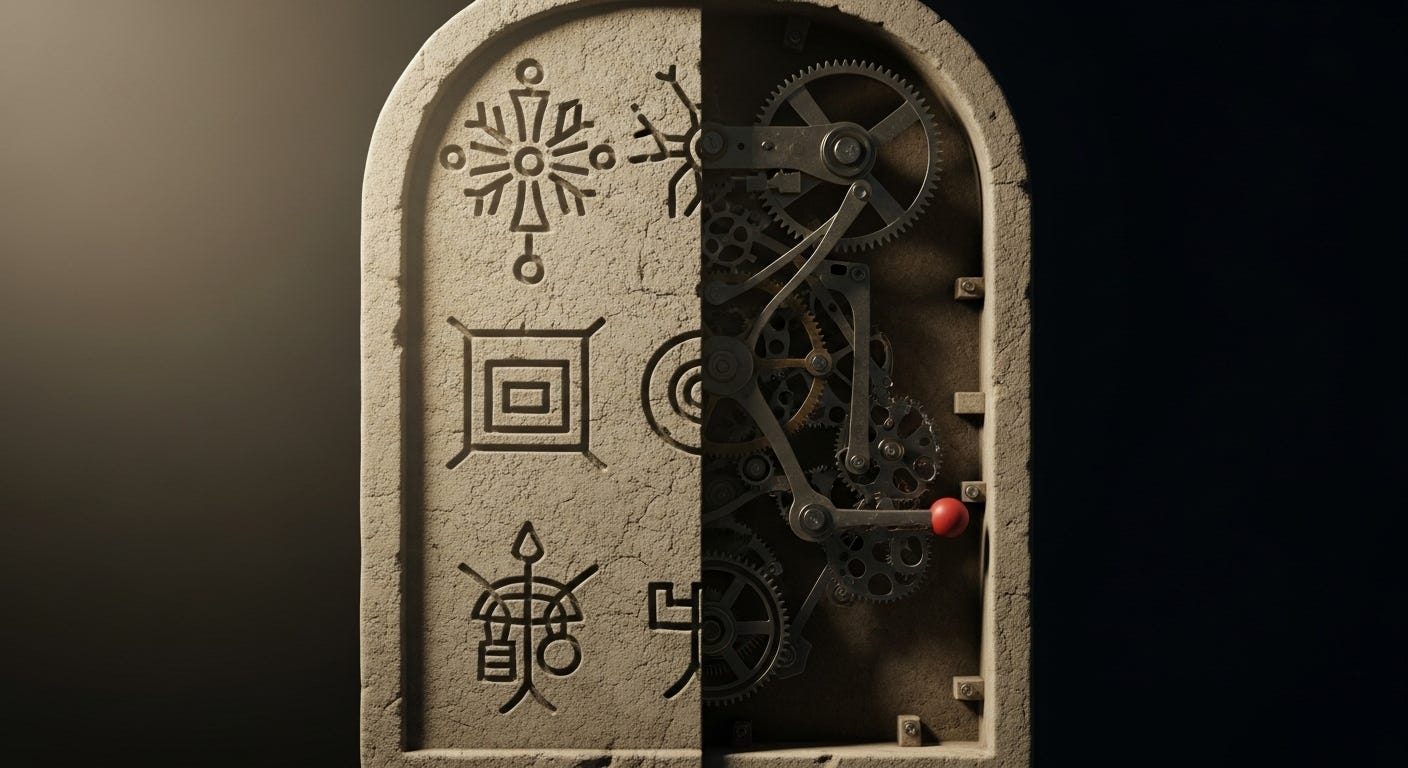
The Manufacture of Ancient Traditions to Keep People Under Control
Rulers created the customs people now defend with emotion, turning political tricks into sacred duties.
Ask anyone where a ritual came from and they’ll point vaguely to “our ancestors,” as if some wise old council spent centuries polishing sacred truths for us. But if you dare to look closer, you'll see it feels less like spiritual wisdom and more like a political workshop. You start seeing fingerprints — kings, priests, generals, tax collectors — all quietly shaping the rules people now defend with emotion they don’t fully understand.
If history teaches us anything, it’s that traditions were engineered, adjusted, repackaged, and sold. And once people believed the story that a ritual had “always been there,” the job was done. Power no longer needed swords. It had memory. Or at least the illusion of it.
Most of the so-called ancient customs people cling to were never about purity, meaning, or community. They were about management — how to calm crowds, silence questions, mark social ranks, and guide behavior without constant threats. And the clever part? The people being controlled treasured the very things designed to control them.
The Birth of a Tradition Starts With One Question: “How Do I Control These People?”
Imagine a king who needs obedience. He can rule with force, but force is expensive. Fear fades. Soldiers get tired. But if he declares a ritual “sacred,” people obey by instinct. Religion turns power into something invisible, something people defend without even realizing whose interests they’re protecting.
Religion historian Karen Armstrong explains the trick perfectly:
Myth and ritual have always been used to legitimize the power of kings.
History is full of examples.
Ancient Egyptian pharaohs declared the sunrise ritual sacred, claiming only their existence kept the world from falling into chaos — a daily ceremony that tied cosmic order to obedience to the crown. Early Chinese emperors performed the Mandate of Heaven rites to prove they were chosen by the cosmos; questioning the emperor meant questioning the balance of heaven and earth. In Mesopotamia, kings invented elaborate New Year rituals where priests “confirmed” the king’s divine right to rule, turning loyalty into a holy obligation. Even medieval European monarchs used coronation rituals to show that God Himself had placed the crown on their heads, making rebellion not just illegal but sinful.
In other words: invent a ritual, attach God’s name to it, and people stop arguing.
Many early traditions were created in moments of political crisis — rebellions, famine, war — and later passed off as “eternal wisdom.” Leaders needed tools of control, not a path to enlightenment.
“Do This Because Our Ancestors Did It” — The Oldest Trick in Politics
When rulers lacked evidence that a practice was ancient, they simply claimed it was. People respect ancestors. Leaders exploited that.
Anthropologist Jack Goody exposed this tactic bluntly:
Appeals to tradition often conceal the relatively recent origin of the practices themselves.
By claiming something came from the ancestors, elites shielded it from criticism. Suddenly, refusing the ritual was not rebellion — it was disrespect to your family. That emotional pressure did the heavy lifting.
Most of these “ancestral customs” were no older than the ruler who invented them. But the lie worked, because people want continuity more than truth.
Marriage Traditions: Made for Love?
People think marriage rituals are romantic. They were logistical. Marriage was originally a contract about land, inheritance, and controlling women’s mobility.
Historian Stephanie Coontz puts it plainly:
For most of history, marriage was more about property and politics than love or personal choice.
Dowries, bride price, arranged unions — these were tools to keep wealth inside certain families and stop women from acting independently. Rituals around marriage looked holy, but they were invented to solve economic problems for elite men.
The fact that these rules survived under the cover of “tradition” shows how effective the trick was.
Food Laws: Purity?
Food laws sound spiritual, but they often had nothing to do with heaven. Leaders created them to control commerce, trade, and class identity. A priest who controls the menu controls the people.
Biblical scholar Jacob Milgrom summarized it in one line:
Dietary laws functioned as markers of social control and group identity.
You can see this pattern all over history.
In ancient Israel, pork was banned partly because pig farming competed with the livestock economy controlled by elites. In medieval Japan, meat was declared spiritually impure, which conveniently protected rice-farming aristocrats and Buddhist monasteries that relied on grain taxes. In ancient Egypt, certain fish and fowl were forbidden for commoners but perfectly acceptable for priests, keeping food access tied to status. Even the Roman Empire used fasting rules to separate social classes and keep the population dependent on state grain distribution.
Some foods were banned to protect elite farmers. Others were labeled sacred so only the wealthy could access them. Some were declared impure so priestly authorities could maintain power over cleansing rituals.
Call it “tradition,” and suddenly the rule becomes holy instead of political.
Clothing Traditions: The Original Class Badges
Dress codes in religion and culture were rarely about modesty. They were about hierarchy. Clothing was a visual map of who had power and who didn’t.
If rulers needed to separate nobles from commoners or men from women, they invented clothing rituals. Then they claimed the gods demanded it. People followed them because the rules felt ancient, even though many were invented on the spot.
Tradition made inequality look divine.
Purity Rituals: Designed to Shame and Control
Purity laws were one of the most powerful political tools ever created. Once you convince people they are “unclean,” you can dictate every part of their life.
Scholar Jonathan Klawans explains that purity systems were tied to power, not just belief:
Purity discourse often supports social hierarchy and the authority of religious elites.
These rituals controlled sexuality, women’s bodies, class mobility, and who could speak in public. They were less about holiness and more about dominance. But once framed as ancient tradition, people enforced them on themselves.
That’s the genius of invented ritual: the people become their own jailers.
Tax Traditions: Taxes as Sacred Duties
Many so-called religious offerings were heavenly taxes. Leaders discovered that people would pay more willingly if the payment was framed as “pleasing the gods.”
Harvest offerings, temple dues, mandatory sacrifices — these weren’t spiritual gestures. They were state revenue. But when rulers and priests wrapped taxes in ritual and called it “tradition,” compliance became automatic.
People believed they were honoring heaven when they were actually funding bureaucracy.
Festivals and Holidays: Invented to Calm Crowds and Redirect Anger
Many holidays began as political emergencies. Drought? Invent a purification festival. Rebellion? Create a unity parade. Economic collapse? Announce a holy feast. Rituals kept people busy and emotionally focused.
You can see it across cultures.
The ancient Athenian Panathenaia was expanded during political unrest to unify the city under one civic identity. The Roman Saturnalia grew in importance whenever social tensions rose, giving the poor a temporary release valve so they wouldn’t revolt. In ancient China, emperors declared new “heavenly mandate” festivals after floods or military failures to convince people the dynasty still had cosmic approval. Medieval European rulers extended feast days during famine or plague to keep morale from collapsing and to redirect anger away from the throne. Even the Persian Nowruz was formalized by kings who needed a way to bind different tribes and provinces under one shared calendar.
Leaders used festivals as pressure valves. Over time, people forgot the political crisis that sparked the ritual. They inherited a celebration without its original motive — control.
Tradition hides the fact that many holidays were invented to stop societies from falling apart.
“Ancient Tradition” Is the Magic Spell to Stop Questions
Once something is called “ancient,” people feel guilty doubting it. That guilt is the real power of tradition: it freezes thought.
As historian Talal Asad described,
Tradition is a claim to authority grounded not in age itself, but in the suppression of alternative possibilities.
Tradition works because it blocks imagination. People stop asking:
Why this ritual?
Who invented it?
Who gains from it?
Why do we still follow it?
If you asked those questions openly, half of today’s “timeless” customs would collapse tomorrow.
Why People Still Defend the Traditions Invented to Control Them
Even when a tradition’s true origin is exposed, people cling to it. Rituals feel safe. They give identity and order, even if they were originally created to control.
Sociologist Peter Berger described this attachment bluntly:
Society creates the sacred and then bows before it.
People defend traditions because they grew up inside them. They confuse familiarity with holiness. And rulers benefit from that confusion long after their thrones crumble.
Tradition survives not because it is wise, but because it is emotionally comfortable.
The Real Test: “If It Were Invented Today, Would Anyone Obey It?”
This single question exposes the truth behind most ancient rituals.
If someone introduced the same purity rules, marriage laws, food bans, clothing codes, or taxes today, people would laugh. They’d reject them immediately.
Historian Yuval Noah Harari captures the core idea:
Most cultures are founded on imagined orders that only feel natural because people are trained to accept them.
Tradition is training, not timeless truth.
Last Thoughts
A huge part of what people call “ancient” was created by rulers and priests who needed obedient citizens, stable taxes, and predictable behavior. These rituals were political tools dressed up as sacred duties.
If people truly want to honor their ancestors, they should question the traditions invented by the powerful, not blindly repeat them.


While most of the article is clearly and irrefutably true, there are two things I would like to comment upon.
1. Dietary rules
Actually, eating pork in the past was risky, because it was frequently passing parasites that live in pigs but not in cows or fish.
Rules about removing blood make sense as they extend the period the meat does not spoil.
Rules about not eating carrion eaters also reduce chance of parasite infections or food poisoning.
Some rules about not combining certain classes of foods increase the nutritional value of dishes / prevent nutrients from becoming less bioavailable / make them more bioavailable.
While obviously many were discovered to control people, it really seems not all, and the ones we can find in Bible or Quran seem mostly health oriented.
2. Tradition
While mindlessly keeping useless traditions does not make much sense, certain level of respect for tradition is necessary to preserve culture integrity. I completely agree that we should always ask ourselves if the rules are not harmful / clearly stupid, but as long as they are not there is nothing deeply wrong in keeping even nonsense traditions just to preserve cultural identity / originality.