


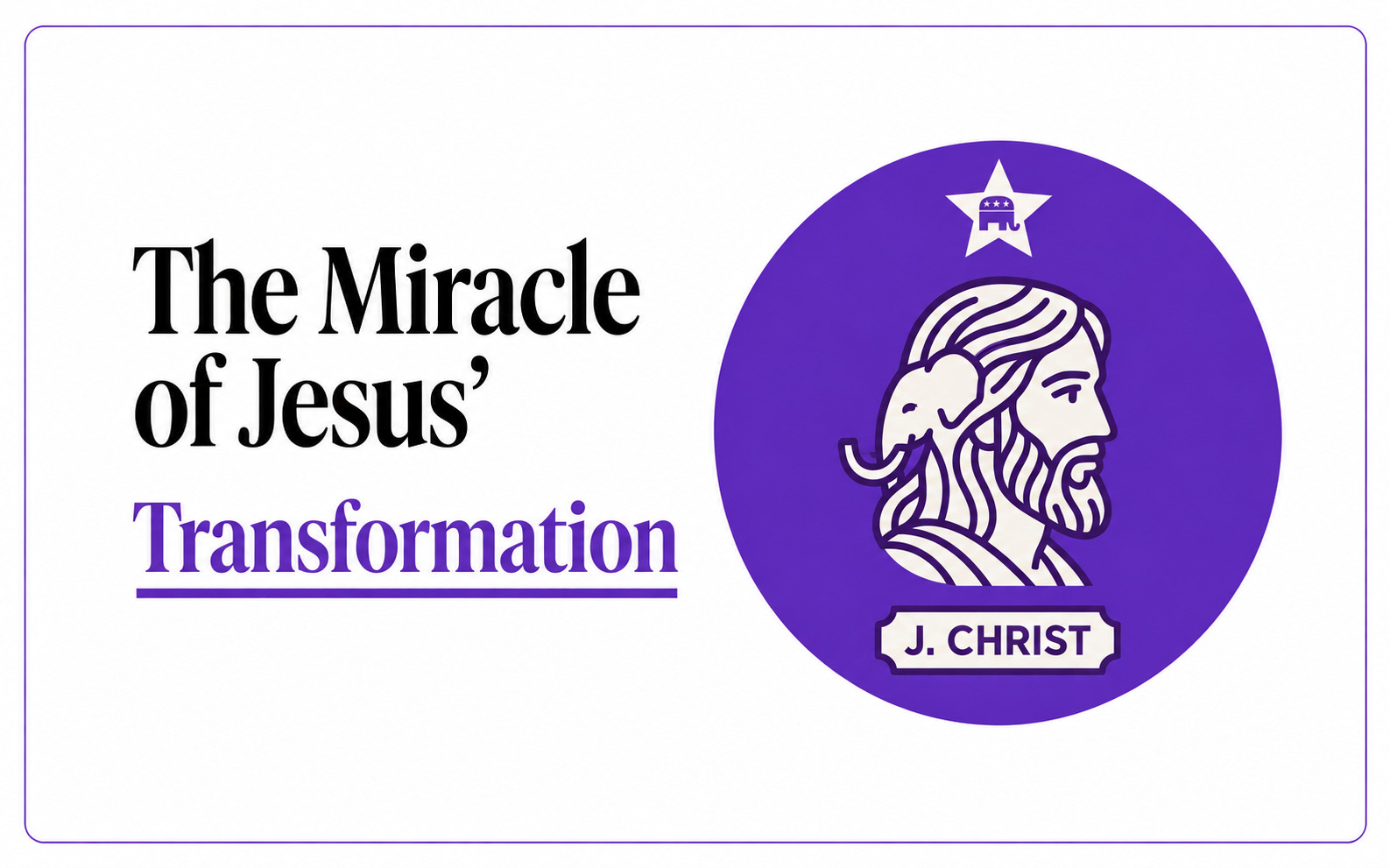
Long before televangelists asked for “seed money” and corporate boardrooms added prayer to the agenda, a 1920s Madison Avenue ad executive looked at the New Testament and noticed at once that the “organizational chart” was missing.
Consequently, the world saw one of the most successful rebrandings in American history, a calculated, multi-billion-dollar effort by oil barons, ad men, and corporate lobbyists to draft Jesus Christ into the service of free-market capitalism. They merged faith with free enterprise and systematically erased the radical, anti-wealth Galilean of the Gospels and replaced him with a corporate CEO who views low wages as a ministry, the tax code as a threat to salvation, and the Sermon on the Mount as a liability in need of aggressive brand management.
Today we’re talking about the story of how American big business bought the pulpit, silenced the Social Gospel, and engineered the “Christian America” as we know it, and in this story, “evangelicals” means white evangelicals, because for reasons I don’t have to spell out, they’re the ones that matter for America.
If you’re a white evangelical and think you don’t fit the bill, then this piece isn’t about you.
From a Religion of Neighbors to a Religion of Everyone for Themselves
Judaism, Christianity, and Islam, the three faiths that trace their origins back to Abraham, share a trait that matters here is that each is built around a community. Judaism starts with a covenant made with a whole people, Christianity with a church where believers held their property in common, and Islam makes helping the poor a required payment instead of a mood, mandating that 2.5% of what the wealthy own be distributed to the poor annually. Belonging came with obligations, and for centuries those obligations meant feeding the hungry, burying the dead, and looking after widows and orphans.
That comes with a price. A faith that makes the group responsible for you also makes you answerable to the group, so the majority’s idea of right and wrong can flatten the woman who wants a divorce, the son who stops believing, and the neighbor who loves the wrong person.
The puzzle to solve is that a religion this wired for neighbors ought to produce an economics wired for neighbors, and yet American evangelicalism ended up preaching hardcore capitalism while the majority kept its grip on everything else. The pressure to conform survived the makeover and the duty to share didn’t, and the donors who paid for the makeover knew which half they wanted to keep.
The Infamous Madison Avenue Ad
In 1925 Bruce Barton, co-founder of the advertising giant BBDO, published The Man Nobody Knows, a book about Jesus that sat on the national bestseller lists for two years. Barton’s Jesus founded modern business. He “picked up twelve men from the bottom ranks of business and forged them into an organization that conquered the world,” and the parables read to Barton like ad copy. The book sold because Americans in the 1920s had already decided that money measured a man’s worth, so Barton only had to hand them a Galilean who agreed, and nobody lingered over the part where Rome executed that Galilean for annoying people in power.
Oil Money Buys a Pulpit
The Depression broke that arrangement for a while. Business leaders had spent the 1920s as national heroes and the 1930s as the guys who wrecked the economy, while Franklin Roosevelt (the president behind the New Deal) polled like a saint. The National Association of Manufacturers, the big business lobby of the day, figured that arguing about tax rates wasn’t going to win the public back.
It found James Fifield, a Congregational minister in Los Angeles who preached to the wealthy and liked them. In 1935 he founded Spiritual Mobilization, an outfit funded by executives like J. Howard Pew, the Sun Oil heir, and aimed at ministers across the country. Fifield mailed them newsletters and sermon material arguing that Roosevelt’s programs amounted to a rival religion, a state demanding the loyalty that belonged to God. His slogan was “freedom under God,” and in an era when the top income tax rate sat at 91 percent, the freedom he had in mind had a specific shape.
The campaign paid off in the 1950s. President Eisenhower told a crowd that American government “makes no sense unless it is founded in a felt religious faith, and I don’t care what it is.” Congress put “under God” into the Pledge of Allegiance in 1954 and made “In God We Trust” the national motto in 1956, both after years of corporate-funded “Christian America” messaging had made those changes feel overdue. Pew kept writing checks, including some to Christianity Today, the magazine Billy Graham helped launch in 1956 to give evangelicals their own voice.
Evangelicals Were Already Halfway There
Money had been in the movement from the start, since Lyman Stewart, a founder of Union Oil, paid for the pamphlets called The Fundamentals (1910-1915) that gave fundamentalism its name. After World War II the movement’s center of gravity moved to Southern California and Texas, where the congregations were full of oilmen, defense contractors, and recent arrivals who’d made it on their own and didn’t enjoy being told they owed anyone.
The business world kept finding new ways to merge the two. Walmart recruited managers from Christian colleges in the Arkansas Ozarks and taught them that serving the customer meant serving God, which made low wages and a union-free store feel like a ministry. Oral Roberts, the Tulsa healing evangelist, told viewers to send “seed faith” donations and God would multiply the return. Once churches treat donations as investments that pay off, the Sermon on the Mount inevitably becomes an embarrassment because Jesus told people to give up wealth, not grow it. The preachers then have to find ways to explain it away.
What the Gospels Say About Money When Nobody Spiritualizes Them
The Jesus of the Gospels has a lot to say about wealth, and none of it flatters a hedge fund. Luke 6:20-24 has him telling the poor that the kingdom of God belongs to them and telling the rich “woe to you,” because they’ve already collected their comfort. In Mark 10:21-25 he tells a wealthy man to sell everything and give the money to the poor, then says it’s easier for a camel to pass through a needle’s eye than for a rich person to enter the kingdom. Matthew 6:24 says you can’t serve God and money, Luke 16:19-31 sends a rich man to Hades while the beggar at his gate gets comfort, and Matthew 25:31-46 judges the nations on who fed the hungry. Acts 2:44-45 shows the first believers selling their property and sharing the proceeds with anyone in need.
Keeping the corporate Jesus understandably requires explaining all of that away. Preachers invented a tiny Jerusalem gate called the Needle’s Eye, which camels supposedly squeezed through when kneeling, though no evidence of such a gate exists before the Middle Ages. The parable of the talents (Matthew 25:14-30) is often interpreted as an endorsement of compound interest, even though the master in that story is a man who reaps where he didn’t sow, a type of tale that peasants knew well from collecting rent.
Abortion Joined the Platform After the Money Did
The standard origin story for the Religious Right says Roe v. Wade (the 1973 Supreme Court ruling legalizing abortion nationwide) woke the sleeping evangelical giant. The historian Randall Balmer has laid out why the timeline fails. Paul Weyrich, the conservative strategist who helped create the Moral Majority, later said that the issue that got the movement moving was the federal government threatening the tax exemptions of segregated Christian schools, with abortion added to the list a few years later. In 1971 the Southern Baptist Convention, the largest evangelical denomination in the country, passed a resolution calling for legal abortion in cases of rape, incest, severe fetal deformity, and threats to the mother’s health.
So the sequence is that business builds the economic Jesus in the 1930s and 1950s, a tax fight pulls evangelical leaders into the Republican coalition in the 1970s, and abortion supplies the moral urgency once the alliance is already in place. The pattern shows up again in 2016, when roughly eight in ten white evangelical voters backed Donald Trump, a casino owner with several bankruptcies, three marriages, and a prosperity preacher named Paula White as his spiritual adviser. Evangelical leaders had spent decades teaching that Jesus rewards success, so when a rich, successful man rode down an escalator to announce he was running for president, they were quick to see him as one of their own.
Paul Gave Evangelicals a Gospel Without Homework
Evangelicals love Paul, and the reason has less to do with Paul than with what he lets them skip. Jesus in the Gospels judges people by what they do. In Matthew 7:21 he says only the person who does the Father’s will gets into the kingdom, and a pile of “Lord, Lord” counts for nothing. In Matthew 25 the nations sort into sheep and goats according to who fed, clothed, and visited the people at the bottom, and in Luke 6:46 he asks why anyone calls him Lord while ignoring what he says.
Paul offers an exit. Romans 3:28 says a person is made right with God by faith apart from the works of the law, and Galatians 2:16 repeats it. Evangelical preachers boil that down to a slogan: believe the right things and your account is settled. A donor who hears that on Sunday and cuts wages on Monday has broken no rule, because the rules got moved inside his head where nobody can audit them.
The New Testament knew these two voices clashed. James 2:24 says works make a person right with God and faith alone doesn’t, and the same letter calls faith without deeds dead. Martin Luther, the German monk who started the Reformation, disliked James so much that he called it an “epistle of straw” and shoved it to the back of his Bible. American evangelicals inherited his preference along with his theology.
Paul himself meant something narrower than the slogan. His “works of the law” mostly refers to the markers that separated Jews from outsiders, namely circumcision, food rules, and holy days, and his fight was over whether non-Jewish converts had to become Jewish to join. Stretching that into “deeds don’t count” took centuries of editing, and the editing paid off for anyone who preferred a faith that costs nothing.
The same selective reading follows Paul around. Romans 13:1-7 tells everyone to submit to the governing authorities, which made it a favorite for sermons against civil disobedience. The line in 2 Thessalonians 3:10 that anyone unwilling to work shouldn’t eat gets quoted against food stamps, even though it was aimed at church members who quit their jobs expecting the world to end and then leaned on the congregation’s charity. Meanwhile the same Paul spent years collecting money from his non-Jewish churches for the poor in Jerusalem (Galatians 2:10), and in 2 Corinthians 8:13-15 he told them the goal was equality. Sermons on that passage are hard to find.
It also matters that Paul never heard Jesus teach. His letters are the oldest writing in the New Testament, composed decades before the first Gospel, and he almost never quotes the Sermon on the Mount or anything else Jesus said about money. Anyone who wanted a Jesus who wouldn’t audit the books could pick the man who rarely mentioned what Jesus taught, and the corporate Jesus never needed a new theology after that, only a steady supply of pastors who preached Romans 3 more often than Matthew 25.
In his defense, Paul couldn’t possibly have known his words would one day produce people who treat poverty as a character flaw passed down in families like a bad gene, who call Black Americans lazy while quoting his advice on honest work, who label a food pantry “socialism” if the government runs it, and who still expect the doors of heaven to swing open for them on the strength of a correct belief and a clean testimony, proud they never questioned. He wrote to small groups of tradesmen and slaves in Greek port cities, expecting Jesus to return within his lifetime, and he spent years collecting money for the hungry in Jerusalem. The preachers who came later had no such excuse. Antebellum Southern ministers leaned on the instructions to slaves in letters traditionally attributed to Paul (Ephesians 6:5 and Colossians 3:22) to defend slavery from the pulpit, and after emancipation many of the same pulpits that had preached obedience to masters preached “pull yourself up” to the people those masters once owned. By the time Bruce Barton and James Fifield showed up, the material was already assembled: a faith that grades you on what you believe, a society that grades the poor on what they supposedly are, and a Paul trimmed down to fit both. All the donors had to add was the funding.
Sources and Further Reading
Kevin M. Kruse, One Nation Under God: How Corporate America Invented Christian America (Basic Books, 2015)
Bruce Barton, The Man Nobody Knows (Bobbs-Merrill, 1925)
Kristin Kobes Du Mez, Jesus and John Wayne: How White Evangelicals Corrupted a Faith and Fractured a Nation (Liveright, 2020)
Darren Dochuk, From Bible Belt to Sunbelt: Plain-Folk Religion, Grassroots Politics, and the Rise of Evangelical Conservatism (W.W. Norton, 2011)
Bethany E. Moreton, To Serve God and Wal-Mart: The Making of Christian Free Enterprise (Harvard University Press, 2009)
Kate Bowler, Blessed: A History of the American Prosperity Gospel (Oxford University Press, 2013)
Randall Balmer, Redeemer: The Life of Jimmy Carter (Basic Books, 2014)
Walter Rauschenbusch, Christianity and the Social Crisis (Macmillan, 1907)
Pew Research Center, validated voter analyses of the 2016 and 2020 elections
Christianity is a big, for-profit business, like any other. Jesus of Nazareth is merely a corporate mascot, like Ronald McDonald, the Jolly Green Giant, or the Geico Gecko. When Paul created his new faith, he adopted that image without ever meeting Jesus. There's no evidence that he read any of the Gospels. But it was Paul's version of Christianity that survived, and spread throughout the Western world. When the Emperor Constantine converted, he adopted the organized religion of Paul, not the faith of a poor itinerant Jewish preacher.
I guess we pick and choose what suits our needs from the Bible whether Republicans, Democrats, or the multitude of others. Few who either earn or receive wealth will use it to directly benefit those in need, however, those who create jobs have the largest impact.