


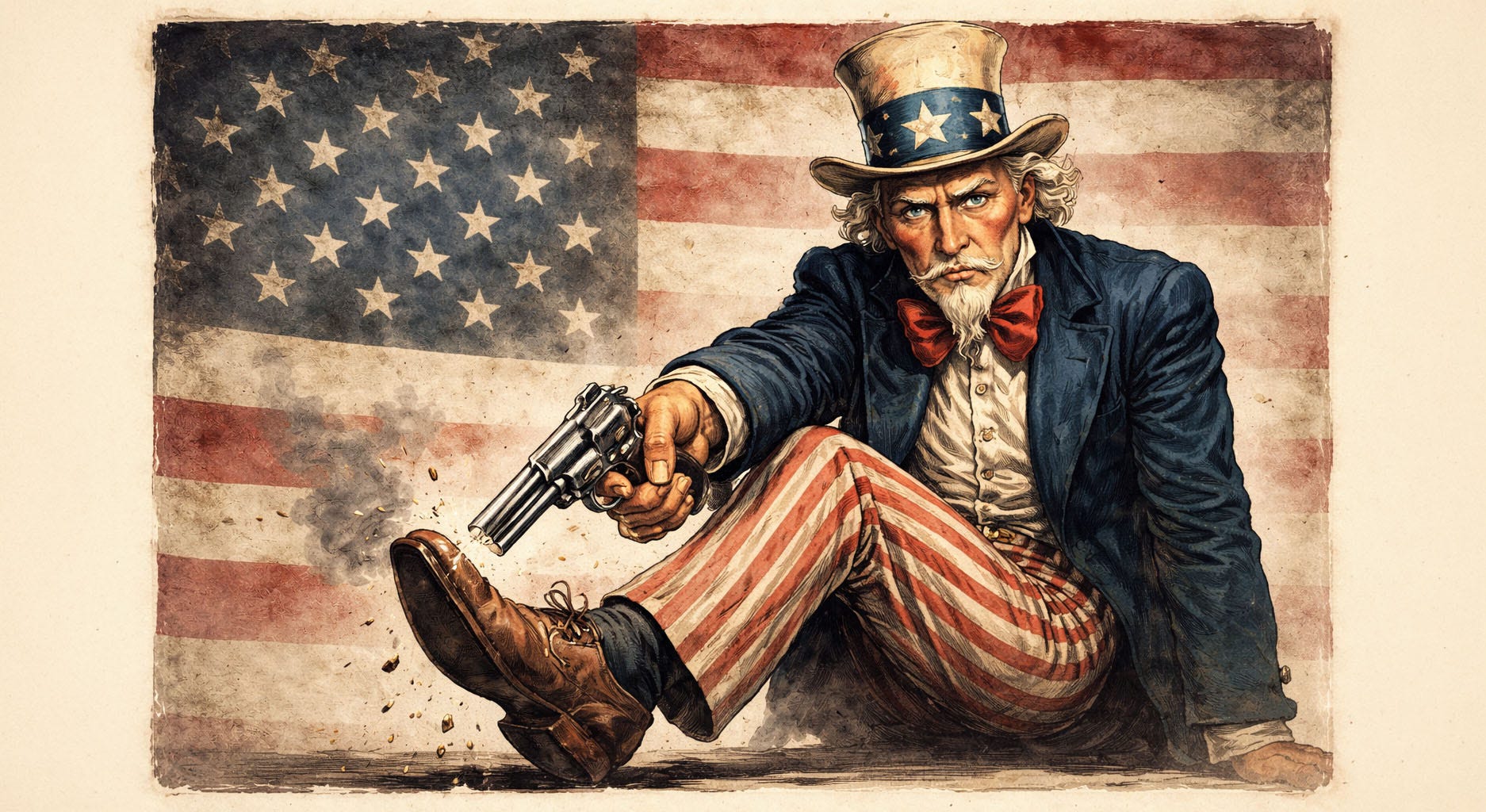
In Part I, we looked at invasion habits, alienated allies, trade misfires, and a growing credibility problem. But those were symptoms. In Part II, we move deeper into the structural patterns and long-term consequences that keep this cycle alive.
The Democracy Promotion Disaster
America loves to talk about spreading democracy. In practice, American democracy promotion has been a disaster that often makes things worse.
The problem is that Washington talks about democracy while supporting some of the most authoritarian regimes on earth. Saudi Arabia is a medieval monarchy that murders journalists and bombs Yemeni civilians, but it’s a close American ally. Egypt is a military dictatorship that imprisons tens of thousands of political opponents, but it gets billions in American aid. Israel receives unconditional American support despite its treatment of Palestinians.
Meanwhile, when countries actually try to democratically elect governments that don’t align with American interests, the United States suddenly loses its enthusiasm for democracy. Venezuela elects a left-wing government? Time for sanctions and coup attempts. Bolivia elects Evo Morales? The United States backs the opposition. Iran tries to nationalize its oil in the 1950s? CIA-backed coup.
The hypocrisy is so glaring that nobody outside the United States takes American democracy promotion seriously anymore. When Washington lectures other countries about human rights and democratic values, the rest of the world rolls its eyes.
This matters because it undermines America’s soft power. The United States used to be able to claim moral authority on the world stage. That authority is gone. America looks like just another self-interested great power, except one that can’t stop talking about values it doesn’t actually uphold.
The Military Budget Black Hole
America spends more on its military than the next ten countries combined. That’s not an exaggeration—it’s literally true. The United States could cut its military budget in half and still outspend any potential rival.
But does all that spending make America safer? Not really.
The bloated military budget crowds out investment in everything else that actually matters for national strength. Infrastructure is crumbling. The education system is falling behind international competitors. Healthcare costs are bankrupting families. Scientific research funding is a fraction of what it should be. All the things that made America a superpower in the first place are being neglected so the Pentagon can buy another aircraft carrier or develop another fighter jet that costs more than some countries’ entire GDP.
Meanwhile, America’s actual security challenges—cyber attacks, climate change, pandemics, economic disruption—can’t be solved by aircraft carriers and fighter jets. COVID-19 killed more Americans than every war since World War II combined, and the military budget did nothing to stop it.
China isn’t trying to match America’s military spending. It’s investing in technology, infrastructure, and economic development. In thirty years, which approach do you think is going to produce a stronger country?
The Losing Propaganda War
Here’s something that should terrify American policymakers: the United States is losing the global propaganda war to China and Russia.
Not because Chinese and Russian propaganda is particularly good—it’s often crude and obvious. America is losing because its actions don’t match its words, and the whole world can see it.
Russia says America is a declining empire that bullies other countries. Then America launches a disastrous war in Iraq and imposes sanctions on half the planet. Russia’s propaganda starts to sound plausible.
China says America is a hypocritical power that preaches democracy while supporting dictators. Then America bears hugs Saudi Arabia and Egypt while bombing Libya. China’s propaganda starts to sound plausible.
The problem isn’t that America needs better messaging. The problem is that America’s actual foreign policy is indefensible. You can’t spin your way out of bombing weddings with drones or supporting coups against democratically elected governments.
Meanwhile, China builds roads and ports around the world through the Belt and Road Initiative. Are some of those projects debt traps? Sure. Are they still more popular than American military bases and lectures about democracy? Absolutely.
The Self-Fulfilling Prophecy Problem
Here’s one of the most frustrating ways America shoots itself in the foot: it treats countries as enemies, then acts surprised when they become enemies.
Take Russia. After the Cold War ended, Russia was weak, poor, and looking for integration with the West. America could have helped Russia become a prosperous democracy tied to Western institutions. Instead, NATO expanded right up to Russia’s borders, American advisors helped oligarchs loot the Russian economy, and Washington treated Russia as a defeated enemy rather than a potential partner.
Putin is a dictator and a thug, no question. But American policy helped create the conditions that brought him to power and made him hostile to the West. Russia didn’t have to become an enemy again. American policy made it one.
Or look at Iran. After the 1979 revolution, relations were hostile, sure. But there were opportunities for détente. The Obama administration negotiated a nuclear deal that was working—international inspectors confirmed Iran was complying. Then Trump tore it up for no reason except that Obama’s name was on it.
Now Iran is closer to a nuclear weapon than ever, and the moderates in Iranian politics who wanted better relations with America have been discredited. The hardliners were proven right: you can’t trust America to keep its agreements.
China is heading down the same path. American policy treats China as an enemy that must be contained. So China acts like an enemy that’s being contained, building up its military and reducing dependence on American technology and markets. The confrontation that American policymakers feared is becoming real because American policy is making it real.
Why Does This Keep Happening?
So why does America keep shooting itself in the foot? Why can’t the supposed superpower learn from its mistakes?
Part of it is simple arrogance. American exceptionalism—the belief that America is fundamentally different and better than other countries—makes it hard for American policymakers to imagine that the rules apply to them too. Invading countries has consequences. Breaking international agreements has consequences. Treating allies like servants has consequences. But if you believe America is exceptional, you think you can get away with anything.
Part of it is the influence of special interests. Defense contractors profit from military spending and foreign interventions. Pro-Israel lobbying groups push for unconditional support for Israel. Oil companies shape Middle East policy. These interests don’t care about America’s long-term strategic position. They care about quarterly profits and the next election cycle.
Part of it is political polarization. Foreign policy has become just another partisan football in America’s culture wars. Republicans and Democrats can’t agree on anything, so consistent long-term strategy is impossible. Each administration reverses the previous administration’s policies out of spite, leaving allies confused and enemies opportunistic.
Part of it is the media ecosystem. Cable news and social media reward hot takes and tough talk, not nuanced understanding of complex situations. Politicians who advocate restraint and diplomacy get accused of weakness. Politicians who advocate bombing someone get called “decisive leaders.”
And part of it is just institutional inertia. The foreign policy establishment in Washington has been making the same mistakes for so long that it doesn’t know how to do anything else. The people who designed the Iraq War are still writing op-eds calling for more interventions. The people who expanded NATO are still defending the policy. Nobody ever gets fired for failure in Washington—they just move to a think tank and keep advocating for the same failed policies.
What’s the Cost?
All of this self-sabotage has real consequences. America’s international influence is declining. Its economy is weighed down by debt from pointless wars. Its infrastructure is third-world quality. Its political system is increasingly dysfunctional. Its reputation is in tatters.
Meanwhile, China is rising not because it’s doing everything right, but because America is doing so much wrong. Russia is able to cause trouble far beyond what its actual power should allow, because America has alienated so many potential partners. Regional powers like Turkey and Saudi Arabia increasingly ignore American preferences because they know American threats are empty.
The world isn’t ending. America is still rich, still powerful, still influential. But the trajectory is clear. Every year, America has less leverage, less credibility, less ability to shape events. And every year, American foreign policy makes that trajectory worse.
Can It Be Fixed?
The good news is that none of this is inevitable. America could stop shooting itself in the foot any time it wanted to. It would require acknowledging mistakes, changing course, and prioritizing long-term strategic thinking over short-term political gains. It would require rebuilding relationships with alienated allies, showing restraint instead of always reaching for military solutions, and actually living up to the democratic values America claims to champion.
It would require, in other words, basic common sense and humility.
The bad news is that there’s no sign any of that is happening. The foreign policy establishment keeps doubling down on failed strategies. Politicians keep pandering to the worst impulses of their base. The media keeps treating international relations like a reality TV show.
So America will probably keep shooting itself in the foot. The wounds will keep accumulating. And one day, America will look around and wonder why it’s no longer the superpower it used to be.
The answer will be simple: you did it to yourself. Nobody else was necessary. America’s greatest enemy has always been its own inability to learn from its mistakes.
And that’s the most frustrating part of all. This isn’t a tragedy where a great power falls to a stronger rival. This is a farce where a great power trips over its own feet again and again, blaming everyone else, learning nothing, and wondering why things keep getting worse.
Welcome to American foreign policy in the 21st century. Please watch your step—or don’t. At this point, it probably doesn’t matter.
Being exceptional is one thing. Being an exceptionalist is a disaster every time. Good luck in trying to change the course of this stupid-tanker.