


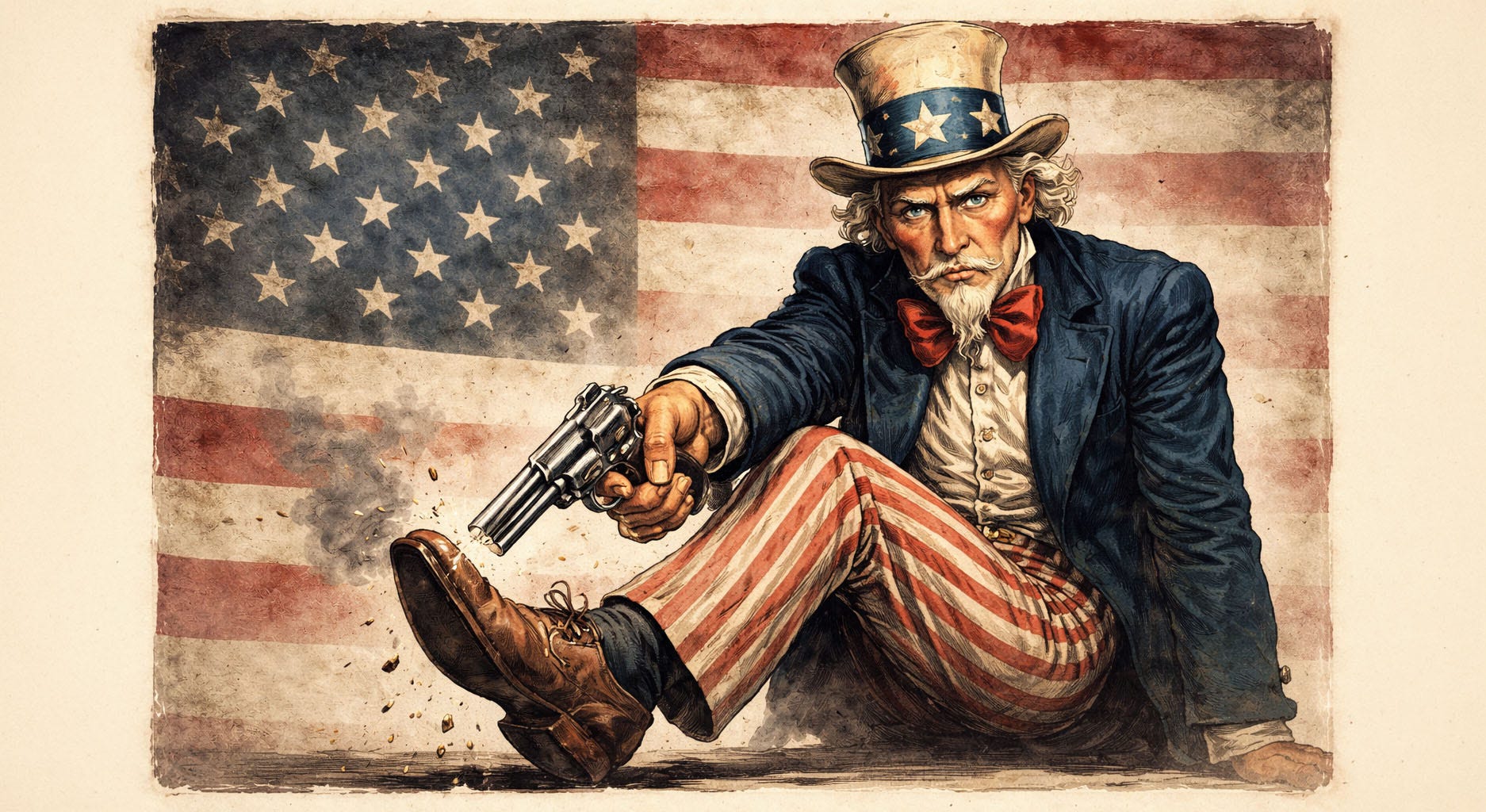
America loves to think of itself as the world’s policeman, the beacon of democracy, the indispensable nation. But here’s the uncomfortable truth: the United States has spent the last several decades making foreign policy decisions that hurt its own interests. Time and again, Washington has picked fights it didn’t need to pick, backed the wrong people, and alienated allies who actually wanted to help. The result? A weaker America, a more chaotic world, and a lot of people scratching their heads wondering what the hell happened.
This isn’t about America being evil or incompetent. It’s about hubris, short-term thinking, and a stunning inability to learn from mistakes.
The obvious one first.
The Invasion Addiction
America’s obsession with invading countries. After September 11th, the United States had the world’s sympathy. Countries that normally couldn’t stand each other were lining up to support America. It was a moment of genuine international solidarity.
Then the Bush administration decided to invade Iraq.
The Iraq War was a masterclass in self-sabotage. There were no weapons of mass destruction. Saddam Hussein, as terrible as he was, had nothing to do with 9/11. The whole adventure was based on either lies or catastrophic intelligence failures, depending on how charitable you want to be. The war cost trillions of dollars, killed hundreds of thousands of people, destabilized an entire region, and created the conditions for ISIS to emerge.
What did America get out of it? A damaged reputation, a depleted military, a massive debt burden, and a Middle East that hates the United States more than ever. Mission accomplished, indeed.
Unfortunately, Iraq wasn’t a one-off mistake but part of a pattern. America has been overthrowing governments and launching military interventions for decades, and most of them have backfired spectacularly. Libya? That intervention helped turn the country into a failed state and a haven for terrorists. Syria? The half-hearted involvement created a power vacuum that Russia and Iran filled. Afghanistan? Twenty years and trillions of dollars later, the Taliban is back in charge.
Every single one of these interventions was sold to the American public as necessary for national security. Every single one made America less secure. The pattern is so consistent that you’d think someone in Washington would notice and maybe try a different approach. But no. The military-industrial complex has bills to pay, and politicians need to look tough on the world stage.
Alienating Allies Like It’s a Sport
America doesn’t just shoot itself in the foot with its enemies. It also has a remarkable talent for pissing off its friends.
Take Europe. For decades, European countries were America’s closest allies, bound together by NATO, shared democratic values, and economic ties. Then America started treating Europe like an annoying younger sibling who doesn’t know what’s good for them.
The United States conducted mass surveillance on European citizens and leaders. It pressured European companies with extraterritorial sanctions that had nothing to do with European interests. It pulled out of international agreements like the Iran nuclear deal and the Paris Climate Accord, leaving European partners scrambling. It imposed tariffs on European goods for reasons that made sense to nobody except Donald Trump. It demanded that Europeans cut off trade with China and Russia without offering viable alternatives.
The message Europe received was clear: America doesn’t see you as partners. It sees you as vassals who should do what they’re told.
The result? Europe is slowly but steadily trying to build strategic autonomy from the United States. European leaders talk openly about not being able to rely on America anymore. That’s not Chinese or Russian propaganda—that’s what America’s closest allies are saying.
Or look at Latin America. The United States has spent over a century meddling in Latin American politics, backing coups, supporting dictators, and imposing economic policies that benefited American corporations while impoverishing ordinary people. Then American politicians wonder why so many Latin Americans want to migrate north and why left-wing governments in the region are skeptical of Washington’s motives.
The Monroe Doctrine—the idea that America gets to control what happens in the Western Hemisphere—is still alive and well in Washington. Meanwhile, China shows up with investment deals and infrastructure projects, no regime change required. Guess who’s winning influence in America’s own backyard?
The Trade War Nobody Wanted
International trade policy is another area where America consistently scores own goals. The Trans-Pacific Partnership was supposed to be America’s economic counterweight to China in Asia. It would have established American-led trade rules for the region and strengthened ties with Asian allies.
Then the United States pulled out.
China, which wasn’t even part of the TPP, couldn’t believe its luck. Asian countries that wanted closer economic ties with America were left hanging. So they turned to China instead. Now China is the economic hub of Asia, and America is on the outside looking in.
The Trump administration’s trade war with China was another brilliant piece of self-sabotage. Tariffs on Chinese goods were supposed to bring manufacturing jobs back to America and force China to change its economic practices. What actually happened? American consumers paid higher prices, American farmers lost access to Chinese markets, and American companies dependent on Chinese supply chains got caught in the crossfire.
China didn’t collapse. It didn’t fundamentally change its system. It just found other trading partners and doubled down on technological self-sufficiency. Meanwhile, American companies that spent decades building relationships and supply chains in China watched their investments become political liabilities overnight.
The Biden administration kept most of those tariffs in place, by the way. Turns out that once you start a trade war, it’s politically difficult to admit it was a mistake and back down.
The Credibility Crisis
Here’s a less obvious way America shoots itself in the foot: it keeps making threats it doesn’t follow through on.
Obama declared that the use of chemical weapons in Syria was a “red line.” Then Assad used chemical weapons, and Obama didn’t follow through. America’s credibility took a hit.
Trump threatened “fire and fury” against North Korea. Nothing happened. He made a deal with the Taliban to withdraw from Afghanistan, then Biden executed the withdrawal so chaotically that it looked like America was fleeing in the middle of the night. America’s credibility took another hit.
Over and over, the United States makes grand statements about what it will and won’t tolerate, then fails to back up those statements with action. This teaches the world a simple lesson: American threats are empty. American promises are negotiable.
Why does this matter? Because international politics runs on credibility. When America says it will defend Taiwan or protect the Baltic states or prevent Iran from getting nuclear weapons, people need to believe those commitments are real. When America’s track record is full of unmet promises and abandoned allies, those commitments start to sound hollow.
The Afghan withdrawal was particularly damaging. After twenty years of telling the world that America stands by its partners, the United States left tens of thousands of Afghan allies behind to face Taliban retribution. The message to every potential American ally was clear: when things get tough, America might just cut and run.
So, What's Going on?
Taken together, these patterns tell a clear story. Military overreach, economic miscalculations, strained alliances, and eroding credibility are not isolated incidents. They are recurring features of American foreign policy in the 21st century. The damage is not always immediate, but it accumulates.
In Part II, we’ll look at the deeper structural forces behind this cycle — the democracy promotion paradox, the military budget imbalance, the propaganda problem, the self-fulfilling rivalries, and why the system keeps repeating the same mistakes.
Because the real issue isn’t just what America does abroad.
It’s why it keeps doing it.