


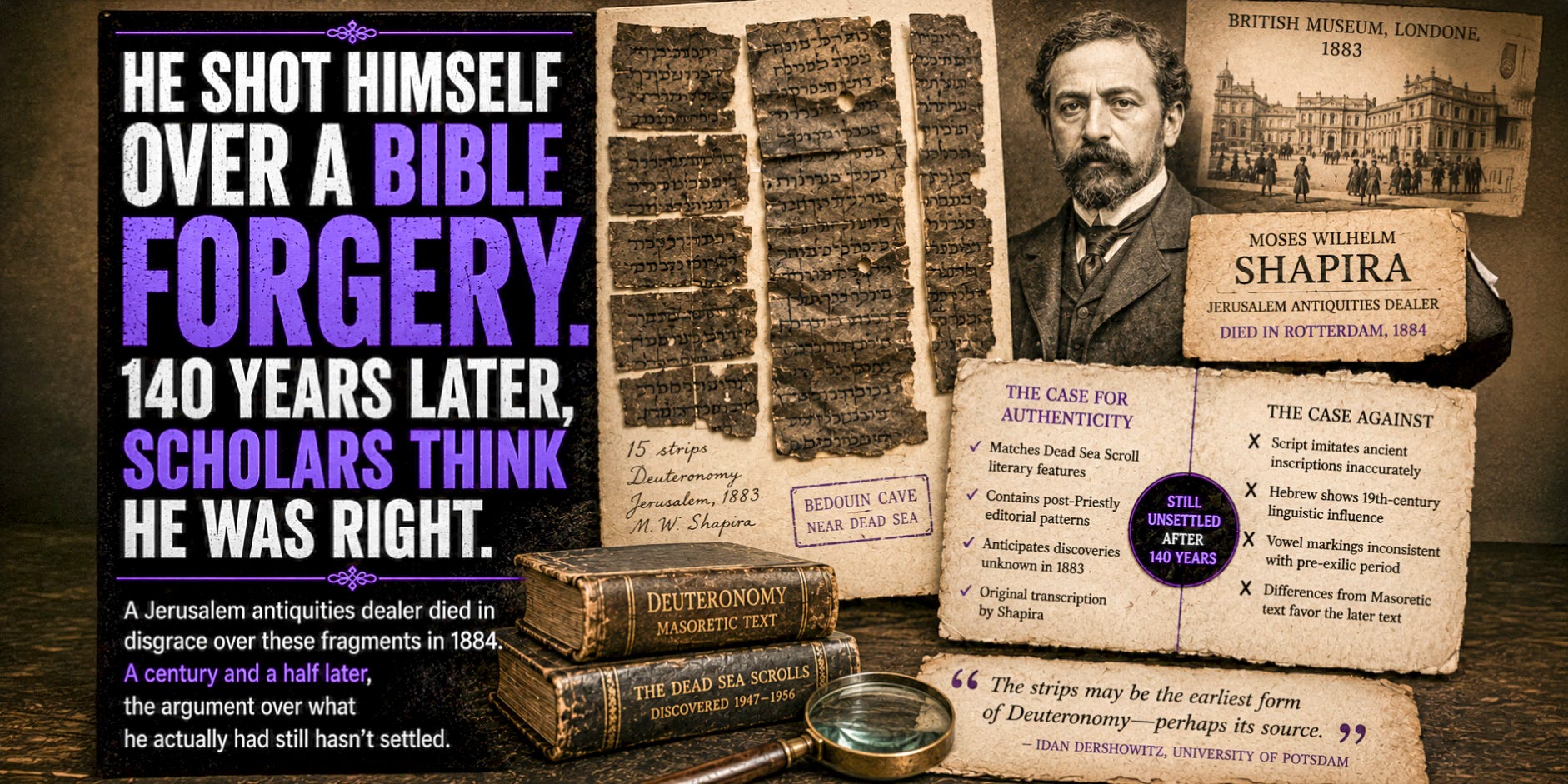
In 1883, a Jerusalem dealer named Moses Wilhelm Shapira brought fifteen strips of blackened leather to the British Museum and asked for a million pounds. He said he’d gotten them from Bedouin traders who’d found them in a cave near the Dead Sea. The text on them looked like Deuteronomy, but not quite. Lines were missing. Whole passages read differently. Names appeared in places they shouldn’t.
The museum’s expert examined them for weeks and leaned toward authenticity. Then a rival scholar, Charles Clermont-Ganneau, who had his own financial stake in discrediting a competitor’s find, got a few minutes alone with the strips, declared them fakes on the spot, and the museum’s expert reversed himself within days. Shapira left London in humiliation. Six months later he shot himself in a hotel room in Rotterdam. The strips vanished not long after, and biblical scholarship filed the whole episode under “forgery” and moved on for the next hundred and thirty-some years.
Then in 2021, a scholar at the University of Potsdam named Idan Dershowitz published a book and a companion article arguing that the consensus had it backward. Not just that the strips were real. That they were older than anything else we have of the Bible, older than the Dead Sea Scrolls, a text from before the Babylonian exile that predates the Deuteronomy we know and may have been one of its sources.
The Case for a Real, Ancient Document
Dershowitz’s argument rests on absence as much as presence. With the physical strips unrecoverable, what he worked with instead was a 19th-century transcription in Shapira’s own hand, plus drawings and photographs made before the sale collapsed. From that material he reconstructed the text and started looking for things a forger in 1883 couldn’t have known to fake.
This is his strongest card, and it’s worth sitting with. He points to specific literary features the strips share with the Dead Sea Scrolls, discovered some seventy years after Shapira’s death. He points to certain post-Priestly editorial patterns identified by biblical scholars only in the following century. A 19th-century forger getting those details right isn’t just unlikely. Nobody in 1883 knew those patterns existed to fake.
He’s not alone in taking the idea seriously. James Tabor, a biblical scholar at UNC Charlotte, co-authored a paper defending the strips as authentic ancient artifacts. Ross Nichols published a companion book the same year making a parallel case. And Dershowitz argues something structural was working against Shapira from the start: once Clermont-Ganneau, a rival dealer with his own financial stake in discrediting the find, called forgery in public, the burden of proof flipped. Every subsequent scholar approached the strips assuming guilt.
The Case Against
The rebuttal starts with the letters themselves. Christopher Rollston, an epigrapher at George Washington University, argues the strips imitate the script of the Mesha Stele and the Siloam Inscription, but imitate them imprecisely, the way someone copying a style from limited reference material would. Ronald Hendel at Berkeley and Matthieu Richelle in Belgium point to specific mismatches in letterforms and stance between the strips and genuine Iron Age inscriptions.
The stronger objection is linguistic. Jonathan Klawans, writing in Dead Sea Discoveries, and other critics note that the Hebrew in the strips mixes biblical grammar with forms that show up specifically in 19th-century Hebrew, the Hebrew being revived and standardized in exactly the decades when Shapira was working. The vowel markings are inconsistent in a way that lines up with post-exilic scribal habits rather than the pre-exilic period Dershowitz is claiming. If you’re trying to fake something ancient, writing like your own century is the single hardest habit to fully suppress. Klawans’s argument is that Shapira, or whoever produced the strips, didn’t suppress it.
There’s also a simpler problem: text-critical comparison. Several scholars argue that where the strips diverge from the Masoretic text, the Masoretic version reads as more original, not less. That’s the reverse of what you’d expect if the strips really were an earlier source Deuteronomy later expanded on.
That said, if period-consistent text isn’t enough to establish authenticity, the same standard should apply to the Pauline epistles. We lack Paul’s original manuscripts too; even the uncontested letters rely on scholarly inference rather than signed originals. This isn’t an argument for the strips’ authenticity—that is beyond my scope—but rather a critique of methodology: when evidence is scarce, standards often soften. Assumptions harden into consensus simply because there is no evidence to the contrary, making any challenge to them an academic offense.
What’s at Stake
If the Shapira strips are real, the consequences run in a few directions:
Start with the text of Deuteronomy itself. Dershowitz’s claim is that the strips predate Deuteronomy as we have it and may be a source Deuteronomy drew from, dated to the First Temple period, before the Babylonian exile. That would push the composition of a core biblical book back by centuries from where most scholars currently place it, and it would mean the version in your Bible is a later, edited descendant of something else, not the original.
It would also change how we understand the way the Bible got written. A pre-exilic proto-Deuteronomy would be direct physical evidence for the kind of editorial layering biblical scholars have mostly had to infer from internal contradictions and style shifts. It’s the same territory as his cut-and-paste thesis, but with an actual artifact instead of textual reconstruction, a much stronger kind of proof, if it holds.
Then there’s what it would mean for the field’s own history. The 1883 verdict would turn out wrong, and wrong in a specific, embarrassing way. The museum’s own expert had leaned toward authenticity after weeks of examination. A rival with a financial motive got a few minutes with the strips, called forgery, and that expert folded within days, not because new evidence turned up, but under the weight of one confident dissent. That’s not just knowing more now than they did then. That’s the process itself failing, which is a harder thing for a discipline to sit with, since it raises the question of what else got waved off for the same reasons.
And there’s Shapira himself. He’d go from footnote-fraud to a man who killed himself over something real, destroyed by an accusation that was never actually proven, just repeated by the right person with enough confidence to stick. Several people involved in the current debate treat that as part of the stakes, not just an aside.
That’s also exactly why the burden-of-proof fight matters so much here. There’s no artifact left to test. So “what if they’re real” isn’t a question anyone gets to settle with a lab. It stays a philological argument, indefinitely, which is part of why the critics push back as hard as they do.
Dershowitz didn’t stop at Shapira. His other major thesis, laid out in The Dismembered Bible, argues that entire sections of the Hebrew Bible were assembled through literal cut-and-paste editing: ancient scribes physically slicing sections from different manuscripts and gluing them into a single scroll, leaving seams you can still trace in the text today. Paid subscribers get the rest of that argument below, including where it runs headfirst into the documentary hypothesis and why some scholars think it explains contradictions in Genesis that source criticism never fully solved.
If you want the full breakdown, upgrading gets you there and keeps this newsletter running on scholarship instead of ads.
Sources and Further Reading
Idan Dershowitz, The Valediction of Moses: A Proto-Biblical Book (Mohr Siebeck, 2021)
Jonathan Klawans, “Shapira’s Deuteronomy, Its Decalogue, and Dead Sea Scrolls Authentic and Forged,” Dead Sea Discoveries 29.1 (2022)
Christopher Rollston, “Déjà Vu All Over Again,” Rollston Epigraphy
Ronald Hendel, “Notes on the Orthography of the Shapira Manuscripts: The Forger’s Marks,” ZAW 133.2 (2021)
Idan Dershowitz and James Tabor, “The Shapira Scrolls: The Case for Authenticity,” Biblical Archaeology Review 47.4 (2021)
Jennifer Schuessler, “Is a Long-Dismissed Forgery Actually the Oldest Known Biblical Manuscript?” The New York Times, March 2021
Biblical "scholarship" has spent 2000 years trying to wrap reality around a folk tale.
This is a fascinating story. Thanks for presenting it.