


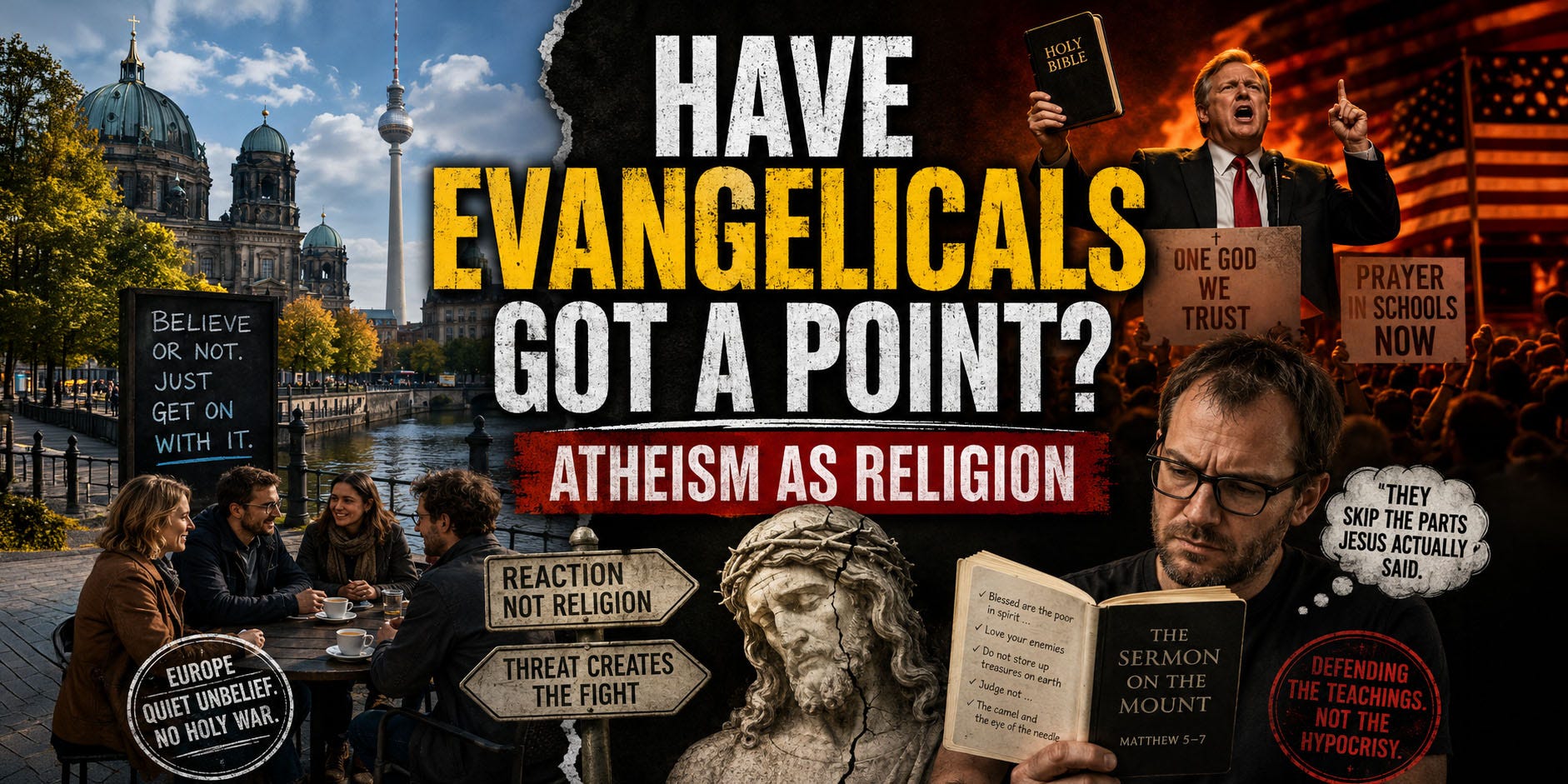
Atheism has become its own religion, with its own saints, its own scripture, its own holy war against the believers. The line gets recycled at dinner tables and in op-eds, usually by someone mildly annoyed that a coworker wouldn’t shut up about Richard Dawkins in 2011. It sounds clever the first time you hear it. A bunch of people so obsessed with God’s nonexistence that the obsession itself starts to look like worship.
So could atheism be hardening into a religion of its own, complete with dogmas, judgments, and a way of life it wants to push on everyone else?
What “Atheist Religion” Describes
When somebody insists that atheism functions like a faith, ask them to name the doctrine. Whatever they say will be wrong and based on false assumptions because atheism has none. There’s no shared cosmology, no agreed-upon ethics, no founding text everyone signs off on. Atheists disagree with each other about nearly everything that isn’t the single proposition they have in common. They split on politics, on morality, on whether the New Atheist crowd of the 2000s was insightful or insufferable. The only thing that unites them is the absence of a belief, and an absence can’t be a creed.
What the complainers are pointing at is a behavior, not a belief system. They’ve met someone who treats unbelief as a cause, who organizes their identity around it, who wants to debate you about Genesis at a barbecue. That person exists. He’s just rare, and he’s concentrated in very specific places for very specific reasons. The mistake is taking the loudest one percent and pretending he’s the prototype. You’d never define Christianity by its sidewalk preachers screaming about hellfire outside a sports stadium, because you know those guys are outliers. The same courtesy never gets extended in the other direction.
Consider what an actual religion requires and then check the list against atheism. A religion has rituals that members perform together on a schedule. Atheists have none. A religion has a community you join, with membership that means something, with elders or clergy or some structure of authority. Atheists have nothing like it, and the handful of “atheist church” experiments that popped up a decade ago folded within a few years because the demand wasn’t there. A religion makes claims about the supernatural, the afterlife, the purpose of existence. Atheism makes exactly one claim, that there’s insufficient reason to believe a god exists, and it’s silent on everything else. Two atheists can hold opposite views on the meaning of life, the source of morality, and what happens when you die, and still both be atheists in good standing, because there’s no standing to be in.
There’s also a sleight of hand buried in the accusation. Calling atheism a religion is meant to level the playing field, to suggest that the believer and the nonbeliever are both running on faith, both equally committed to an unprovable position. It’s a tidy way to avoid defending the specific claims of your specific tradition. If everybody’s religious, then nobody has to answer for the talking snake. Convenient. The move quietly redefines “faith” to mean any strongly held position, which would make a vegetarian’s diet a religion and a skeptic’s doubt a sacrament. Words stop meaning things when you stretch them that far, which is the point of stretching them.
Founding members now get, besides my heartfelt thank-yous, unlimited Q&A (within reason), to pick one newsletter topic per month, and a name mention in every post. You name the price.
Europe Forgot to Have the Argument
In much of the West, science denial isn’t tied to Christianity but to irrationality, the same impulse that drives anti-vaccine forums and astrology apps and the conviction that the moon landing was staged. The mainstream Christian churches in Europe got off that train decades ago. The Catholic Church accepts evolution and the Big Bang, and has for a long time. The Anglican Communion isn’t fighting to put creationism in classrooms. The Lutheran churches of Scandinavia and Germany aren’t lobbying against climate science. If atheism were a reaction to religious anti-intellectualism as such, Europe would be crawling with combative atheists. It isn’t.
Walk around London, Amsterdam, Stockholm, or Berlin and try to find someone who structures their weekend around disproving God. You’ll have a hard time. Not because Europeans are more devout, they’re famously less so, but because the fight that produces the angry atheist never really happened there in the same way. Religion sits in the background of European public life like a cathedral you walk past on your way to work. It’s part of the architecture. Nobody’s storming it because nobody’s defending it as a weapon.
That’s the tell. Militant atheism shows up where militant religion shows up. It’s a mirror, and it only appears where there’s something aggressive standing in front of it. Take away the aggressive religion and the mirror has nothing to reflect.
The numbers back this up rather than contradict it. Surveys consistently put the religiously unaffiliated at a far higher share of the population in Western and Northern Europe than in the United States, sometimes more than half a country. Yet you don’t see proportionally more atheist activism in those places. You see less. A nation can be majority nonreligious and have essentially no organized atheist movement, because there’s nothing for one to organize against. The unbelief is settled, ambient, uncontroversial. It doesn’t need spokesmen because nobody’s trying to take it away. Activism is a function of threat, and where the threat is gone, so is the activism, regardless of how many nonbelievers are around.
British Atheists Make Their Money Elsewhere
Britain is the instructive case because it produced the most famous unbelievers of the modern era and then ignored them at home. Dawkins, the late Christopher Hitchens, and the rest became household names, but look at where the demand was. They built their lecture circuits, sold their books, and packed their auditoriums largely in the United States. The market for aggressive, public, take-no-prisoners atheism was American. The supply happened to be British, because Britain produces excellent debaters and exports them like it once exported everything else.
At home, religion and politics mostly don’t mix, so there’s nothing to push against with any urgency. A British politician who started quoting scripture to justify policy would be met with embarrassment, not applause. The Church of England is literally the state church, with bishops sitting in the House of Lords, and it functions as a polite ceremonial presence rather than a political attack dog. That arrangement defuses the very tension that makes atheism feel necessary as a public stance. When faith isn’t being used as a cudgel, you don’t need a shield.
The clinching detail is the one nobody in Britain bothered to celebrate. A sitting Prime Minister can be an open atheist and the country shrugs. It barely registers as a fact about him, let alone a controversy. And here’s what should bury the “atheism is a religion” thesis for good: British atheists didn’t treat that as a victory. There were no triumphant op-eds, no movement claiming a scalp, because it was never the point. You only count wins in a war you think you’re fighting. They weren’t fighting one. Compare that to the American scene, where the religious affiliation of every candidate gets scrutinized like a credit score, and a confessed nonbeliever running for high office would be committing electoral suicide in large parts of the country.
American Atheism Is a Response to American Christianity
So why is the United States different? Because American atheism is a reaction, and you can’t understand the reaction without the thing it’s reacting to. It grew up across the table from Christian fundamentalism, the well-funded, politically organized, openly theocratic strain that wants prayer back in schools, evolution out of them, and the Ten Commandments bolted to courthouse walls. It grew up watching politicians wave Bibles they’ve clearly never opened, men who couldn’t name a single book of the Gospels but have learned that saying “Jesus” on a debate stage moves voters in the primary.
That’s the engine. American unbelievers got loud because the religion in front of them got loud first, and got political, and started writing its preferences into law. You don’t get a Madalyn Murray O’Hair without prayer in public schools to fight about. You don’t get the Four Horsemen of New Atheism filling theaters without a creationist movement trying to rewrite biology textbooks. The aggression is downstream of the provocation. Remove the provocation, as Europe largely did, and the aggression evaporates, as it largely has.
This is the context the “atheism is a religion” crowd keeps leaving out, because including it ruins the symmetry they’re going for. They want a picture of two equally fanatical sides, equally unreasonable, equally faith-based. What they’ve got is a fire and the people complaining about the smoke. One side is trying to legislate a particular reading of Leviticus. The other side mostly just wants to be left out of it.
The asymmetry runs deeper than tone. The fundamentalist movement in America has real institutional muscle behind it, megachurches with budgets that rival small corporations, think tanks, legal advocacy groups that take cases to the Supreme Court, and a voting bloc that politicians court openly. The atheist “movement,” by contrast, is a few nonprofits, a publishing imprint or two, and a podcast circuit. Treating these as matched combatants in a holy war is like describing a man with a leaf blower and a hurricane as two weather systems. The scale isn’t comparable, and the direction of force isn’t either. One side is pushing to expand its reach into law and schooling. The other is pushing to keep the existing wall between church and state from being knocked down. Defending a boundary is not the same act as trying to cross it, no matter how loudly the people defending it talk.
Atheists Defend Jesus Better Than the Christians
And now the irony, because there’s a genuinely funny one sitting at the center of all this. The American atheist who engages, who reads the text closely enough to argue about it, often ends up treating the New Testament with more care than the politicians invoking it. He’s read the Sermon on the Mount. He knows what it says about wealth, about violence, about judging your neighbor, about the camel and the eye of the needle. He can quote the passages where Jesus tells you to give your money away and pray in private rather than perform on a street corner.
Then he watches a self-described champion of Christian values campaign on cruelty to the poor, on nationalism, on stockpiling wealth, on the exact behaviors the figure they’re invoking condemned in plain language. The atheist, the supposed enemy of the faith, is the one pointing out that the emperor’s robes don’t match the rulebook. He’s defending the integrity of a text he doesn’t even believe is divine, purely because watching it get strip-mined for political cover offends his sense of basic honesty.
That’s the position the “atheism is a religion” argument can’t account for. If atheists were the mirror-image fanatics the accusation needs them to be, they’d want Christianity to look as ugly as possible. Instead, the engaged ones keep holding up the actual teachings against the people claiming to follow them, and the comparison is brutal. It turns out you don’t have to worship a carpenter to notice when his name is being used to sell something he’d have flipped a table over.
You can watch this play out in real time during any election cycle. A candidate brands himself as the defender of the faith, the bulwark against godless liberalism, and then governs in a way that would make the Beatitudes blush. Blessed are the meek, blessed are the merciful, blessed are the peacemakers, and here’s a man who built his whole appeal on contempt for all three. The believers in the pews either don’t notice or don’t care, because the brand matters more than the content. Meanwhile the atheist sitting at home, who long ago decided the resurrection didn’t happen, is the one going line by line through the Gospels to show exactly where the politician departed from the script. He’s doing the homework the faithful skipped. There’s something almost touching about it, a nonbeliever guarding the reputation of a teacher he thinks was wrong about the metaphysics but right about the meanness of greed.
If you’re not already a paid subscriber and you’re finding value here, I’d love for you to consider becoming one to keep The Unholy Truth alive.
Can Atheists Sound Like Religious Zealots?
Anyone who lives in a black-and-white world, claims absolute truth, and leaves no room for discussion will sound like a religious zealot, atheist or not. Intolerance to scrutiny looks the same whether the certainty is Christianity, Islam, capitalism, Marxism, or communism. It’s the posture that matters; the label is just a detail.
Yes, there’s a group of atheists, concentrated in America, who came out of religion carrying a need for certainty and went looking for it in science once the church stopped supplying it. The instinct is human. Certainties, the G-spot of all religions, make it easy to get on with life. You want a solid floor to stand on, a final answer you can stop questioning, and religion was very good at handing one over. When that floor disappears, some people go shopping for a replacement, and science looks like the obvious candidate because it wears the lab coat and carries the prestige.
The trouble is that science isn’t in the certainty business. It calls certainties dogmas, and it’s sometimes annoyingly humble about what it’ll commit to. Take Bertrand Russell’s teapot. If you claim there’s a teapot orbiting the Sun, the burden of proof sits with you and no one has to disprove it, but science will never declare there isn’t one. The best it’ll offer is that there’s no evidence to suggest there is. That’s a weaker, more careful statement than the convert wants, and the ones who treat science as a substitute scripture tend to overstate it, talking as if the absence of evidence were thundering proof of absence. Science is fundamentally incompatible with non-existence claims because they require omniscience.
Science is so humble that it treats the statement “every natural phenomenon has a natural explanation” as an assumption it has to work with, not a fact.
But notice what that humility buys.
The refusal to claim more than the evidence supports is exactly why science works as common ground between believers and nonbelievers across much of the West. A Catholic biologist and an atheist biologist can stand at the same bench and agree on the result, because the method doesn’t ask either of them to swear an oath about ultimate things. The zealous convert misunderstands the tool he’s reaching for. Science isn’t a louder, smarter religion. It’s the one place the argument gets to pause, and the people who treat it like a creed are missing the only feature that made it worth adopting.
Sources and Further Reading
Pew Research Center, “Religious Landscape Study” and successive surveys on the religiously unaffiliated in the US and Europe.
Phil Zuckerman, Society Without God: What the Least Religious Nations Can Tell Us About Contentment (2008).
Charles Taylor, A Secular Age (2007), on how secularization unfolded differently across the West.
Steve Bruce, God Is Dead: Secularization in the West (2002).
Richard Dawkins, The God Delusion (2006), and Christopher Hitchens, God Is Not Great (2007), as primary texts of the movement discussed.
Grace Davie, Religion in Britain: A Persistent Paradox (2015), on “believing without belonging” and the quiet status of British religion.
Susan Jacoby, Freethinkers: A History of American Secularism (2004), on the reactive character of organized US unbelief.
Tags: atheism, secularism, religion and politics, Christian nationalism, New Atheism, Richard Dawkins, Christopher Hitchens, separation of church and state, American politics, European secularism, hypocrisy, fundamentalism, freethought, religious decline, culture war
There are certainly teapots orbiting the sun. I have about 10 of them in my pantry.
I have been following the rise of James Talarico with great interest. He is certainly not an atheist, but he is arguing that the Democratic party, as imperfect as it is, is far better aligned with message of Jesus than are the Republicans. Frankly the fact that the Democrats ceded Christianity to the Republicans was political malpractice. Can he win on Texas? The odds are against him but the polls are encouraging, and he is running against a monumentally flawed opponent.