


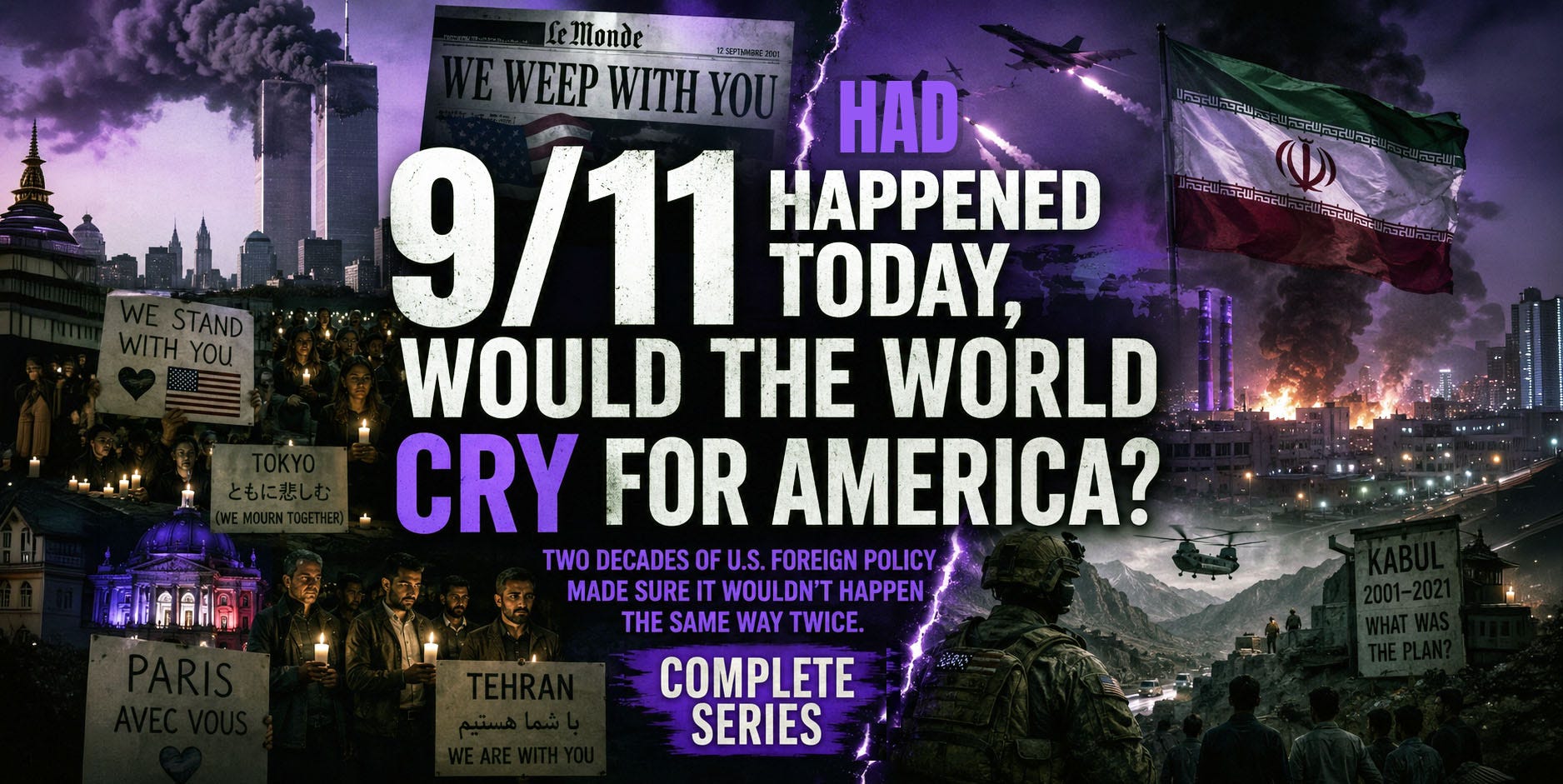
When the towers fell in 2001, the whole planet cried with America. Older generations remember that. Newer ones never heard of it at all. The shock reached Paris cafés, Nairobi markets, Tokyo offices, and villages in Afghanistan that had never had a reason to think about New York. Countries that despised U.S. politics still lit candles, held vigils, and sent condolences. Iran, yes, Iran, held a public moment of silence for the victims. NATO invoked Article 5 for the first time in its history: an attack on one member is an attack on all.
That same Iran is the country the U.S. has been bombing since February 2026. A joint U.S.-Israeli campaign hit Iranian nuclear sites, military leadership, and infrastructure that month, a ceasefire in April didn’t hold, and by late July the U.S. was in its second week of renewed nightly strikes, with Washington and Tehran trading talk of negotiations and talk of further escalation in the same breath. The country that once paused in silence for American dead is now the one receiving American bombs, turning even the Iranians who once mourned with America against it.
It’s hard to explain to anyone too young to remember, but the mood back then was almost surreal. Newspapers across Europe printed the American flag on their covers. Crowds left flowers at U.S. embassies. Moscow’s city hall hung a banner reading We Weep With You. The whole world pressed pause for a moment, like it wanted to say: we’re with you. That early wave of goodwill is exactly what makes the next two decades feel like such a massive, once-in-a-century waste.
What the World Sent Beyond Its Condolences
Governments, alliances, and ordinary people showed up in ways that are easy to forget now. NATO backing the U.S. under Article 5 was only the start. European allies tightened airports, shared intelligence, and sent forces once ISAF formed in Afghanistan. Canada diverted hundreds of flights and hosted thousands of stranded passengers in towns like Gander.
The UN Security Council condemned the attacks and pushed new counterterrorism rules. Russia offered intelligence and opened logistics routes through Central Asia. Muslim-majority states across the world publicly condemned the attacks, and many granted overflight rights and cooperation. Pakistan became a key logistics corridor. Gulf partners hosted bases and aircraft, and Central Asian states provided airfields that made early operations possible.
Cities well beyond Europe held vigils and moments of silence. Cathedrals, mosques, synagogues, and temples hosted joint prayers, and crowds lined up to donate blood. In Tehran, ordinary Iranians held candlelight vigils while their leaders issued condolences. From Nairobi to Tokyo, flags flew at half-mast, newspapers ran black covers, and radio stations paused their programming. People organized, gathered, and mourned, which takes more out of a person than posting sympathy does.
Allies sent forensic teams, search-and-rescue specialists, air marshals, and port-security advisers. NATO AWACS crews patrolled U.S. skies. Intelligence services shared names, money trails, and travel data that led to arrests far from New York or Washington, and banks tightened rules and froze accounts linked to terror networks. Airports changed screening overnight. Moments of silence took place at football matches in Europe and Latin America, orchestras dedicated performances to the victims, and landmarks lit up in U.S. colors. Even rival states paused the usual rhetoric. For a brief window, the tone worldwide was grief first, politics second.
That early solidarity turned into commitments with troops attached: forces for ISAF, trainers for Afghan security forces, development teams, medics, engineers, police mentors. Not every promise held up, and not every country agreed on strategy later. But in the days and weeks after 9/11, the reaction was clear and concrete. Condemn the attacks, stand with the victims, help shoulder the load.
Afghanistan, the One War That Made Sense at the Start
The U.S. had a golden moment. For a brief window after 9/11, it held near-universal sympathy and support, the kind of goodwill that doesn’t come around often. It could have built lasting alliances, coordinated a global counterterrorism strategy, and even addressed some of the political grievances that fed extremism in the first place. Instead, Washington went full cowboy and decided raw military power would do the job on its own.
Afghanistan came first, and at the start it made sense. The Taliban had sheltered bin Laden and al-Qaeda, and the world accepted that something had to be done. NATO allies sent troops, intelligence agencies shared information, and even countries with frosty relations to the U.S. offered logistical help. The mission’s stated goal was clear enough: dismantle al-Qaeda, remove the Taliban from power, and keep Afghanistan from becoming a terrorist safe haven again.
That mission didn’t stay focused for long. What began as a targeted counterterrorism operation turned into a massive nation-building project the U.S. had neither the patience nor the cultural grounding to pull off. The strategy drifted from fighting al-Qaeda to propping up a deeply corrupt Afghan government and trying to rebuild the country’s institutions from scratch while fighting an insurgency that never let up.
It became a 20-year grind. The Costs of War project at Brown University puts the direct death toll in the hundreds of thousands when Pakistan is included, with estimates ranging from roughly 176,000 to over 240,000, and the financial cost above $2 trillion. The war outlasted multiple presidents and military commanders, each promising a corner was about to be turned. Instead it ended with a chaotic, televised withdrawal in August 2021, the Taliban sweeping back into Kabul before the last U.S. plane had even left the runway. What started with overwhelming global sympathy ended in a humiliating retreat that left behind hard questions about whether the mission had been doomed from the moment it tried to do everything at once.
Jordan’s Field Hospital in Helmand
Jordan was one of the top non-NATO troop contributors to ISAF, and its help started early and stayed consistent. The Jordan Armed Forces sent a field hospital to Afghanistan in 2002 that treated hundreds of thousands of patients over the years it operated there. Jordanian infantry task forces later deployed to Helmand and guarded coalition bases like FOB Sharana, freeing up American soldiers for other missions. NATO officers who worked alongside them made a point of thanking Jordan specifically for what its troops brought to the mission.
Jordan’s role went beyond boots on the ground. Its Female Engagement Teams worked with Afghan women and children in ways American units structurally couldn’t, given how differently gender and family access work in rural Afghan society. Jordanian troops preached what they called the true, moderate essence of Islam in villages where the Taliban had been the only religious voice locals ever heard, renovating mosques and running Ramadan programs for orphans and struggling families. A small, Muslim-majority kingdom sent doctors, soldiers, and outreach teams into a war zone to counter a Taliban that claimed to speak for their shared religion, and it kept doing it for over a decade.
That mattered on the ground in Afghanistan, and it mattered for the “West versus Islam” storyline extremists were trying to sell.
The Alignment Historians Usually Have to Reach Back Generations to Find
That’s the world America had in the fall of 2001. NATO allies, Gulf monarchies, European tabloids, Iranian mourners, and a Jordanian field hospital all pointed the same direction at once. Governments that agreed on almost nothing else agreed that what happened in New York and Washington was a crime against everyone, and they backed that agreement with troops, intelligence, airspace, and money. The U.S. had that handed to it in a single morning.
None of that goodwill was owed to anyone. It was earned in real time, by an America that had just been hurt and had the world’s sympathy because the world recognized the moment for what it was. What happened to that sympathy over the following two decades starts with a choice Washington made about what to do with a war in Afghanistan that still, on paper, made sense.
The Iraq Invasion That Had Nothing to Do With 9/11
Then came Iraq, the moment everything flipped. Iraq had nothing to do with 9/11, no weapons of mass destruction, no links to bin Laden. The Bush administration wanted a war anyway, so it cooked the intelligence, played the fear card, and dragged the UK, Australia, and a handful of others along for the ride.
Most of the world saw through it instantly. Millions protested in the streets of London, Rome, Madrid, Sydney, and New York. America ignored them. The message landed clearly: thanks for the sympathy, now shut up and get out of the way while we bomb whoever we want.
That’s when the goodwill began to rot, and it happened at full speed.
Abu Ghraib, the Black Sites, and the Drone Program
Nothing burns through global credit faster than invading a country on false pretenses, killing civilians, and setting up torture camps. Abu Ghraib, Guantanamo Bay, and the secret CIA black sites all landed inside a few years of each other. The country that claimed to stand for freedom and human rights was running medieval-style dungeons and calling it “enhanced interrogation.”
Then came the drones, sold as precise tools that would only kill bad guys. Precision in theory and precision in practice turned out to be two very different things. Weddings, funerals, kids playing soccer, all hit by missiles at various points. By the time the U.S. government admitted how many civilians had died, the damage was already done. In much of the world, “American drone” became shorthand for a flying death lottery.
By the mid-2000s, that 2001 wave of goodwill had curdled into open resentment. For millions, America played the part of the angry drunk who wrecked the bar and then lectured everyone else about manners.
Cozying Up to the Hijackers’ Home Country
The same America that demanded the world unite against terrorism had no problem staying close with Saudi Arabia, a monarchy that produced most of the 9/11 hijackers. It scolded other countries over human rights while running its own secret prisons. It claimed to fight extremism while toppling governments and leaving chaos behind that bred more of it.
People notice this pattern, and once they see it, they stop buying the freedom-and-democracy pitch. By now, a lot of the planet hears “U.S. foreign policy” and thinks: what’s in it for them, and how badly is this going to hurt the rest of us?
Blaming Islam, Excusing Budapest
After 9/11, America and much of Europe treated the attacks as something that happened because of Islam, full stop, as if the religion itself were the cause rather than decades of specific political conflicts and Western missteps. That framing was convenient for everyone except the truth. Terrorist organizations wanted it, because it let them sell their fight as Islam under attack rather than a set of grievances tied to specific regimes and specific wars. And Western politicians wanted it too, because it let them skip explaining where their own policies in the region had gone wrong.
The 9/11 hijackers were Muslim Arabs, and the roots of their hatred ran through decades of Western intervention in the Middle East. Scripture had very little to do with it. But “the West’s problem is with Islam, and Islam is under attack” recruits a lot more people than “the West’s problem is with specific regimes and specific policies.” It lets extremist groups turn a regional grievance into a global one, telling anyone who identifies as Muslim that an attack on Arabs is an attack on them too.
Jordan is the clearest proof that framing was always a lie. In 2005, Abu Musab al-Zarqawi, a Jordanian-born militant running al-Qaeda in Iraq, sent suicide bombers into three hotels in Amman. One of the blasts hit a wedding reception in full swing, killing dozens of guests. The attack killed around 60 people, most of them Jordanians, and Jordanians came to call it their own 9/11. A decade later, ISIS captured a Jordanian pilot named Muath al-Kasasbeh and burned him alive in a cage on camera. Jordan answered with three straight days of airstrikes on ISIS positions in Syria. These groups have spent two decades killing Muslims who work with the West as often as they’ve killed anyone in the West itself, which is why religion never was the dividing line.
And yet plenty of Americans who couldn’t find Jordan on a map are quick to treat a small Arab kingdom that hosts U.S. troops, shares intelligence, and has taken in more refugees per capita than almost anywhere on earth as a standing security risk, purely because it reads as Muslim on a map. Meanwhile Hungary, a NATO member with a treaty vote, is run by a nationalist populist who blocks EU aid to Ukraine, cozies up to Moscow, and has been accused of gutting judicial independence and press freedom to keep himself in power. Nobody’s calling for Hungary to be kicked out of NATO. Most Americans have never even heard how bad it’s gotten there. Suspicion, it turns out, tracks with who looks the part more than with who causes the alliance trouble.
Livestreams Where the Anchors Used to Be
If 9/11 happened today, you’d still see sympathy in the first hours. People would post condolences, leaders would send formal statements, hashtags would trend. It wouldn’t feel like 2001, though, because the gut-level unity is gone along with the trust that made it possible.
After the original attacks, America went past defending itself and reshaped the world in ways that made things worse for a lot of people. The wars killed hundreds of thousands and displaced millions. Countries got stuck taking in refugees by the hundreds of thousands. The War on Terror became a convenient excuse for other governments to pass their own surveillance laws and crackdowns. The U.S. told the world it was either with us or against us, and plenty of people decided fine, then we’re against you. America lost friends and made new enemies, and it taught old ones that all they had to do to bait the U.S. was wave a flag with Arabic writing and yell “terrorism.”
In 2001, news still had gatekeepers. TV anchors and newspapers shaped the narrative, and the story was America under attack, full stop. Now, if a 9/11 happened, you’d have live streams, conspiracy theories, and amateur analysis pouring out of every corner of the web within minutes. People in countries the U.S. had bombed would be posting “now you know how it feels” before the dust even settled. The story wouldn’t stay contained to the victims in New York or D.C. Every post would drag in Afghanistan, Iraq, Libya, Syria, Yemen. The sympathy would still be there, but it would come with a lot more “but” attached to it than it did in 2001.
By the time you add it all up, the pattern is hard to miss. Iraq torched the credibility. Abu Ghraib and the drone strikes torched the moral high ground. The internet made sure nobody outside America could forget any of it. The Saudi relationship exposed the hypocrisy for anyone still paying attention. And the reflexive suspicion aimed at a country like Jordan, while a NATO member gets a pass for doing far worse, showed that a lot of the reaction was never really about security to begin with. None of this happened to America. America did it, decision by decision, over the better part of a decade, to a world that had shown up for it without being asked.
So where did all of that go? Who benefited from two decades of wars that killed hundreds of thousands, cost trillions, and left America with fewer friends than it started with? The answer isn’t really about Iraq or Afghanistan anymore.
How America Did Bin Laden’s Job For Him
In many ways, America did to itself what bin Laden never could. No organization on Earth possesses the resources or budget to dismantle America’s global image quite like America has.
Terrorism aims at more than a body count. Bin Laden couldn’t care less what religion the victims were, or whether they were Muslim, Christian, or atheist. The aim is always to provoke a reaction, hoping to give the target enough rope to hang itself. Terrorism works best when it goads a government into an overreaction that erodes its own legitimacy and alienates its allies. Look at the October 7 attack that triggered the war in Gaza: Israel’s severe response destroyed its standing on the world stage and strained key alliances, maybe even irreparably. The aftermath of 9/11 followed the exact same playbook.
Instead of staying focused, targeting the perpetrators, and working with allies who were ready to help, the U.S. went full tilt into wars that had little to do with the original attack. Afghanistan was at least directly tied to al-Qaeda’s base of operations. Iraq wasn’t. The 2006 U.S. National Intelligence Estimate, a consensus document from every American intelligence agency, concluded the Iraq War had become a rallying cause for jihadists that was breeding more terrorists than it killed. U.S. policy was doing recruitment work for the other side.
Al-Qaeda’s long-term strategy was arguably to draw the U.S. into a draining, unwinnable conflict in the Muslim world, echoing the Soviet Union’s experience in Afghanistan during the 1980s. The U.S. walked right into that trap. Toppling Saddam Hussein’s regime shattered Iraq’s state structure and unleashed sectarian chaos that became fertile ground for al-Qaeda in Iraq and eventually ISIS. It turned a regional conflict between Arabs and the West into the global war between Islam and the West that the recruiters had been advertising all along.
While all of that played out abroad, America was handing terrorism a domestic win too. The Patriot Act, passed in a hurry with minimal debate, gave the government broad power to spy on its own citizens with little meaningful oversight. Legal scholar David Cole put it bluntly: the most enduring legacy of 9/11 is the damage done to constitutional freedoms, more lasting than the damage to buildings or even the lives lost.
Then came the security theater: the endless TSA lines, the confiscated shampoo bottles, the color-coded terror alerts. None of it stopped a determined attacker, but it reminded Americans every day to stay afraid, and fear is exactly what terrorists want. Bin Laden bragged in a 2004 video that for every dollar al-Qaeda spent on the 9/11 attacks, the U.S. was spending millions in response. A country that bleeds itself dry on purpose has done the enemy’s accounting for him.
Drone strikes aimed at “high-value targets” often killed civilians instead, a pattern human rights groups like Amnesty International and Human Rights Watch have documented repeatedly. A 2012 joint Stanford and NYU report, Living Under Drones, found the strikes created a constant state of fear in the communities they targeted, undermining whatever goodwill toward the U.S. remained. Every child killed in a strike became a propaganda gift to extremists, who didn’t need to invent lies about America. They could just point at the rubble.
Beyond failing to stop terrorism, America helped the movement evolve, spread, and adapt. Chalmers Johnson warned in Blowback (2000, updated after 9/11) that U.S. military interventions often plant the seeds of future attacks. After 9/11, that warning went from theory to reality fast. By 2014, when ISIS declared its caliphate, the Middle East had become a patchwork of failed states and war zones, many of them shaped or worsened by post-9/11 U.S. policy.
Terrorism is about reshaping the political environment to favor the terrorists’ goals as much as it’s about bombs and bullets. On that front, bin Laden succeeded on 9/11 and America helped him keep succeeding for years afterward.
Trump, Burning Bridges with Allies
If George W. Bush squandered America’s goodwill after 9/11, Donald Trump took the bridges that were left and set them on fire.
Allies who had stood alongside the U.S. in Afghanistan, who had shared intelligence and spilled their own soldiers’ blood, suddenly found themselves treated like freeloaders. Trump’s foreign policy, if it deserves the name, was built on the idea that every relationship was a zero-sum business deal, and the only way for America to win was for someone else to lose.
NATO, the very alliance that had invoked Article 5 in solidarity with the U.S. after 9/11, became one of his favorite punching bags. He called it obsolete in a 2016 interview, then spent years publicly insulting member states over defense spending. NATO had debates over burden-sharing for decades, but previous presidents handled it behind closed doors. Trump blasted allies in public and handed Russia exactly the propaganda it wanted: the image of a divided West.
Then came the trade wars. In 2018 the Trump administration slapped tariffs on steel and aluminum imports, citing national security. That framing didn’t just target China. It hit Canada, the EU, and Japan too, countries that had fought alongside the U.S. in multiple wars, suddenly treated like security threats over metal imports. Former Canadian Prime Minister Brian Mulroney called it insulting and absurd. European leaders were just as blunt.
The Iran nuclear deal went next. The Obama-era agreement, officially the JCPOA, had been signed by the U.S. and Iran along with the UK, France, Germany, Russia, and China, and international inspectors had confirmed Iran was complying. Trump tore it up in 2018 without a serious alternative in hand. Allies came away convinced the U.S. couldn’t be trusted to stick to its own agreements. Richard Haass, president of the Council on Foreign Relations, warned the move undermined not just that one deal but the credibility of the U.S. in every future negotiation.
Then there was climate. In 2017 Trump pulled the U.S. out of the Paris Agreement, making it the only country in the world to reject the pact. French President Emmanuel Macron mocked Trump’s slogan right back at him with his own: “Make Our Planet Great Again.” In diplomatic terms, that’s a slap in the face.
By the time Trump left office, Pew Research surveys showed U.S. favorability had dropped in most allied countries. In Germany, trust in the U.S. president fell to single digits, lower than it had been during the Iraq War. A 2020 Pew study found confidence in U.S. leadership had hit record lows in key allies like the UK, France, and Canada since the poll began tracking the question.
And all of that covers only the first term. What the second one has done to those same relationships deserves an article of its own.
If 9/11 happened during the Trump years, America would have been asking the world for sympathy with an empty reputation account. Allies would still send condolences, but the mass candlelight vigils in Paris and Berlin would have been long gone.
What America Spent the Sympathy On
If 9/11 happened today, the world would still mourn, just not the way it did in 2001.
Raw human empathy for innocent lives lost doesn’t disappear, and most people, regardless of their politics, do not want to see thousands die in a single morning. But today, that grief would come laced with frustration and cynicism. A quiet voice in the back of many minds would whisper that the U.S. brought some of this on itself. After all, hundreds of thousands of deaths in Iraq dwarf the tragedy of a few thousand lives lost in America.
Particularly in Muslim-majority countries, mourning for America, especially with Trump as the president, might even be seen as a political statement best avoided in public.
That is the true tragedy underneath it all. In 2001, the U.S. had the entire world standing behind it. Global unity like that is exceptionally rare, and when it happens, it offers a historic chance to build something meaningful. Instead, America burned through that goodwill in record time. It treated allies like disposable tools, lied its way into wars, dismissed civilian casualties as mere collateral damage, and transformed global sorrow into permanent distrust.
If 9/11 happened today, the vigils would be smaller, the flags fewer, and the condolences shorter. Once the official statements were read, the world would quickly move on, mindful of the long list of countries still living with the fallout from the last time everyone rallied around America, only to watch it waste the moment.
The Unholy Truth is a full-time job, and it can only go on with reader support. If you find value in this work, please consider becoming a paid subscriber. And if you’re currently going through a rough patch, don’t worry about it, just message me and I’ll set you up with a complimentary subscription, no questions asked.
Upgrade to a paid subscription to unlock this exclusive bonus section and get the complete picture.
A fascinating and compelling look at America’s march across the Middle East, carelessly, and with little thought for consequences as it finds a way to alienate both it’s allies and sometimes its own citizens by making the world a more dangerous and unpredictable place.
Of course America must respond to attack and to any threat of nuclear assault, but limits to military action must also apply. Unchecked aggression must be tempered with restraint.
An exciting and powerful three part journey with America gone to war.
Thank you, Tanner.
Before 9-11, Business Week had an article noting that the US was getting frustrated negotiating with the Taliban in Afghanistan over building an oil pipeline to get oil from central Asia. At that time, the Taliban had 2 allies, Pakistan and Saudi Arabia. So it was pretty clear 9-11 was Saudi Arabia telling the US to back off Afghanistan.
Of course George W. Bush blamed bin Laden. Bin Laden said he had nothing to do with it. It turns out bin Ladin had chronic kidney disease and had to live in Pakistan, but the US decided to invade Afghanistan to get bin Ladin. During the conflict, bin Ladin made one video that was in Afghanistan, and he was clearly suffering. The rest of his videos and tape recordings were made in Pakistan, where he could get medical care.
Iraq was part of the plan to retaliate against Saudi Arabia. The US and Saudi Arabia jointly controlled the world oil market, but Iraq had large oil reserves, and if the US controlled those, it wouldn't need Saudi Arabia. The Saudis decided to fight the US in Iraq. The people hired by the US to protect Iraq's oil infrastructure were paid by the Saudis to blow it up. And the Saudis had the unemployed Iraqi army to hire as mercenaries.
BTW, China built the oil pipeline to Afghanistan. And George W. Bush finished his second term with a global economic catastrophe. Get ready for the sequel.