


Welcome to the second Friday Edition, where we’ll look at Christian history and antisemitism.
It’s a subject that gets people’s backs up, and usually for the same reason. When someone treats it critically, the blame lands on Christianity itself, as though one unchanging religion has been running since the first century. Readers hear an accusation pointed at their own faith, go defensive, and the history stops being something anyone can learn from.
Antisemitism has worked in Christian history the way white supremacy has. Both claim Christian inspiration, both tell people how they’re supposed to live, and both reach for political power on that basis, which makes them ideologies.
So when I write “Christians” and “Christianity” in what follows, I mean the churches, councils and preachers who spoke in Christianity’s name and had the power to act on it at the time.
Hitler Wasn’t Reading Aquinas
The Nazis weren't, by any meaningful theological measure, devout Christians executing church doctrine although crowds involved were predominantly Catholic or Protestant. Hitler wasn't reading Aquinas for policy guidance, and the SS didn't check with the Vatican before Babi Yar. The regime wasn't trying to convert Jews to Christianity to give them their citizenship back. But that makes it anything but a closed case when it comes to Christianity's relationship with the Holocaust.
You have to ask where several hundred million ordinary, baptized, church-attending Europeans got the idea that Jews were a poison in the body of Christendom that needed to be cut out. The resentment wasn’t a twentieth century thing that went viral. They inherited it, generation after generation, from an institution that had been road-testing that idea since before the Roman Empire converted.
The Original Sin: Deicide
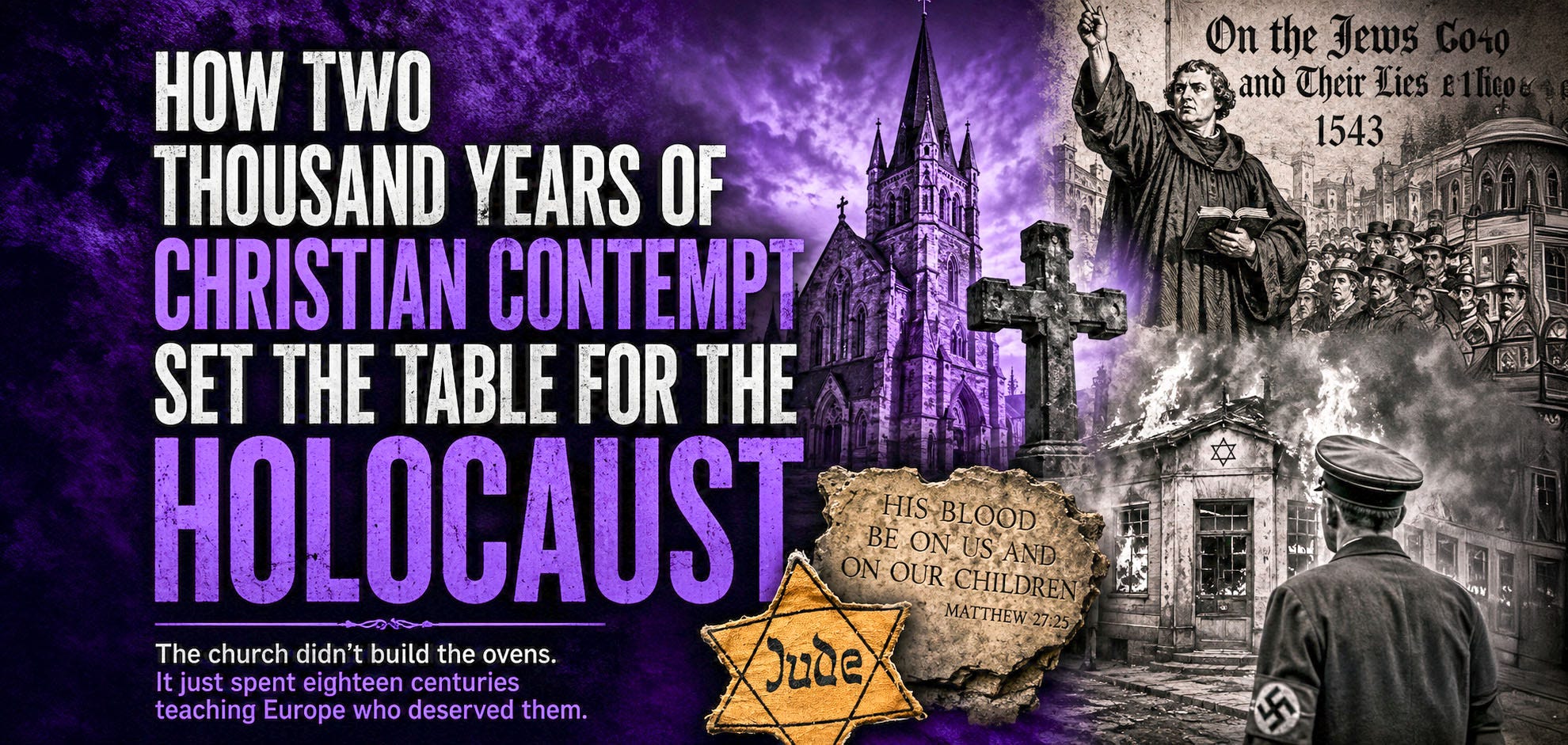
The charge itself is older than Christendom as a political entity and it never left. The Gospel of Matthew has a Jewish crowd shouting “His blood be on us and on our children,” and for the next nineteen centuries, preachers treated that line as a permanent indictment, not a piece of first-century polemic between Jews arguing with other Jews about who Jesus was. By the time gentiles ran the church instead of Jews who followed Jesus, the argument had curdled into a permanent verdict: Jews were guilty of killing God, and guilt like that doesn’t expire.
Once Emperor Theodosius made Christianity the state religion in 380, that theological grudge got teeth. Bishop Ambrose of Milan, a man the church now calls a saint and a Doctor of the Church, argued against Jews receiving compensation after a mob burned down their synagogue, asking rhetorically who would even avenge a synagogue. That’s a bishop, on the record, treating the destruction of a Jewish house of worship as barely worth mentioning, and he wasn’t some crank on the margins. He was mainstream fourth-century leadership, setting the tone for everyone downstream.
Building the Machinery
From there the church legislated hostility. The Fourth Lateran Council in 1215 ordered Jews to wear distinguishing clothing so Christians wouldn’t accidentally mix with them, the same logic the Nazis reached for with the yellow star seven centuries later, minus the subtlety. Ghettos, formalized in Venice in 1516 but practiced in various forms earlier, physically walled Jewish communities off from Christian ones. Forced conversions ran through Visigothic Spain and France in the seventh century, where Jews were given the choice of baptism, slavery, or exile, a pattern that repeated across Europe for a thousand years under different kings.
Then there’s the blood libel, the accusation that Jews murdered Christian children to use their blood in religious rituals. It got preached from pulpits, endorsed by local church authorities, and used to justify massacres from England in the twelfth century through to Russia in the twentieth. The Crusades, ostensibly launched against Muslims controlling Jerusalem, produced some of the worst anti-Jewish violence in medieval Europe before the armies even left the continent, because Christian mobs decided the “infidels” back home were a more convenient target than the ones holding the Holy Land itself.
Luther Doesn’t Get a Pass
Martin Luther, the man Protestants credit with restoring the true gospel, wrote a 1543 pamphlet called “On the Jews and Their Lies” after Jewish communities declined his offer to convert. In it, he called for synagogues to be burned, Jewish homes destroyed, prayer books confiscated, rabbis forbidden to teach on pain of death, and Jews reduced to forced labor or expelled outright. It’s Luther’s own explicit program, in his own words, no footnote scholars had to dig up.
Four hundred years later, in November 1933, the Nazi party threw a nationwide celebration for the 450th anniversary of Luther’s birth, describing their movement as the completion of what Luther started. When Kristallnacht happened in November 1938, Nazi propagandists made a point of noting it fell near Luther’s birthday, treating a pogrom that burned synagogues and murdered Jews across Germany as a kind of anniversary gift to a Reformation hero. That line was drawn by the Nazis themselves, not by historians looking to smear the church after the fact.
But if Christianity is the source of this hatred, how come thousands of Christians in Nazi Germany ended up in the transport wagons that carried them to their suffering and, for many, even to their deaths? The answer to that is sitting in Mein Kampf, the book Hitler published long before he took power.
Friday Editions are exclusive to paid subscribers. The rest of this one covers what Hitler wrote that no church council ever taught, why Christians were killed too, and what the Vatican admitted in 1965.