


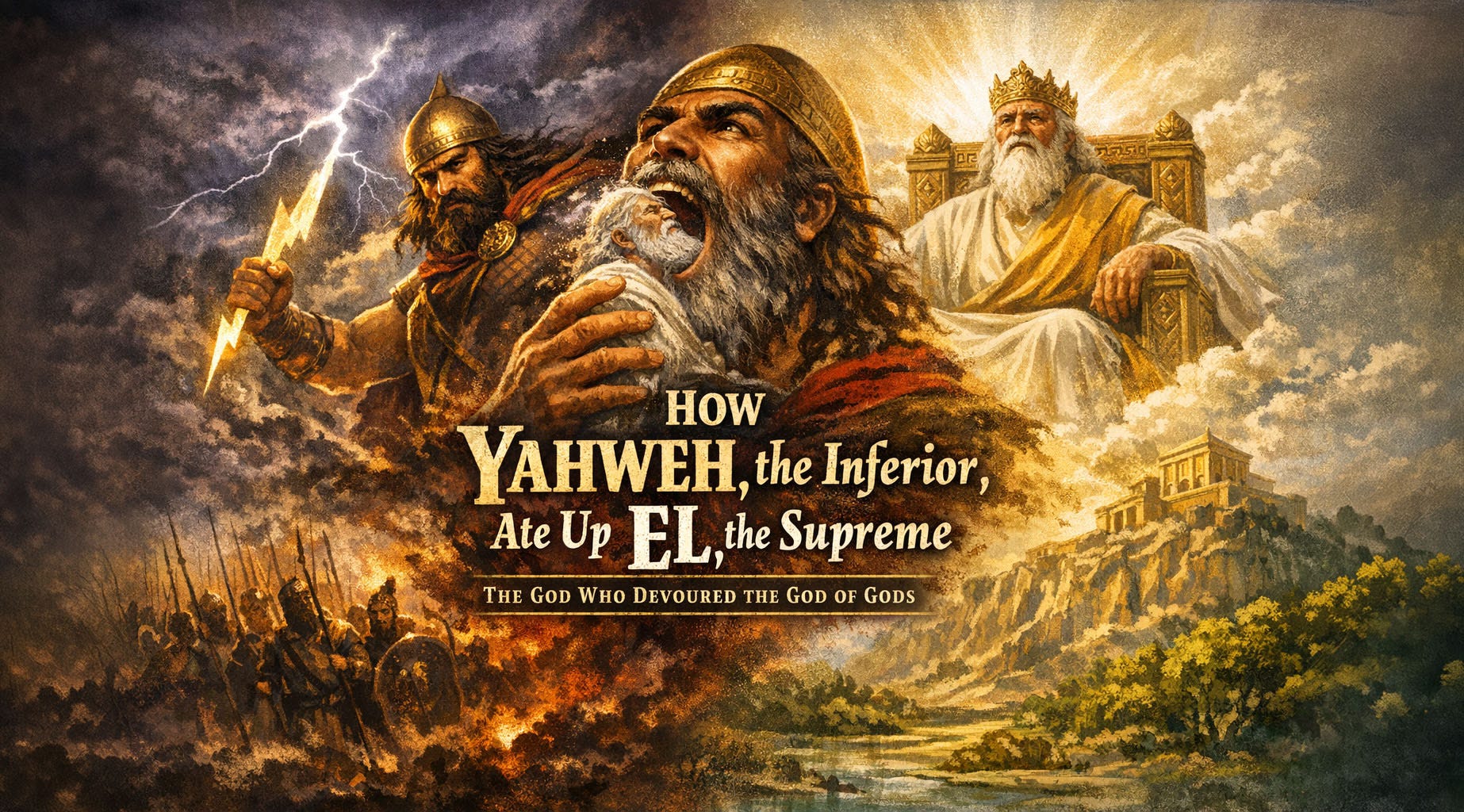
The god whom Jesus called Alaha, and whom people today call “God” in English, Elohim in Hebrew, and Allah in Arabic, has a name — Yahweh. And Yahweh demonstrably wasn’t always in charge.
Before he became the god of Moses, before he became the sole deity of Judaism, Christianity, and Islam — before he became the creator of the universe, the judge of all nations, the one and only — Yahweh was a minor regional deity, a storm god from the southern deserts and a second-tier figure in a pantheon he didn’t run. As a god of war, he wasn’t gentle, either — a vicious god you didn’t question. You just obeyed and didn’t let your conscience get in the way.
The god who ran things had a different name: El.
El was the head of the Canaanite pantheon — the patriarch, the creator, the god the other gods answered to, the Zeus of the Ancient Near East. His name is embedded in words billions of people still use without thinking about it: “Elohim,” “Allah,” “Israel,” “Bethel,” “Immanuel.” Every time someone says “Israel,” they’re invoking El. The name means something like “May El persevere.” Not Yahweh. El.
It’s an interesting fossil, a linguistic trace of a time when the people who became the Israelites worshipped a god named El, and Yahweh was either unknown to them or, at best, one of El’s subordinates.
What happened next is one of the most consequential religious mergers in history.