


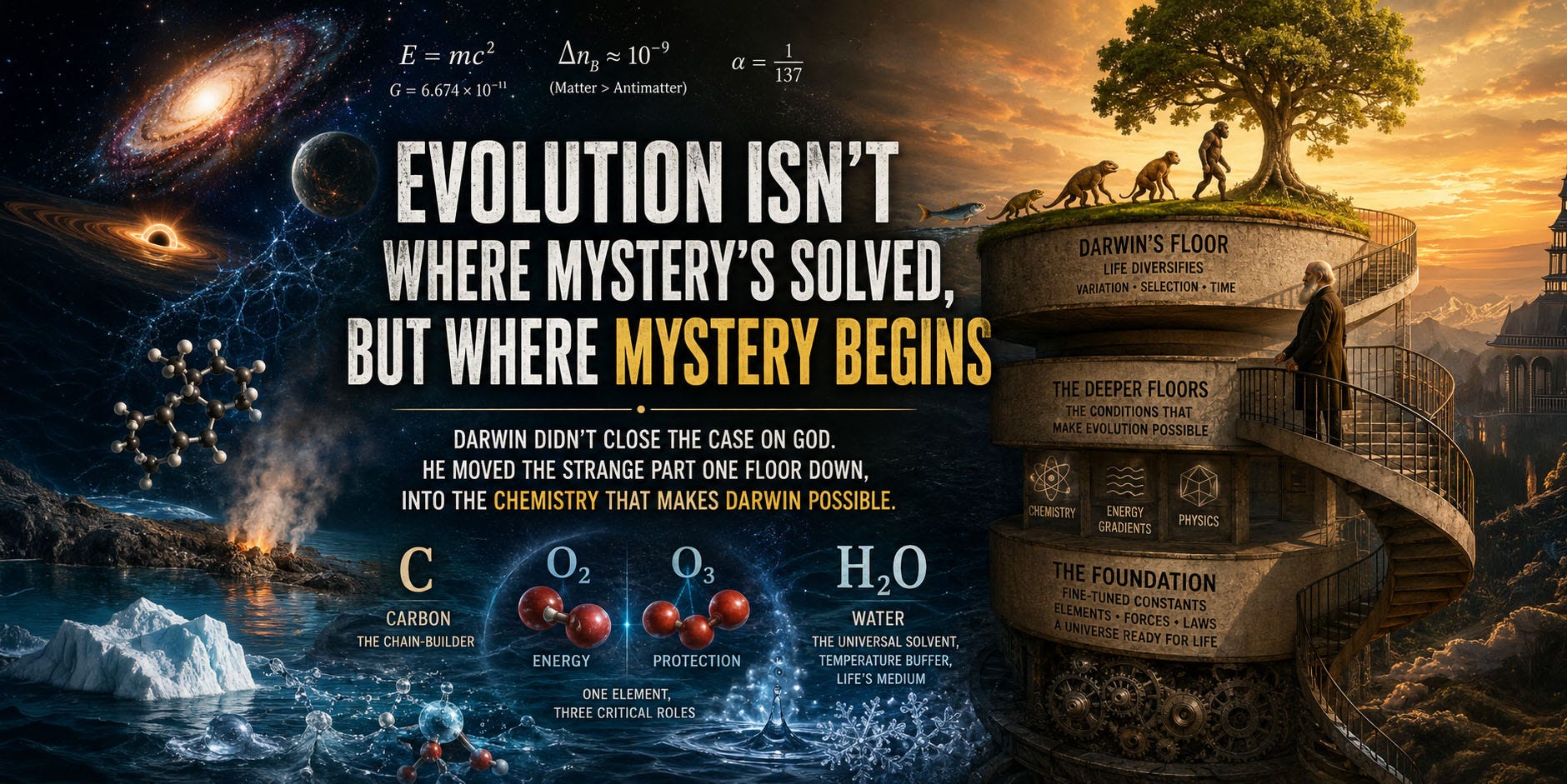
There’s a story a lot of people carry around without ever examining it. Darwin showed up, explained how complex life arose from simple beginnings, and in doing so, he quietly retired God. No designer needed; the watch made itself. Whether you cheer for that or mourn it depends on where you’re standing, but most people on both sides agree on the basic shape of the claim: evolution is the explanation that dissolved the mystery.
I want to argue something different, and it’s got nothing to do with whether God exists. Evolution explains a great deal. It explains how variation plus selection plus deep time produces eyes and wings and the human brain. What it doesn’t do is explain why the universe was the sort of place where that process could ever get going. A universe that runs itself, with no outside help, has more to account for, not less. The self-sufficient machine has to come pre-loaded with an absurd amount of fine-tuned hardware before the first replicator can copy itself.
So the mystery doesn’t vanish when you accept evolution. It relocates to a level, from biology into chemistry and physics, and once you follow it down there it gets stranger, not tamer.
And as always, don’t read this piece only in your inbox; like it, comment on it, criticize it, so that you have a say in how The Unholy Truth takes shape.
The Setup Almost Nobody Looks At
When people defend evolution against design arguments, they usually fight on Darwin’s home turf. Did the bacterial flagellum evolve in steps? Can the eye be built incrementally? These are good fights and the evolutionists generally win them. But notice what both sides take for granted while they’re arguing. They assume a universe that already has stable atoms, an element that bonds into long chains, a solvent that dissolves and transports those chains, energy gradients to run reactions, and physical constants tuned tightly enough that any of this holds together for billions of years.
That’s the part nobody puts on trial. Without that there’s nothing for selection to select. Evolution is software that needs the hardware first, and the hardware is where the real puzzle lives.
I’m not even leaning on the cosmological arguments here, though they’re worth a glance. There’s the question of why causality bottoms out somewhere instead of regressing forever. There's the matter-antimatter asymmetry, where for every billion antimatter particles in the early universe there were roughly a billion-and-one matter particles, and that tiny surplus is the only reason anything material survived the mutual annihilation instead of leaving a cosmos of pure radiation. There's gravity, which is staggeringly weak compared to the other forces, weak enough that stars burn slowly over billions of years rather than flaring out in an afternoon. There's dark matter, which barely interacts with ordinary matter at all yet shapes galaxies through gravity, and without that scaffolding the structures that house stars and planets don't form the way they did.
There’s the iron, an element where fusion stops paying out energy, because it has the most tightly bound nucleus of all. A massive star’s core can’t burn past it, so once the core fills with iron, it collapses under its own weight, and that collapse triggers the supernova that scatters every heavier element into space. Without an element with the properties of iron, there would be no supernovas. Stars would settle quietly into dead cores, and the universe would remain a thin broth of hydrogen, helium, and dead suns, with no way to forge the heavier atoms life depends on.
Those are the famous cases, and physicists argue about them constantly. Set them aside. I want to stay closer to home, inside the chemistry that evolution actually depends on, because that’s where the fine-tuning stops being abstract and starts being something you can taste.
Carbon Was Never Going To Be Optional
Life on Earth runs on carbon, and that isn’t a quirk of local availability. Carbon sits in a chemical sweet spot that almost nothing else occupies. Each carbon atom carries four unpaired outer electrons, which lets it bond to four other atoms at once, and crucially it bonds strongly to other carbon atoms. That property, catenation, is what lets carbon build the long stable chains and rings that proteins, sugars, lipids, and DNA are made of. No long chains, no information storage, no metabolism, no replicators. No Darwin.
The usual objection is that silicon could do the same job. Silicon sits right below carbon on the periodic table, it also has a valence of four, and on paper it looks like a clean substitute. Science fiction has run with this for decades. The chemistry doesn’t cooperate. Silicon can only form short chains of silicon linked to silicon, which sharply limits the complexity of its compounds, and that limit matters enormously when you’re trying to build the high-molecular-weight molecules living matter requires. But even with silicon did,
So the picture isn’t that carbon happened to be lying around so life used it. Life needed an element with carbon’s exact bonding behavior, and the field of candidates is essentially one entry long. Boron and a few others get mentioned for forming multiple bonds, but none of them deliver carbon’s combination of strength, versatility, and stability at the temperatures where liquid water exists. The universe had to manufacture carbon, in quantity, with these properties, before evolution had a single brick to work with. And carbon itself only exists in abundance because of a separate fine-tuning story inside dying stars, where a specific nuclear resonance has to fall in a narrow window for stars to fuse carbon faster than they destroy it, so the supply that evolution drew on came at the cost of its own delicate setup deep inside collapsing suns.
Oxygen Plays Three Different Games
Carbon builds the structures. Oxygen runs the energy, and oxygen is a strange enough element on its own to deserve its own section, because it does at least three jobs that look like they belong to three different substances.
As O2, the diatomic molecule we breathe, oxygen drives combustion and aerobic metabolism. The same reactivity that makes fire possible is what lets complex animals extract large amounts of energy from food. Anaerobic life can manage without it, but it stays small and slow. The energy budget that pays for big multicellular bodies, nervous systems, and eventually brains comes from oxygen’s appetite for electrons. But even if we can imagine a life form that doesn’t depend on O2, without an element like oxygen there is no fire, no control over energy conversion, and far less of the technology we know.
Stack three oxygen atoms instead of two and you get ozone, O3, which does something completely unrelated. It sits in the upper atmosphere and absorbs the ultraviolet wavelengths that would otherwise shred DNA at the surface. The same element that powers the metabolism down here builds the shield up there that keeps the metabolism from being sterilized. One atom, two molecular forms, two jobs that have nothing to do with each other except that life needs both.
Then bind oxygen to hydrogen and you get water, and water is where the coincidences pile so high they start to look like a joke. Virtually all liquids get denser as they cool and solidify, so the solid sinks. Water does the opposite near freezing. Ice floats. That single anomaly is why lakes and oceans freeze from the top down instead of solid from the bottom up, which is why aquatic life survives winters and why the planet never locked itself into a permanent deep freeze it couldn’t escape. Water also has an enormous heat capacity, so it buffers temperature swings and keeps living systems from cooking or freezing on every hot afternoon and cold night. It’s a near-universal solvent, which is what lets it ferry nutrients, ions, and waste through every cell. It climbs against gravity through narrow channels by capillary action, which is part of how tall plants move water from root to leaf. Pull on a column of it and it resists breaking, so that column can be hauled upward without snapping.
No single one of these properties is miraculous on its own. The trouble is that life needs all of them at once, and they all fall out of the same modest little molecule that also happens to be made from the two most cooperative atoms available. Strip out the floating ice, or the heat buffering, or the solvency, and the chemistry of life doesn’t get harder. It stops.
The Battery Had To Exist Before The Devices
There’s another piece that gets skipped, and it’s the one that finally made the whole problem click for me. Even granting carbon and oxygen and water, evolution still needs something to push against. Life isn’t a substance, it’s a process, and processes need energy flowing downhill to run. A cell that’s reached chemical equilibrium with its surroundings is a dead cell. Life is the trick of staying far from equilibrium, of holding a gradient and feeding off it, and that means the universe had to supply gradients to feed off before the first organism could exist to do the feeding.
It supplied them generously, and again the reasons run back to physics that has nothing to do with biology. Stars exist because gravity is weak enough to let hydrogen pile up and fuse slowly rather than all at once, which gives you a steady output of usable energy over billions of years instead of one brief flash. That sunlight hits a planet that’s cold on the night side and in the depths, so there’s a temperature difference to exploit. Early life almost certainly got its first push from chemical gradients at hydrothermal vents, where mineral-rich hot water met cold ocean and the difference in proton concentration across thin mineral walls looked uncannily like the proton gradients that every living cell still uses to make energy today. The machinery of life didn’t invent the gradient. It found one already running and learned to tap it.
Without the gradients, you can have all the carbon chains and water you like, and nothing happens. The molecules sit there. What turns chemistry into biology is the constant flow of energy from a high state to a low one, and that flow is a gift of the same finely set constants that gave us long-burning stars and a structured cosmos. The battery had to be charged and wired before any device could plug into it, and nobody charged it on life’s behalf. It was charged by the time life showed up.
Abiogenesis Makes Sense
We have close zero idea how abiogenesis actually happened. Nobody has run the experiment from raw chemistry to a self-replicating cell, and the gap between a warm pool of organic molecules and the first thing that copies itself is enormous and largely unmapped. Yet, to scientists it doesn’t sound like magic because we understand the properties of carbon, oxygen, and water, and we know there aren’t real substitutes for them.
Carbon builds the chains, water dissolves and ferries everything, oxygen runs the energy and shields the surface. Given those three doing what they do, the move from complex organic chemistry to self-copying molecules looks less like a miracle and more like water running downhill. We can’t yet trace the exact channel it ran down, but we know the slope was there and we know what it was made of.
This is where the Big Bang picture matters, and people skip past how strange the implication is. The best theory we have for the universe says the same atoms are everywhere. The hydrogen, carbon, oxygen, and nitrogen on Earth are the same hydrogen, carbon, oxygen, and nitrogen on every other planet and moon and dust cloud out there, differing only in their proportions and which isotopes dominate. The cosmic recipe runs heavy on the light elements and on everything up to iron, then drops off sharply for the heavier stuff, because, as we just saw, anything past iron only gets made in the violence of a dying star. So the chemistry available for life anywhere in the universe is the chemistry we already know. There’s no secret periodic table for aliens. They’d be working with our atoms, under our physics, building from the same handful of elements that bond well enough to carry information.
That’s what makes the carbon-hydrogen-oxygen combination behind life so hard to wave away as a local accident. It isn’t one option pulled from a deep bag where Earth happened to draw this particular ticket. It’s close to the only hand the universe deals, everywhere, because the elements that bond into the rich, stable, information-carrying molecules life requires are scarce in the lineup of candidates and abundant in the cosmos. Both at once. The thing that works is also the thing that’s lying around in quantity, and that coincidence repeats on every world.
Suppose someone insists there’s some other chemistry we simply haven’t imagined, an exotic route to life that skips carbon and water entirely. Grant it for the sake of argument. It doesn’t rescue the accident reading, it deepens the problem. Now you’re asking the universe to be set up so that consciousness can arise through multiple independent chemical paths, not just one, which means the dials were tuned for life even more generously than the single-path version requires. Either way the same fact stares back: the cosmos arrived stocked with exactly the materials a living, thinking system would need, in the amounts it would need them, and abiogenesis is what you get when that stock sits in the right conditions long enough. The puzzle was never whether life could emerge from this chemistry. It’s why this chemistry was here, loaded and waiting, in the first place.
Let me be straight with you. The Unholy Truth runs on readers who decide it’s worth paying for. If you aren’t a supporter yet and you’re meaning to become one, now’s the time.
What Exactly Am I Saying
Put the pieces side by side and a pattern shows up. Evolution needs a chain-builder, and the chemistry hands it carbon, the one element with the right bonds, forged in stars under a separate set of fine tunings. It needs an energy source and a UV shield, and oxygen covers both with two forms of the same element. It needs a solvent that transports everything, buffers temperature, and refuses to freeze life to death from below, and water does all of it through one structural quirk after another. None of this is the product of selection, because selection can’t begin until the whole arrangement is already in place. There’s nothing to mutate and nothing to inherit until the hardware exists.
This is why evolution isn’t the place where the mystery gets solved, but where the mystery announces itself. Darwin gave us a gorgeous account of what happens once you have replicators competing in an environment. He said almost nothing about why the environment was built to permit replicators at all, and he never claimed to. The fine-tuning of the constants, the manufacture of carbon, the triple life of oxygen, the freakish behavior of water: these aren’t biology’s questions, and biology can’t answer them. They sit underneath biology, holding it up.
Discovering that the universe runs itself, with no hand reaching in to nudge each species along, doesn’t shrink the thing you have to explain. It enlarges it. A universe that needs constant intervention only has to be good enough to be patched. A universe that runs unassisted from the first instant has to arrive with every constant already set, every element already tuned, every coincidence of water chemistry already baked in, because there’s no one around later to fix what’s broken. Self-sufficiency is the harder thing to account for, not the easier one.
I’m not going to tell you what’s behind that. I’ve got the questions, and I don’t pretend to have the answers. I’m not smuggling in a god through the back door either, partly because nobody can even agree on what the word is supposed to point at, and an explanation nobody can define explains nothing. So I’m not even selling agnosticism to you as a philosophical label, since even that sounds like picking a side in the question.
The cause of the fine-tuning might be a vast spread of other universes with other settings, or a deeper physics that forces these values and we haven’t found it yet, or something that fits no category a human has invented. I don’t know, and the people who sound certain in either direction are usually selling something. None of those guesses puts more on the table to be tested or falsified than the existence of a god does.
So I’ll end where the honest position leaves you: unsettled. Stay curious and stay humble, because we’ve barely started to work out how any of this hangs together. We know just enough about the universe to misread our own confusion for understanding, and the chemistry that makes a reader possible is stranger, the longer you look at it, than the story that says it was all explained a century and a half ago.
Sources and Further Reading
Anthony Lane, The Vital Question: Energy, Evolution, and the Origin of Complex Life
Caltech, “Bringing Silicon to Life” (2016), on the chemical similarity and limits of silicon versus carbon
Cosmic Evolution (Harvard/CfA), Eric Chaisson, on alternative biochemistries and why carbon prevails at Earth-surface temperatures
Fred Hoyle’s work on the carbon resonance in stellar nucleosynthesis
Martin Rees, Just Six Numbers: The Deep Forces That Shape the Universe, on the physical constants and matter-antimatter asymmetry
Philip Ball, H2O: A Biography of Water, on the anomalous properties of water
Tags: evolution, fine-tuning, origin of life, carbon chemistry, philosophy of science, cosmology, agnosticism, science and religion, water chemistry, biochemistry
Re "This is why evolution isn’t the place where the mystery gets solved, but where the mystery announces itself." This has been true from the beginning ... and religion solved none of it. Pointing out that there is much we do not know and much we need to explain doesn't imply a god at all, just the status quo on this planet.
You are extremely well read and can think deeply about many subjects. The superpower 'behind' the various physical and chemical entities that made biological evolution possible is hardly the God of various religions. This superpower cannot be worshipped or prayed to.
More importantly, here is some food for thought for you:
Spirituality is related to Biology exactly the way Biology is related to Chemistry.