


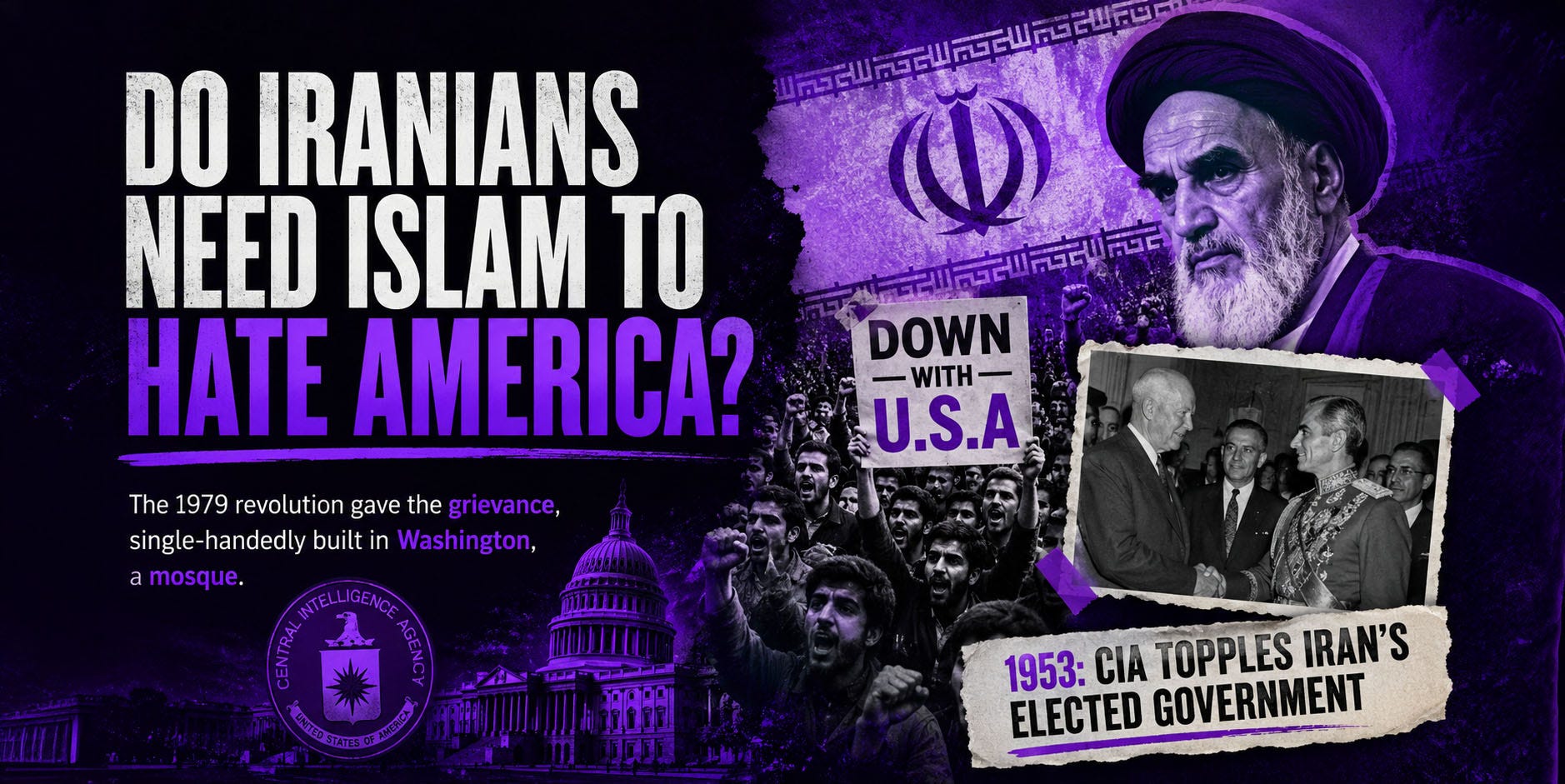
A typical American will tell you the reason Iran hates the United States is that they’re religious fanatics. The mullahs need an enemy to keep the population angry, so they picked us, and the whole thing runs on Quran verses and Friday sermons about the Great Satan. Take away the theocracy, the reasoning goes, and the hostility evaporates, because it was never about anything except Islamic zealotry looking for a target.
It’s a comforting story if you’re American, because it means none of this is your fault. The problem is Iranian, specifically the Iranian religion, and the United States just happens to be standing where the fanatics are pointing.
That story requires you to know almost nothing about the actual history of the two countries, which is convenient, because most Americans know almost nothing about the history of their own country’s foreign policy. The anti-Americanism the Islamic Republic runs on isn’t an invention of the clergy, and the easiest way to see that is to notice who else holds it. By the government’s own friendly surveys, better than one in four Iranians are irreligious, and the anonymous polling puts that figure far higher. Plenty of those people would sooner die than get behind anything with America’s fingerprints on it, and they’ve got reasons that have nothing to do with a mosque.
Not a paid subscriber yet? If you can afford it, consider joining. It’s what keeps this project open for the people who can’t.
Elected Iranian Government the CIA Erased
In 1951 Iran had a prime minister named Mohammad Mossadegh, and he’d been brought to power through parliamentary politics, not a putsch. His signature move was nationalizing the Anglo-Iranian Oil Company, the British concern that had spent decades pumping Iranian oil and keeping most of the money. When an American oil firm in Saudi Arabia agreed to split revenues fifty-fifty with Riyadh in 1950, the pressure on the British operation in Iran became unbearable, and Mossadegh acted on what a lot of Iranians already believed, which was that the oil under their feet ought to benefit them.
The same allied powers that never tire of reminding you they invented democracy and saved the world from the Nazis decided an elected government helping itself to its own oil was intolerable. The government of Winston Churchill, of all people, approached Washington repeatedly, first under Truman, who declined, worried about the precedent covert regime change would set. The Eisenhower administration had fewer such worries.
In 1953 the CIA, working with British intelligence, ran the operation that toppled Mossadegh and restored the Shah, Mohammad Reza Pahlavi, to unchallenged power. The Americans called it Operation Ajax. For decades it was an open secret, denied officially, understood by everyone paying attention. Then the documents came out.
The admissions came in stages. In 2013 the National Security Archive at George Washington University published a declassified internal CIA history that stated the coup “was carried out under CIA direction as an act of US foreign policy,” the first time the agency formally acknowledged what it had done. In 2017 the State Department released roughly a thousand pages on the operation, documenting how it was planned, cabled, and paid for. In 2023 the agency conceded on its own official podcast that the coup had been undemocratic, and admitted that 1953 stands as a rare exception to its standard claim that its covert operations propped up popularly elected governments. They overthrew a popularly elected government, and they said so.
So before you get to the mullahs, before you get to a single Friday sermon, you have this: the United States reached into a foreign country, destroyed its elected leadership, and installed a monarch who would rule for the next twenty-six years on American support. Iranians didn’t need a cleric to explain this to them. They lived it.
How America Trained Shah’s Secret Police
The Shah understood what had happened to him and what had saved him, and he built his rule accordingly. In 1957, he established a secret police force, SAVAK, and the CIA helped him do it. This isn’t contested. A classified Senate Foreign Relations Committee report, later cited in a declassified CIA memo, confirms that the agency provided the Shah both money and training to set up the organization. Israel’s Mossad contributed as well, particularly on interrogation.
SAVAK became the most feared institution in the country. It censored the press, screened applicants for government jobs, ran its own prisons including Evin, and surveilled Iranians not just at home but abroad, tracking students in the United States through case officers assigned to that specific task. Its interrogation rooms produced techniques that Amnesty International documented in detail in the 1970s: electric shocks, extraction of fingernails, sleep deprivation stretched over weeks. A former chief Iran analyst for the CIA later went on the record that a senior agency officer had instructed SAVAK personnel in torture methods drawn from German techniques of the Second World War, that the Shah knew his people were being tortured, and that among CIA officers, stories of SAVAK torture were common knowledge.
In short, American intelligence helped stand up the machine, staffed the classes, and its own analysts knew what the machine was doing to Iranian bodies in Iranian basements. And the American public heard none of it. To an Iranian who lost a brother in Evin, the United States wasn’t a distant abstraction. It was the country that trained the men who did it.
By the late 1970s the Shah had made himself one of the largest purchasers of American military equipment on earth, a reliable oil supplier, and Washington’s designated pillar of stability in the region. Jimmy Carter, who’d campaigned on human rights as the soul of American foreign policy, flew to Tehran on the last night of 1977 and toasted the Shah as an island of stability in a troubled region, a tribute to the love his people bore him. Fourteen months later the Shah’s people ran him out of the country. Carter’s toast tells you exactly how much the United States understood about the population it was underwriting, which was nothing.
What the Clergy Inherited
When the Shah fell in 1979 and Khomeini’s movement took control, the new regime didn’t have to manufacture anti-Americanism out of theology. Every faction that had suffered under the Shah already had its own reasons to loathe Washington, and those factions covered the entire ideological spectrum. Marxists, secular nationalists, Islamists, liberal constitutionalists, all of them had been surveilled, imprisoned, or tortured by a secret police the United States helped build to defend a monarch the United States had installed. That shared experience was one of the few things holding the revolutionary coalition together.
The genius of the clerical regime, if you want to call it that, was recognizing a ready-made emotion and claiming it. The Great Satan rhetoric, the annual chants, the murals of skull-faced Statues of Liberty, all of that is theological branding applied to a grievance that predates the theology by a quarter century. Khomeini didn’t invent Iranian anger at America. He put a turban on it and pointed it where he wanted it to go.
You can see the split clearly if you look at what the regime kept and what it discarded. It kept Evin Prison. It kept the apparatus of political policing, rebuilt as VEVAK, and turned it on Iranians with an enthusiasm that outstripped anything SAVAK managed, including the mass executions of 1988. The Islamic Republic didn’t oppose the Shah’s methods. It opposed the Shah, and then adopted his methods wholesale. What it needed from America was the villain, and America had spent twenty-six years auditioning for the part.
This is why the “they only hate us because they’re religious” explanation collapses on contact with the record. When Iran’s mission to the United Nations responded to the CIA’s 2023 acknowledgment of the coup, it didn’t cite scripture. It said the 1953 operation marked “the inception of relentless American meddling in Iran’s internal affairs,” and it noted, accurately, that admitting the coup never came with any change in American behavior toward Iran. That’s not a mullah quoting the Quran. That’s a diplomat citing a historical fact the United States finally confirmed after seventy years of denying it.
Sources and Further Reading
Stephen Kinzer, All the Shah’s Men: An American Coup and the Roots of Middle East Terror (Wiley, 2003)
National Security Archive, George Washington University, declassified CIA internal history of the 1953 coup (released 2013) and the 2017 State Department Foreign Relations of the United States volume on Iran
Seymour Hersh, “Ex-Analyst Says CIA Rejected Warning on Shah,” New York Times, January 7, 1989
Amnesty International, reports on human rights and SAVAK torture practices in Iran (1970s, and Report 2005)
PBS NewsHour, “In first, CIA acknowledges 1953 coup it backed to overthrow leader of Iran was undemocratic” (2023)
Ervand Abrahamian, A History of Modern Iran (Cambridge University Press) for the broader arc from Mossadegh through the revolution
Tags: Iran, US foreign policy, 1953 coup, Mossadegh, CIA, SAVAK, Cold War history, Middle East, Islamic Revolution, American history
Very good analysis. There are plenty of other instances where the US interferred with the internal affairs of Iran: Iran Contra Affair under Reagan, supporting Irag in the Iran/Iraq War. Etc, etc.....
Insightful as always