


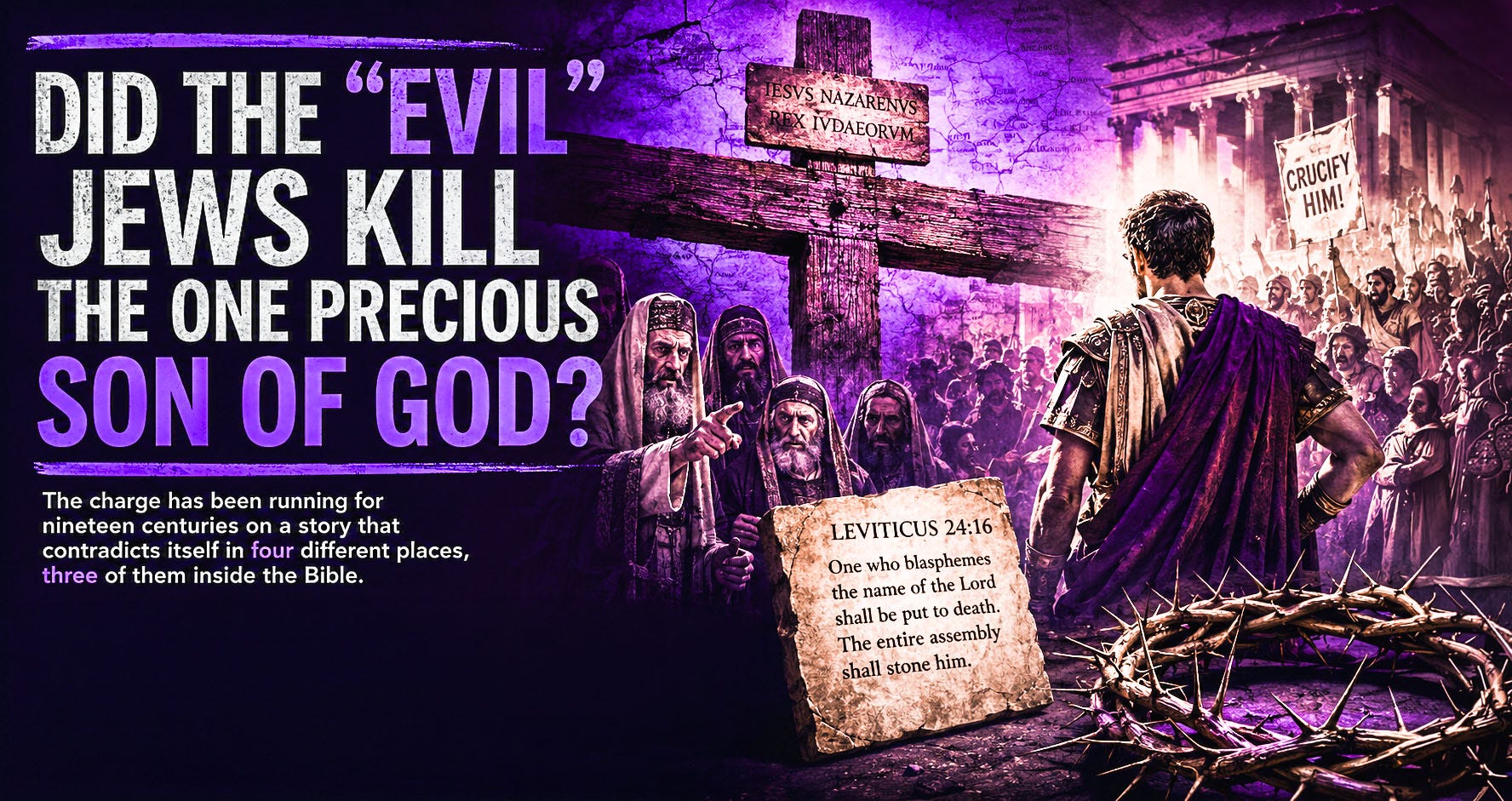
Every Easter, the accusation gets dusted off and put back on the road: The Jews rejected him, handed him over, and shouted for his blood while a decent Roman governor tried to save him. Christ-killers. Two thousand years of pogroms, expulsions, and ghettos have rested on that phrase.
Yet the same tradition that blames the Jews insists the execution was voluntary. He went willingly; he could have called down legions of angels to stop it at any moment. He also knew precisely what it would take to convince the crowd he was the Messiah, yet chose to conceal his glory and walk among them as an ordinary man.
Before We Begin
Two things.
First, this post may read like an attack on Christianity to my Christian readers. Please take the whole thing as a set of questions instead. If you have sensible answers to anything raised here, answers that hold your faith together and leave you confident you've been intellectually honest with yourself, I'm fine with that too. Your faith is yours to question or not to question, and nobody else gets a vote.
Second, this post runs about 50% longer than what I aim for, since a lot of you have told me you want the pieces to be shorter and more pointed. I spent quite a while trimming what you’re about to read, and then decided to give you the unabridged version anyway.
So tell me: is this piece too long, or am I keeping myself busy for nothing? Answer in the comments, and tell me what you thought of the piece while you’re there.
Best,
-Tanner
The Statute They Convicted Him Under Came From God
Let’s talk a bit about the accusation the Gospels themselves put in the high priest’s mouth now. Mark 14:64 has Caiaphas tear his robes and say “You have heard the blasphemy.” That’s the charge. That’s the whole basis of the Sanhedrin scene.
Torah commands in Leviticus 24:16: “One who blasphemes the name of the Lord shall be put to death. The entire assembly shall stone him.” No ambiguity, no discretion, no wiggle room for good behavior. The penalty is death and the community carries it out.
That law didn’t come from Roman occupation policy or from a corrupt priesthood inventing pretexts. In the text Christians treat as divinely given, God wrote it. He dictated it to Moses. So if the Sanhedrin heard a man claim to be the Son of the Blessed One and convicted him of blasphemy, they were doing precisely what their God had commanded them to do, under a statute he authored, with a penalty he specified.
You can’t hand a people a capital law, spend fifteen hundred years insisting they follow it to the letter, and then curse their descendants for following it. Either the law was good or it wasn’t. Christian theology has never picked one.
He Had Every Chance to Say They’d Misheard Him
Mark 14:61-62 has the high priest ask directly: “Are you the Messiah, the Son of the Blessed One?” Jesus answers, “I am, and you will see the Son of Man seated at the right hand of Power and coming with the clouds of heaven.”
Under the statute as written, that’s a defendant supplying the confession the law requires, and then adding the Daniel 7 imagery on top of it for emphasis. Matthew and Luke soften it into something more evasive, which tells you the later writers noticed the problem, but Mark, the earliest Gospel we have, gives us a straight answer to a straight question.
To Jewish clergy operating under Levitical law, what else was that supposed to sound like? A man in first-century Judea claiming a seat at the right hand of God is describing something the law has one category for.
And Jesus doesn’t correct the reading. He knew first-century Judea had as many messianic claimants as we have YouTube influencers. Nobody’s word was taken at face value, and nobody’s should have been.
Nobody Threw a Stone
Father prescribes stoning for blasphemy in Leviticus. Jewish capital punishment in this period, as the Mishnah later lays it out in Sanhedrin 7:1, ran to four methods: stoning, burning, decapitation, strangulation. Crucifixion isn’t on the list, and it isn’t on the list because it isn’t Jewish.
A crowd demanding Jesus’s execution for blasphemy would certainly have demanded the chance to stone him, the way their own God had ordered it done.
There’s also the question of who was permitted to kill anybody. Under Roman rule the Sanhedrin had no capital jurisdiction, and John 18:31 concedes it when the priests tell Pilate they aren’t allowed to put anyone to death. Josephus confirms it from the other direction: when the high priest Ananus convened the council and executed James, the brother of Jesus, during a gap between governors, Rome removed him from office for it (Antiquities 20.200). Whatever happened in that courtyard, the death sentence wasn’t the Sanhedrin’s to hand down.
Crucifixion was a Roman penalty, and a specialized one. Rome used it on slaves, on bandits, and above all on rebels and political agitators, people whose deaths needed to be public, slow and instructive. Six thousand of Spartacus’s followers went up along the Appian Way for the same reason.
One detail worth noting in passing. Only the lucky ones died within a few hours. Men nailed up this way commonly hung there for days, dying of thirst, exhaustion and asphyxiation.
Breaking God’s Laws to Hold God’s Law?
Let’s start with Deuteronomy 17:6 and 19:15, which require two or three witnesses in agreement before anyone can be put to death. Mark 14:56-59 states twice that the witnesses contradicted each other. By the standard the text itself sets, the case was over. Deuteronomy 19:16-19 goes further and says a witness who lies in a capital case receives the penalty he tried to inflict, and no one in the story faces so much as a question about it. Deuteronomy 17:7 then requires the witnesses to throw the first stones, which tells you what the end of a lawful blasphemy case looks like.
The high priest tears his robes at the decisive moment (Mark 14:63). Leviticus 21:10 forbids the high priest to rend his garments. Whatever a first-century court did or didn’t do procedurally, that prohibition sits in the same Torah the charge was supposedly drawn from.
Then there’s the timing, and it takes no later tradition to see it. This is Passover. Exodus 12 has every household indoors for the night. The Gospels ask you to accept that the chief priests, the elders and the scribes assembled in full during the festival, ran a capital case overnight, and got a man executed by the occupying power before the holiday meal had settled.
And these are only a few. I’ll write about this in detail in a later post.
Pilate Didn’t Prosecute Insults to a God He Didn’t Worship
The blasphemy theory needs Rome to care about blasphemy, and Rome didn’t. Pontius Pilate was a prefect of an imperial province who worshipped the Roman gods and answered to Tiberius. Yahweh’s honor was not on his list of administrative concerns. Roman governors had no jurisdiction over Torah violations, no interest in adjudicating them, and a standing policy of leaving local religious disputes to local authorities as long as nobody rioted.
Then there’s the Pilate the Gospels hand us, agonizing over the fate of one Galilean preacher, washing his hands, declaring innocence three separate times in Luke, and finally caving to a crowd. Compare him to the Pilate we meet in the sources written by people who lived under him. Philo, in Embassy to Gaius 302, describes his “briberies, insults, robberies, outrages and wanton injuries, executions without trial constantly repeated, ceaseless and grievous cruelty.” Josephus records him sending troops with concealed clubs into a crowd protesting his seizure of temple funds, and later slaughtering a group of Samaritan pilgrims, which finally got him recalled to Rome in 36 CE.
The Blame Shifts in Step With the Publication Dates
Mark, written around 70 CE, has a Pilate who’s suspicious and manipulable. Matthew, roughly 80 to 85, adds the handwashing and then the line that would fund two millennia of violence: “His blood be on us and on our children” (27:25). Luke, written in that same stretch, has Pilate declare Jesus innocent three times. John, around 90 to 95, refers to “the Jews” as a hostile bloc more than seventy times, in a Gospel whose hero, mother, disciples and entire early audience were Jewish, and hands us a Pilate who’s practically a philosopher.
The further the text sits from the events, the more innocent Rome becomes and the guiltier the Jews become. That’s what you expect of a movement writing for an audience inside the empire that had just crushed the Jewish revolt, burned the Temple, and paraded its treasures through Rome. A sect trying to survive under Roman rule had powerful reasons to explain that the empire had nothing to do with its founder’s death.
By the end you almost feel sorry for him, this confused and weak Pilate, cornered by the people he was sent to govern. The man behind the character was notorious for his cruelty, indifferent to what anybody in Judea wanted, and violent enough that Rome eventually recalled him for it.
The Empire’s Hand, The Empire’s Hostage
Crucifixion was never a Jewish sentence. It belonged to Rome, and Rome used it as public theater. What the ancient world saw on that hill was an empire executing an itinerant Galilean under the title nailed above his head, King of the Jews, which named the one offense Rome punished this way: challenging Caesar’s peace.
Over the centuries that followed, a brutal prefect got whitewashed into a hesitant philosopher, and a divided population living under occupation got flattened into a single guilty body, with the guilt handed down to its descendants forever.
Take the Gospel account at face value and Pilate still gave the order. Look at what that defense amounts to: I executed a man half-heartedly, because other people wanted it, on evidence that broke no law I was charged with enforcing. Therefore, I’m innocent.
Would antisemitism have vanished if the Gospels had blamed Rome primarily? Hardly. Jews would still fit the bill as scapegoats, since a minority group that maintains a distinct identity while rejecting the host culture’s Messiah will always invite suspicion. They would still be a convenient common enemy for any ruler who needed one. But the theological charge provided the core pretext, turning ordinary human prejudice into a divine mandate, and it blamed the victims for an execution designed, ordered, and carried out by Rome.
The last irony is that if Jews as a group had rejected Jesus as the Messiah, there'd be no Christianity to argue about, given the first Christians were all Jews. On the traditional attributions, so were the authors of the Christian scriptures for the most part.
If even a small fraction of regular readers became supporters, I’d spend less time running the business side of this publication and more time in the archives doing the research this work demands.
If you’re getting something out of these pieces, consider supporting The Unholy Truth. Supporters get the bonus sections, the Friday Editions, and the full archive.
Support the work and unlock all exclusive content on the site.
Sources and Further Reading
Bart D. Ehrman, Jesus: Apocalyptic Prophet of the New Millennium (Oxford University Press, 1999)
Paula Fredriksen, Jesus of Nazareth, King of the Jews (Alfred A. Knopf, 1999)
John Dominic Crossan, Who Killed Jesus? Exposing the Roots of Anti-Semitism in the Gospel Story of the Death of Jesus (HarperSanFrancisco, 1995)
E. P. Sanders, The Historical Figure of Jesus (Penguin, 1993)
Amy-Jill Levine, The Misunderstood Jew: The Church and the Scandal of the Jewish Jesus (HarperOne, 2006)
Helen K. Bond, Pontius Pilate in History and Interpretation (Cambridge University Press, 1998)
William Wrede, The Messianic Secret (1901; English translation, James Clarke, 1971)
Philo of Alexandria, On the Embassy to Gaius, 299-305
Flavius Josephus, Antiquities of the Jews, 18.55-64, 18.85-89
Tacitus, Annals, 15.44
Nostra Aetate, Second Vatican Council, 28 October 1965
Length of article was fine. Thanks for the excellent summation that invalidates 50 years of my indoctrination.
Thanks much for this article. Very well done. I was taught as a child decades ago that there were so many violations of Jewish law in the Gospel trial (15 at one recent count) that it casts doubt on the whole narrative. There was no reason for most of those violations, and their inclusion can be chalked up to either the Gospel authors' ignorance of the law, or their need to make the incident fit a prophetic framework.