


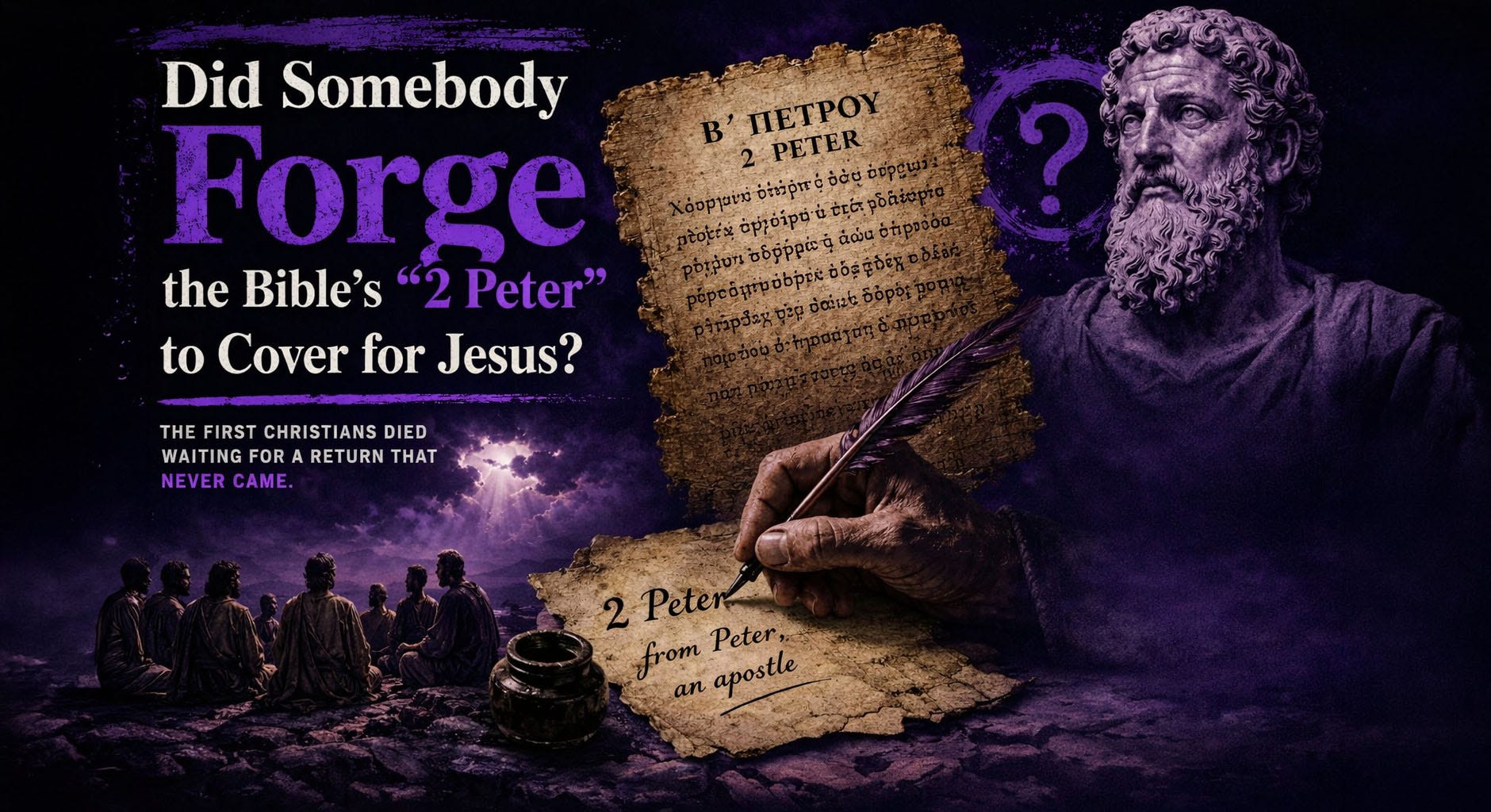
Including Paul, every early Christian believed Jesus was coming back soon. And not “soon” in the geological sense theologians retreat to now but “soon” as in within their lifetimes, within the lifetimes of the people standing next to them. It was Paul himself who told the Thessalonians that “we who are alive, who are left” would be caught up to meet the Lord in the air, and he meant himself and the people reading his letter. Jesus, in Mark, says some standing here won’t taste death before they see the kingdom come with power. Mark 13 continues, noting that this generation won’t pass away until all these things happen.
Then the generation passed away. The people who’d seen Jesus started dying of old age (or execution), and Jesus stayed gone. And the movement was left with a lot to explain.
Who Was the Historical Peter?
Start with who Peter was, because the letter depends on you not thinking about it too hard. His name was Simon, a fisherman from Capernaum on the Sea of Galilee, and he worked the family trade with his brother Andrew until Jesus pulled him into the movement. Jesus gave him the nickname that stuck, Kepha in Aramaic, the rock, which comes into Greek as Petros. Aramaic was his language while Greek was the language of the educated elite. Paul, who knew the man and is our earliest source, describes staying with him in Jerusalem, where Peter led the young church as its most prominent figure.
Acts calls him and John agrammatoi, unlettered men, in 4:13, yet the letter we’re about to look at is written in some of the most ambitious Greek in the New Testament.
The Author Gives Himself Away in the First Sentence
Among scholars who study the New Testament for a living, 2 Peter is the most widely rejected book in the entire canon when it comes to claimed authorship. Bart Ehrman calls it the one book that critical scholars are nearly unanimous about. Even conservative commentators who defend Petrine authorship for everything else tend to go quiet here.
The Greek in 2 Peter is elaborate, self-conscious, full of rare vocabulary and literary flourish, the work of someone trained in Hellenistic rhetoric. Peter was a Galilean fisherman. Acts 4:13 describes Peter and John as “unlettered” men, agrammatoi, which is about as blunt as ancient Greek gets about someone lacking formal education. The idea that this same man produced one of the most rhetorically ambitious documents in the New Testament, in a language that wasn’t his first, doesn’t survive contact with the text.
Then there’s chapter 2, which lifts huge chunks of the letter of Jude almost verbatim, reworking Jude’s attack on false teachers into its own. The author of 2 Peter is copying an earlier Christian document and folding it into a letter he’s signing with the name of Jesus’s chief disciple. Jude itself references events and a level of church development that already puts it late. Copy from something late and you land later still.
And the letter refers to Paul’s writings as a collection, comparing them to “the other scriptures.” Paul’s letters being gathered, circulated, and treated as scripture on par with the Hebrew Bible is a process that took generations. In Peter’s actual lifetime, Paul was a controversial contemporary he’d reportedly clashed with at Antioch, not a canonized authority whose letters you’d cite as holy writ.
Put it together and 2 Peter is writing from somewhere around 100 to 150 CE, decades after Peter was executed under Nero. Somebody wrote it in his name and hoped the borrowed authority would carry the argument.
Chapter 3 Is Where the Mask Slips
What sets 2 Peter apart in the Bible is that the author is more concerned with addressing a complaint than with teaching.
“Scoffers will come in the last days,” he writes, “saying, Where is the promise of his coming? For ever since the fathers fell asleep, all things are continuing as they were from the beginning of creation.”
Sit with what that sentence admits. “The fathers fell asleep” means the first generation of believers has died. The people who were promised they’d see the return are in the ground. And the scoffers, who are real people the author is dealing with, are pointing at those graves and asking the obvious question. Where is he? You said he was coming and they died waiting.
This is the single most damaging objection early Christianity faced, and 2 Peter is the receipt proving people were making it out loud. The author wouldn’t need to manufacture a defense if nobody were attacking. You build a wall where someone’s been getting in.
So how does he answer? He reaches for two moves that Christian apologetics has been recycling ever since.
First, the clock.
“With the Lord one day is as a thousand years, and a thousand years as one day.” God doesn’t experience time the way you do, so what feels late to you is nothing to him. Notice what this does. It takes a specific, falsifiable promise, this generation, some standing here, we who are alive, and dissolves it into a timescale where “soon” can mean anything and can never be wrong.
Second, the blame flip.
The delay isn’t a broken promise, the author says, it’s mercy. God is holding off so more people have time to repent. The failure of the prophecy gets rebranded as evidence of divine patience rather than divine no-show. And if you're still complaining, that just marks you as one of the scoffers. The objection gets folded into the theology as proof the theology is right.
If you’re finding value here, I’d love for you to consider becoming a paid subscriber to keep The Unholy Truth alive.
The Controversy Isn’t New
The rejection of 2 Peter as a letter from historical Peter isn’t as controversial as it may seem. To begin with, 2 Peter almost didn't make it into the Bible, because the early church thought its authorship was shaky.
Origen, writing in the early third century and one of the most learned Christians of the ancient world, is the first person on record to even mention 2 Peter by name, which is itself a problem, since the letter supposedly written by Jesus’s chief disciple leaves no trace in the historical record for over a century. And when Origen finally does mention it, he flags that its authenticity is disputed. Eusebius, the great church historian of the fourth century, sorted the Christian writings into categories, the accepted, the disputed, and the rejected, and he filed 2 Peter among the disputed, the antilegomena, the books “spoken against.” He says that it was not part of the recognized New Testament and that most had received it only with hesitation. Jerome, translating the Bible into Latin around 400, knew the letter’s Greek looked nothing like 1 Peter’s and had to explain the gap by suggesting Peter used a different secretary, which is the same patch conservatives reach for today, sixteen centuries later, and it wasn’t convincing then either.
So, the letter goes unmentioned for something like a hundred years and when it finally surfaces, the sharpest minds in the church treat it as questionable. This is not how a genuine letter from the leader of the apostles enters the historical record. A real letter from Peter would have been treasured, copied, and quoted from the start. Instead 2 Peter shows up late, gets side-eyed by the very people most invested in accepting it, and squeaks in only after generations of argument.
Yet, the church eventually canonized it, and the modern inerrantist inherits the result as the settled word of God, seamless and unquestionable. The people closest to the evidence, the ones who decided, saw something the inerrantist is committed to not seeing. They saw a book that didn’t add up, and they said so in writing.
Sources and Further Reading
Bart D. Ehrman, Forged: Writing in the Name of God — the fullest accessible treatment of 2 Peter as pseudepigraphy.
Bart D. Ehrman, The New Testament: A Historical Introduction to the Early Christian Writings — standard survey on dating and authorship.
Bruce M. Metzger & Bart D. Ehrman, The Text of the New Testament — on the letter’s late attestation and disputed canonical status.
Richard Bauckham, Jude, 2 Peter (Word Biblical Commentary) — a more conservative counterweight, useful for seeing the strongest defense of the traditional view and where it strains.
Tags: biblical criticism, 2 Peter, early Christianity, forgery, New Testament, pseudepigrapha, apocalypticism, church history, second coming
To say you would have more time to repent makes absolutely no sense.
Re "Yet, the church eventually canonized it, ..."
Yes they did, because good propaganda is hard to find?