

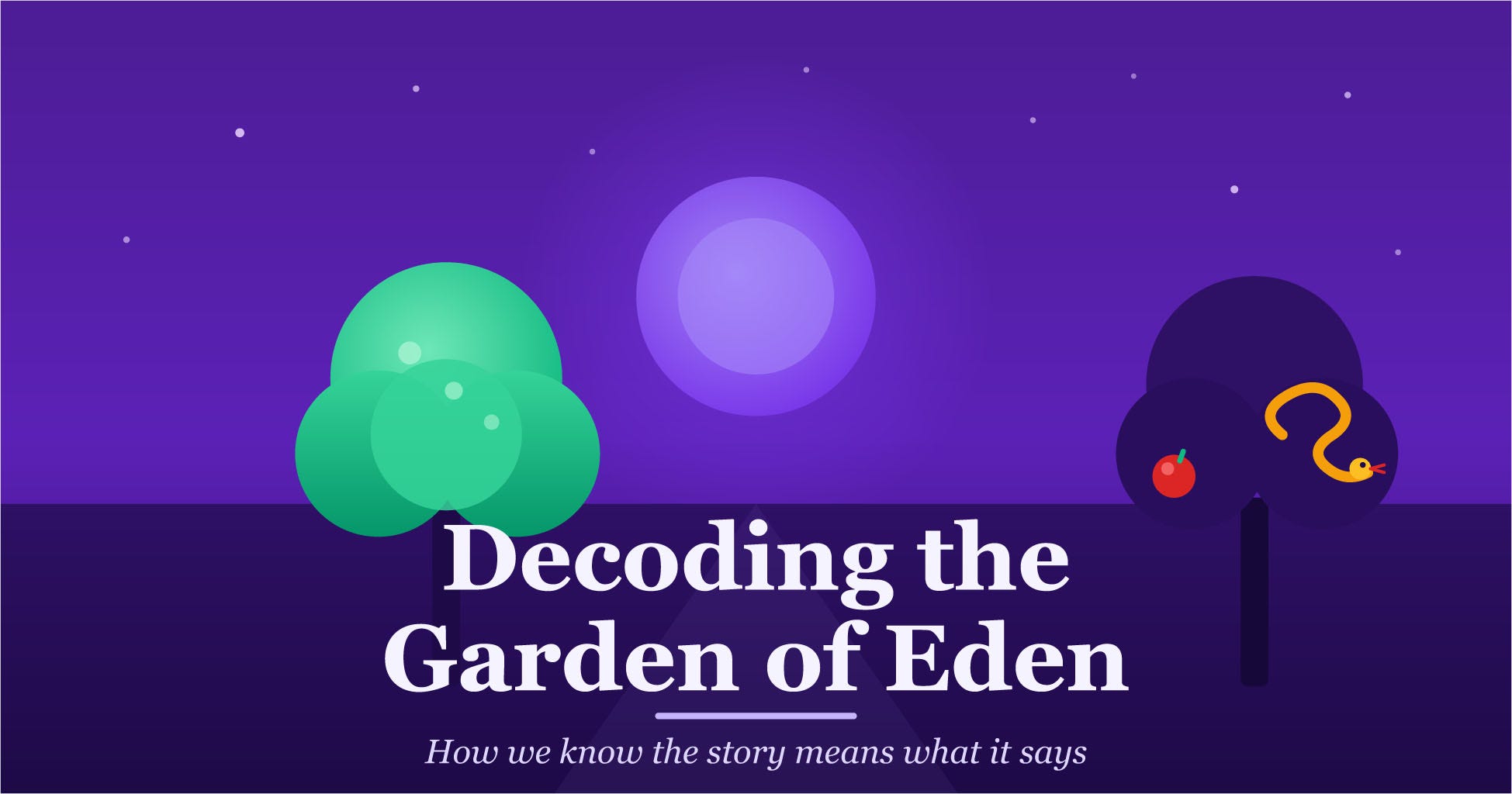
If you read the previous piece, The Truth Behind the Garden of Eden, and thought the coming-of-age reading sounded nice but convenient, that’s a fair pushback. Anybody can take an old story and project a meaning onto it that flatters their own sensibilities. So the question worth asking is how we know the growing-up reading is in the text rather than draped over it. The answer comes down to method.
Quick Run Down of the Truth Behind Eden
The first piece argues the Garden of Eden gets read backward. The version, where God plants a forbidden tree, acts shocked when Adam and Eve eat from it, then punishes them for disobedience, makes the story buckle under its own logic: an all-knowing God blindsided by an outcome he engineered, a punishment for a crime the culprits were too innocent to understand, and a talking snake who turns out to be the only honest voice in the garden.
If you read the story in its own terms, meaning as Near Eastern literature of its time, Eden is a coming-of-age story. “Knowledge of good and evil” is a merism for the full adult capacity to discern and judge, so the tree marks the threshold between childhood and adulthood rather than a trap. The serpent is the trickster-catalyst who tells the truth, the pre-fruit pair are naked and unashamed like small children, and the “curse” just describes the terms of grown-up life: pain in childbirth, labor for food, and death. Gilgamesh runs the same machinery through Enkidu losing the wild after gaining knowledge. The Hebrew version adds the moral weight that becoming a knowing creature is both a gain and a wound, which is why the authors wrote something closer to a birth than a fall.
The Hebrew Won’t Support “Knowing Right From Wrong”
The tree in question gives knowledge of “good and evil,” and the entire reading we’re accustomed to hearing depends on translating that as moral knowledge, the ability to tell sin from virtue. Yet, the Hebrew doesn’t cooperate.
“Good and evil,” tov va-ra, is a paired-opposite construction, and Hebrew uses these constantly to mean totality rather than the two named items. When Genesis says God made “heaven and earth,” it doesn’t mean he made the sky and the dirt and skipped everything in between. It means he made all of it. When Laban tells Jacob he can’t speak to him “either good or bad” (Genesis 31:24), he isn’t drawing a moral distinction; he’s saying he can’t say anything at all. The same pairing shows up in 2 Samuel 14:17 and Deuteronomy 1:39, and in every case the two poles stand in for the whole range between them.
So “knowledge of good and evil” reads as comprehensive knowledge, the full adult capacity to discern and judge and weigh, not a moral compass installed by a piece of fruit, which is what the Hebrew grammar does everywhere else it appears, and there’s no intellectually honest reason to make this one verse behave differently.
The Text Itself Calls It Childhood
The coming-of-age reading also doesn’t have to import the idea of childhood from outside; Genesis is there to supply it. The pre-fruit pair are “naked and not ashamed” (Genesis 2:25), which is how the Hebrew Bible describes the unselfconscious state of the very young, not the moral innocence of adults who’ve chosen well. Right after they eat, the first thing that changes is that they notice their nakedness and cover it. That’s the arrival of self-awareness, the exact thing that separates a small child from an adult.
Look at what they do and don’t do before the fruit. They take no part in producing their own food, the garden produces it for them. They don’t reproduce, that comes after, in the curse about childbirth. They follow one rule without understanding its consequences, the way a four-year-old avoids the hot stove because they were told to, not because they grasp burns. The text builds the picture of a protected, provided, pre-responsible existence and then ends it. You’re not reading childhood into Eden. You’re reading the childhood the authors already put there.
Gilgamesh Was Running the Same Story
The strongest outside check is that the ancient Near East already had this story, and we can read their version. In the Epic of Gilgamesh, Enkidu lives with the wild animals, naked and innocent, until a woman named Shamhat introduces him to sex and human knowledge. Afterward the animals run from him and he can’t return to the wild. The text says outright that he had grown wise, that he had become like a man. He gains humanity and loses the easy animal world in one motion.
That epic predates the written form of Genesis by about six centuries, and the Israelite authors lived inside a cultural world that knew it. So when Eden runs the same sequence, innocent human in a natural enclosure, a catalyst bringing knowledge and sexuality, expulsion from the easy world and no road back, we’re not noticing a coincidence. We’re noticing that Genesis is participating in a story its neighbors told, the one about the human creature crossing into self-awareness and paying for it. Reading Eden as a fall from grace makes it an oddity. Reading it as the Hebrew take on the Gilgamesh material makes it a recognizable member of a known type.
The Serpent’s Accuracy Is the Tell
There’s one detail the disobedience reading can’t explain away, and it’s the strongest evidence that the authors weren’t writing about a crime. The serpent makes three claims. They won’t die, their eyes will open, and they’ll become like God knowing good and evil. Every one comes true. They don’t drop dead that day. Their eyes open in the very next verse. And God says, out loud, “the man has become like one of us, knowing good and evil” (Genesis 3:22).
A liar whose every lie comes true is incoherent, so the disobedience reading has to treat the most honest voice in the story as its villain. That gets easier to question once you know what a serpent meant to the people who wrote this. Across the ancient Near East the snake was a potent symbol that could stand for chaos and danger but also for fertility, protection, and wisdom. Its habit of shedding its skin tied it to renewal and immortality, which is why it became the most common symbol of healing and rejuvenation in the region, the same logic behind the bronze serpent Moses lifts up in Numbers 21. Mesopotamian gods like Ningishzida were pictured as horned serpents guarding the door of heaven and warding off death, and serpents turn up at Canaanite fertility shrines and in Gilgamesh, where a snake steals the plant of immortality and sheds its skin to prove it works.
So a creature that’s cunning, knows things humans don’t, and stands near questions of life, death, and forbidden knowledge would have read to the first audience as the obvious figure to crack the garden open, not a stand-in for Satan. That identification came centuries later.
The Snake Becomes the Villain
Humans evolved to fear snakes, and most of us still do, even people who've never met one outside a zoo. That instinct made the serpent easy to recast. A figure the ancient Near East read as wisdom, healing, and the keeper of life slid into the role of tempter once a later religion needed a villain at the start of the story, and the slide cost almost nothing, because the audience was already primed to distrust the animal.
The irony is that the serpent never tells Adam and Eve to do anything. It corrects God's claim about dying, it describes what the fruit will do, and every word holds up. The eating is their choice, made with accurate information for the first time in their lives, which is the whole point of a coming-of-age story. The serpent that gets blamed for the fall is the one character that treated them like adults, and we turned it into the devil because a snake was the easiest thing in the garden to be afraid of.