


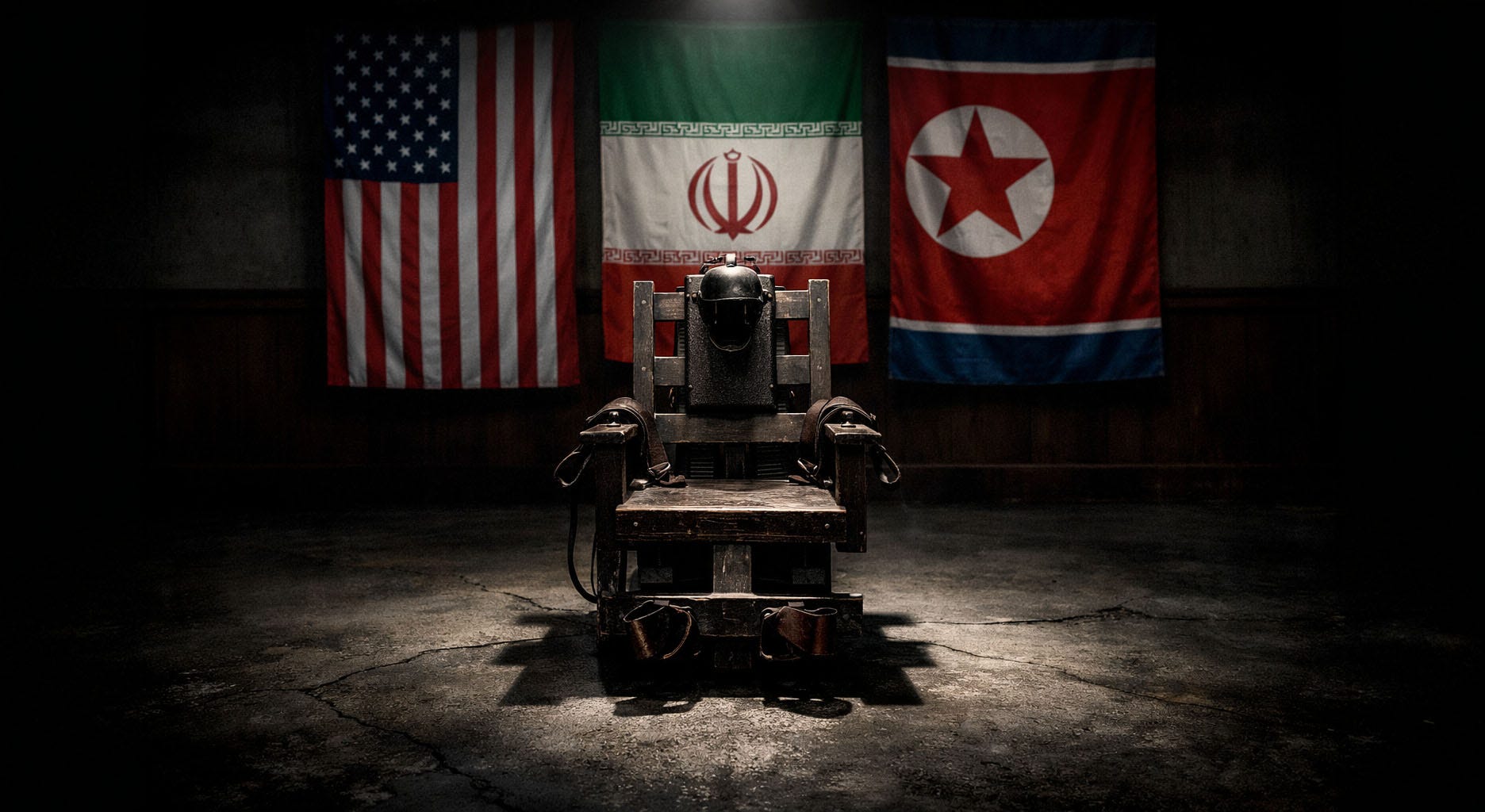
If you’re asking what we should do with a monster who cold-bloodedly killed 20 women and children—and whether that justifies the death penalty—keep reading. I’ll answer that too.
As you’ve probably already guessed, today let’s talk about the death penalty—also known as capital punishment. It is the practice of the government killing a citizen for a crime, most often murder, based on the decision of 12 random citizens with no degree or experience in criminal justice, vulnerable to manipulation.
Most of the world now sees the death penalty as outdated, even brutal. That’s why so many countries have banned it.
But the United States — along with the federal government and more than half the states — still uses it. And look who else is on that list:
China: No one knows exactly how many people are executed there each year — it’s a secret, but the numbers are believed to be very high.
Iran: Protesters, women, even teenagers have been executed.
Saudi Arabia: Executions can include beheadings and, in rare cases, crucifixions.
North Korea: Even owning a Bible can result in execution.
Egypt, Iraq, Singapore, Somalia, Belarus, Vietnam: These countries also still use the death penalty.
These are often places Americans describe as violent, oppressive, uncivilized, or dangerous.
So what does it say about American society that the U.S. is standing shoulder to shoulder with them?
Before We Begin
This post first ran on Medium. I usually don’t cross-publish, but I made an exception this time.
America gets a lot of things right.
It gave the world the First Amendment — free speech, the right to protest, a press that can challenge those in power without fear of violence or prison. Those are big achievements. In theory, everyone gets a fair chance. In theory, you’re innocent until proven guilty. In theory, anyone can rise from nothing.
This is the country that built some of the world’s most influential universities, invented the internet, and sent people to the moon. It’s a place people still risk everything to reach, hoping to build a better future. For all its flaws, America still has moments of brilliance, generosity, and freedom that many around the world can only imagine.
Yet, the same country that prides itself on liberty and justice still uses execution as punishment — often believing people deserve it, especially (somehow) during election years.
It’s Not About Justice. It’s About Power.
The death penalty isn’t about justice. If it were, it’d be fair. It’d be flawless. It’d be the last resort in a clean, honest system.
But the American justice system is none of those things. It’s messy, racist, classist, and often just plain wrong. Courts send people to death row based on:
Bad science
Fake confessions
Lying cops
Useless lawyers
Jury bias
And “tough on crime” politics
Since 1973, more than 190 people in the U.S. have been exonerated after being sentenced to die. That’s 190 people the state nearly murdered for crimes they didn’t commit.
If your system is broken, why are you still using the ultimate punishment?
The Death Penalty Is a National Lie
America loves to sell itself as “civilized.” As a country that believes in freedom, rights, and second chances. But the death penalty exposes the lie.
You can’t be a society of second chances if you’re still killing people.
You can’t say “we believe all lives have dignity” while strapping someone down and injecting them with poison.
You can’t call yourself “a shining light of democracy” while sitting next to Iran and Saudi Arabia on the global death squad bench.
It’s Racist, Too. Don’t Pretend It’s Not.
People love to say “race has nothing to do with it.” Cool story. Now look at the numbers:
Over 40% of death row inmates are Black, even though Black people make up only 13% of the population.
If the victim is white, the killer is far more likely to get the death penalty.
Prosecutors seek death more often when the accused is not white.
And rich white people? They almost never end up on death row.
Right now, 99% of people on death row are living below the poverty line.
Americans Want Blood, Not Solutions
The U.S. doesn’t have the death penalty because it works. It has it because Americans are addicted to punishment. Ask people why they support executions, and you’ll hear the same emotional garbage:
“They deserve it!”
“Eye for an eye!”
“Closure for the families!”
“They’re monsters!”
But what does that solve? Nothing.
It doesn’t bring victims back.
It doesn’t prevent future crime (there’s no proof it works as a deterrent).
It costs more than life in prison.
And it keeps innocent people at risk.
The only thing it does? Feed this sick need for revenge that Americans confuse with justice.
America Loves Violence. Always Has.
This is the country of mass shootings, police brutality, and endless wars. It’s the country where movies glorify vigilantes and where guns outnumber people.
Violence is baked into American culture. The death penalty is just another ritual to feed the beast.
And let’s not forget — every time an execution happens, it’s a show. Reporters cover it. Protesters show up. Politicians brag about it. Some people even cheer.
It’s not justice. It’s a blood sport.
Innocence Isn’t Enough
You’d think “we might be killing innocent people” would end the debate.
Nope.
When states get evidence that someone might not be guilty, they fight like hell to keep the execution anyway. They hide files. They block DNA tests. They rush the process.
Why? Because admitting error means admitting the system isn’t perfect. And Americans would rather kill someone than admit they’re wrong.
That’s what this is really about: pride, politics, and performance.
No Consistency
Here’s one of the ugliest truths about the death penalty in America: You can commit the exact same crime as someone else and still end up with a totally different punishment.
Why, you ask?
Because it all depends on the judge you get, the county you’re in, the politics of the prosecutor, the media coverage, and even what kind of “useful information” you can trade to the state.
Seriously. Two people kill someone. One gets life in prison. The other gets the needle.
Maybe one confessed and led cops to the body — stupidly leaving nothing left to trade for his life. Maybe one had a better lawyer. Maybe one cut a better deal. Maybe the jury liked one face more than the other. Or maybe the district attorney was running for re-election and needed to look “tough on crime.”
There’s no fixed rule. It’s not about fairness. It’s about leverage, image, and luck.
Sometimes, snitching saves your life. If you whisper the right thing to the right person in prison — something about another case, another killer — you get “cooperation credit.” That could literally keep you off death row. Doesn’t matter how brutal your own crime was.
Other times, just knowing where the victim’s body is becomes your bargaining chip. You hold on to it, and the state holds back the execution.
So, What’s Going On?
America is scared of being weak. Scared of losing control. Scared of admitting it got things wrong.
And instead of fixing what actually drives violent crime — poverty, trauma, inequality, broken families, hollowed‑out communities, you name it — it feeds on the damage.
A society that lacks empathy doesn’t just create violence. It starts enjoying punishment. That’s why executions get applause. That’s why politicians win votes by promising to kill more people.
Here’s something you almost never see in the headlines — and it’s honestly heartbreaking: most murders in America go unsolved. About half of all homicide cases just stay open. Meanwhile, in many other Western countries, police solve 70, 80, sometimes even 90 percent of murders. Back in the 1960s, the U.S. cleared nearly 90 percent too. Now? Solving a murder here is almost like flipping a coin.
If you’re clever and looking to get away with murder, America might actually be your best bet — unless you’re doing it for insurance money. When there’s cash on the line, the system suddenly pays a lot more attention.
Norway, on the other hand, is a definite no-go. Even though the maximum penalty is only twenty years for any crime and there’s no life sentence, your chances of getting caught there are almost guaranteed.
Understaffed departments, overworked investigators, and broken trust in poor communities all play a part. But somehow, the same system that can’t solve half its murders still insists on executing people as if it’s some moral authority.
That tells you everything.
The death penalty isn’t justice. It’s not about truth. It’s a desperate performance by a society that would rather kill than admit failure.
A system that can’t protect life shouldn’t be trusted to take it. And yet, here we are.
The death penalty is not a sign of strength. It’s a sign of fear. And it’s a scar on any country that still clings to it.
For decades, America has been asking the wrong question. Instead of focusing on “What do we do with this monster who killed 20 women?” maybe we should be asking, “Why does our society keep producing serial and mass killers — and what can we actually do to prevent violent crime?”
A society that refuses to take its part of responsibility for these problems is a society that loses the moral authority to demand personal responsibility from individuals.
What’s your take?
I now write full-time, and this work exists because readers support it. If you want to help keep this space alive, consider subscribing.
You can also support the work at no cost to you. Sharing your personal referral link helps this publication grow, and as a small thank-you, I offer the following:
3 referrals (free or paid) → 1 month free
5 referrals (free or paid) → 3 months free
25 referrals (free or paid) → 12 months free
100 referrals (free or paid) → Lifetime free access
If you’re already a supporter, your subscription will be extended automatically.
Sources and Further Reading
Death Penalty Information Center — Facts About the Death Penalty
https://deathpenaltyinfo.org/facts-and-researchThe Innocence Project — Death Row Exonerations
https://innocenceproject.org/death-penalty/Prison Policy Initiative — Pre-incarceration Income of People in Prison
https://www.prisonpolicy.org/reports/income.htmlEqual Justice Initiative — The Death Penalty in America
https://eji.org/issues/death-penalty/United Nations — Capital Punishment and Implementation of the
FIDH — The Death Penalty: A Punishment for the Poor
https://www.fidh.org/en/issues/death-penalty/the-death-penalty-a-punishment-for-the-poor
This post was written and edited with the assistance of Grammarly.
I completely agree that the death penalty should be abolished. But I do object to the idea of describing the U.S. as a country of police brutality. Does police brutality exist? Of course. But considering the population of the country, and the number of interactions between cops and lawbreakers on a daily basis, police brutality is sporadic and the result of some rogue cops. It is not built into the system. It does not define our country. We also have teachers who sexually abuse their students. So, are we a country of sexually abusive teachers?
Good to see an American saying this. It's banned throughout Europe. In UK we banned it after several people whom we hanged turned out later to be innocent.