


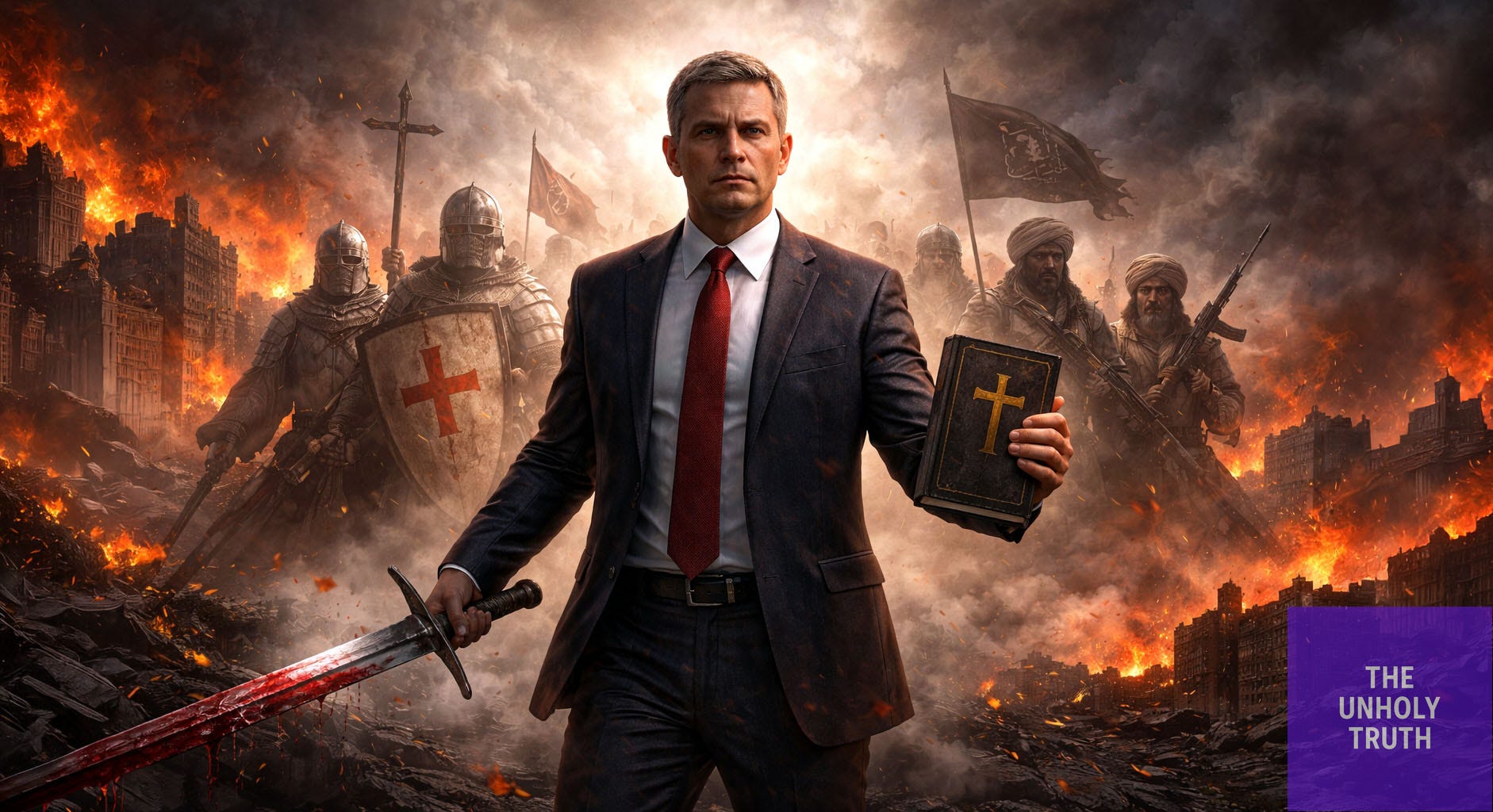
Let’s get this out of the way, first: Religion didn’t start most wars because leaders were deeply faithful. Power did. Greed did. Ego did.
Religion was just the most convenient excuse.
Take the Crusades. Everyone’s heard of them. From 1095 to the 1200s, waves of European knights stormed the Middle East, supposedly to “free the Holy Land” from Muslim rule. That’s the fairy tale. What actually happened was a bunch of bored, land-hungry nobles saw a chance to get rich and kill with divine approval. The Pope, eager to expand his influence, offered salvation in exchange for slaughter.
It worked. Tens of thousands marched off to war. They didn’t know much about the Middle East. They didn’t care. They were promised gold, glory, and a free ticket to heaven. And they left a trail of blood behind them.
The Crusades were not simply religious conflicts, but rather political expeditions with religious packaging— Thomas Asbridge, The Crusades: The Authoritative History of the War for the Holy Land
Crusaders Killed Christians Too
Think it was all Muslims vs Christians? Think again. On their way to the Holy Land, Crusaders sacked Constantinople in 1204—a Christian city. They looted churches, killed fellow believers, and even set up a fake Latin empire. Why? Because they were broke, angry, and power-hungry.
Religion didn’t stop them. It gave them cover.
The Fourth Crusade’s sack of Constantinople marked the moment when religious rhetoric crumbled in the face of pure political ambition— Jonathan Riley-Smith, The Crusades
Jihad Doesn’t Mean What You Think It Means
Thanks to the media, the word “jihad” now basically means “suicide bomber.” But that’s not what it meant in classical Islamic tradition. Jihad means “struggle”—and most of the time it refers to personal spiritual effort, not war. When it does mean fighting, it’s supposed to be defensive, not offensive slaughter.
That didn’t stop modern extremists from twisting the concept. And it sure as hell didn’t stop Western politicians from milking the word to justify endless war. They say “Islam is at war with the West.” But in reality, it’s Western war machines occupying Muslim countries, not the other way around.
Jihad in Islamic tradition is a broad and complex term. Reducing it to ‘holy war’ ignores centuries of theological, spiritual, and legal scholarship— Reza Aslan, No god but God: The Origins, Evolution, and Future of Islam
How Bush Made It a “Crusade” Again
After 9/11, George W. Bush stood in front of cameras and called the upcoming invasion of Afghanistan a “crusade.” His advisors tried to walk it back, but the damage was done. Muslim-majority countries heard what he really meant.
For many Muslims, “crusade” wasn’t just a careless word—it was a historical threat. It meant hundreds of years of foreign soldiers burning cities, raping civilians, and claiming to do it for God.
Calling modern war a “crusade” was like reopening a 900-year-old wound.
The term ‘crusade’ used in modern political rhetoric evokes a deeply problematic and historically loaded narrative that justifies aggression under the guise of moral righteousness— Karen Armstrong, Fields of Blood: Religion and the History of Violence
War by Myth, Not Reason
When you look at how wars are sold to the public, it’s never about messy stuff like economic policy or corporate contracts. It’s about good vs evil. It’s about moral panic. They don’t say, “We want oil.” They say, “We’re defending freedom.”
The myth of eternal religious war is perfect for this. It makes the enemy look ancient, fanatical, and beyond reason. You can’t negotiate with religious madness, right? You just have to destroy it.
That’s how we ended up in Iraq, bombing cities for “liberation,” based on lies.
Religious language continues to be used as a moral shield for political agendas, particularly in wartime— Mark Juergensmeyer, Terror in the Mind of God
Muslim Empires Fought Each Other More Than Christians
Here’s another truth bomb: Most Islamic history is full of Muslims fighting other Muslims. Sunni vs Shia. Arabs vs Turks. Persians vs everyone else. Same goes for Christianity—Catholics vs Protestants, Orthodox vs Catholics, etc.
Religious identities were real, but the violence was about power, not theology.
It wasn’t “Islam vs the West.” It was empire vs empire.
But modern politicians want you to believe in a neat, eternal clash. So they simplify centuries of complex history into a cartoon.
The so-called clash of civilizations ignores the internal complexities and rivalries within each tradition— Edward Said, Orientalism
The Reformation Made Religion Personal—And Dangerous
When Martin Luther told Christians to read the Bible themselves, he lit a fire under the whole system.
Before that, faith was controlled by elites—priests, bishops, and popes. Luther said screw that.
Faith became personal. And when belief becomes personal, it becomes political.
Suddenly everyone thought God was on their side.
And surprise: Europe exploded into war.
The Reformation marked a turning point where faith became detached from centralized political control— Diarmaid MacCulloch, The Reformation
Thirty Years’ War: The Real Christian Apocalypse
If you want to see what happens when religion and politics melt together in a powder keg, look at the Thirty Years’ War.
From 1618 to 1648, Europe tore itself apart. Catholics vs Protestants. Royalists vs rebels. Whole towns wiped out. One in every three Germans died.
And for what? A Bible verse? No. For land. For dominance.
The “religious” war was just nationalism wearing a priest’s robe.
The Thirty Years’ War was fought under religious flags but driven by territorial ambition— Peter H. Wilson, Europe’s Tragedy: A History of the Thirty Years War
Politicians Took Over the Reformation
Did faith get purer after the Reformation? No. It got weaponized.
Kings saw that they could break away from Rome, keep church taxes, and control what people believed—all in one move.
Henry VIII wanted a divorce. Rome said no. So he created a whole new church. Not because he had a spiritual awakening, but because he wanted power.
Religion became nationalized. Churches were now arms of the state.
The state appropriated religious authority, not to secularize society, but to control it more effectively— Brad S. Gregory, The Unintended Reformation
The State Became the New Church
Modern governments don’t need popes. They have flags.
They have national anthems. They have holidays that glorify war.
They call dissent “unpatriotic” the same way the Church once called it heresy.
And they still use religious language when it suits them. “God bless our troops.” “In God we trust.” But they mean: obey the system.
Modern secular ideologies often inherit the same absolutism that characterized religious institutions— Talal Asad, Formations of the Secular
The Media Helps Spread the Gospel of War
Look at how wars are reported.
You don’t see interviews with historians. You get screaming headlines: “JIHADISTS STRIKE AGAIN!”
You don’t see context. You see flags, funerals, and fear.
Every war is simplified into “us good, them evil.”
The media knows fear gets clicks. And war makes ratings go up.
The media simplifies conflict into digestible narratives that often reinforce dominant power structures— Edward Said, Covering Islam (1981)
Jihadis and Crusaders Use the Same Tricks
The irony? Extremists on both sides speak the same language.
Jihadis claim they’re fighting a holy war. Crusaders claimed the same.
Both say God wants violence. Both think history is a divine script.
They’re stuck in the same fantasy.
And regular people—Muslim, Christian, atheist—keep dying for it.
Extremism thrives on myths that present violence as a sacred duty— Jessica Stern, Terror in the Name of God
It Was Never About Faith—It Was About Power
Whether it was a pope launching a crusade, a king forming a new church, or a president dropping bombs while quoting Scripture—it’s the same playbook.
Use faith. Stir fear. Control people.
And then pretend it was holy.
Religious rhetoric continues to be instrumentalized by political elites to serve non-religious goals— Elizabeth Shakman Hurd, The Politics of Secularism in International Relations
Last Thoughts
When you hear politicians talk about “jihad” or “crusades” or “defending faith,” ask what they’re really hiding.
What’s the land grab?
Where’s the oil?
Who’s getting paid?
They’re not selling salvation. They’re selling slaughter with a choir in the background.
To be honest, only a small portion of subscribers are paid—most of my posts are free for everyone to read, with some exclusives. But reader support buys something priceless: time. Time to research, question power, and hold the powerful accountable. If you can afford it, your support helps keep this work alive.
Sources and Further Reading
The Crusades: The Authoritative History of the War for the Holy Land (Thomas Asbridge, 2010)
No god but God (Reza Aslan, 2005)
Fields of Blood (Karen Armstrong, 2014)
Terror in the Mind of God (Mark Juergensmeyer, 2000)
The Myth of Religious Violence (William Cavanaugh, 2009)
The Reformation: A History (Diarmaid MacCulloch, 2003)
The Unintended Reformation (Brad Gregory, 2012)
Formations of the Secular (Talal Asad, 2003)
Covering Islam (Edward Said, 1981)
Europe’s Tragedy: A History of the Thirty Years War (Peter H. Wilson, 2009)
The Politics of Secularism in International Relations (Elizabeth S. Hurd, 2008)
Orientalism (Edward Said, 1978)
Terror in the Name of God (Jessica Stern, 2003)
A hundred years ago the great Polish poet Julian Tuwim wrote a great poem explaining exactly that. The original sounds better of course, but not everyone knows Polish, so let me quote the English translation:
To the Common Man
When the black print sounds alarm
And freshly posted fliers cry
“To the Public,” “For the Troops”
When the glue is not yet dry
And any stud or young recruit
Will take to heart their age-old lie
That it’s time to fire the cannons
To murder, plunder, poison, raze;
When they start to tout “our country”
in a thousand worn clichés
Incite with ostentatious flags
And champion the “historic right”
to every inch, to glory, might
That now has come the time to fight
For our fathers, and forefathers,
Avenge the heroes or the victims,
And when bishop, pastor, rabbi come
to place a blessing on your gun
Because God whispered the command:
go and defend the fatherland
When tabloid headlines spread their noise,
vulgar, nefarious, savage and crude
and frenzied women in wild herds
sprinkle rose petals on our boys
— Hey listen, my untutored friend
Brother from this or another land
Know that it’s kings and portly men
who ring the bells that sound alarm;
And know that it’s bull, a common ruse
When they cry out: “Shoulder arms!”
That for them somewhere gushes crude
Meaning some hefty sacks of cash
And bank accounts do not add up
Or that they caught the whiff of bucks
And that those fat pigs hedged their bets
With an import tax on cigarettes.
Go drum your guns on cobblestones
It is your blood and their crude!
And let your voices linger on
It’s your wage that your blood has won:
“What you’re selling we won’t buy!”
Then there is Pete Hegseth with his Crusader tattoo.