


The Arab armies took Syria, Mesopotamia, and Egypt in the 630s and 640s, and across all of that territory Byzantine orthodoxy was a minority holding. Mesopotamia and Persia belonged to the Church of the East, which had backed the losing side at Ephesus in 431. Syria, Egypt, and Armenia were overwhelmingly Miaphysite, meaning they had rejected the Council of Chalcedon in 451 and been prosecuted for it by Constantinople ever since, sometimes with soldiers. The Christians of Najran in southern Arabia were Miaphysite, and so was the Ethiopian kingdom that sheltered Muhammad’s followers during the first hijra.
So the Christianity that Islam grew up next to was made almost entirely of people the imperial church had condemned. That contact stayed close and stayed workable for centuries. Hunayn ibn Ishaq, the man most responsible for moving Greek philosophy and medicine into Arabic under the Abbasids, belonged to the Church of the East, as did most of his colleagues in the translation effort. Muslim rule handed those communities something Byzantium had withheld, which was permission to run their own churches without an emperor auditing their Christology.
Read the Qur’an’s arguments about Jesus with that in mind and its Jesus starts looking about as Christian as anybody else’s in the seventh century.
The Group That Stayed Closest to Jesus Ended Up on the Heresy Lists
There was a Christian constituency for the Qur’an’s position on Jesus, a human messenger of God and nothing more, and it had been around for six hundred years before Muhammad. Irenaeus called them Ebionites. Origen, Eusebius, and Epiphanius all wrote about them, none of them kindly.
They kept the Torah. They circumcised their sons, observed the sabbath and the food laws, took Jesus as the messiah promised to Israel, and treated Paul as an apostate who had wrecked the movement by throwing out the law. Epiphanius quotes their gospel, in which the voice at the baptism tells Jesus “today I have begotten you,” a line that also survives in one of our oldest gospel manuscripts, Codex Bezae, at Luke 3:22. It describes adoption. God chooses a man. Nobody gets born divine.
Now consider what that position is continuous with. The Jerusalem community under James kept Torah, worshipped in the temple, and had to be argued out of requiring circumcision of gentile converts, which is the entire business of Galatians 2 and Acts 15. Paul wrote his angriest letter about that fight, which tells you he was not winning it easily. The believers who stayed closest to the practice of Jesus’s own family and first followers were the ones later classified as heretics, and the tradition that won was built by gentiles who had never kept the law in the first place.
Stack up what Islam holds and the resemblance gets uncomfortable. One God who has no son and shares his nature with nobody. Dietary law, ritual washing, circumcision, prophets in succession, revelation delivered through a man who stays a man. Every item on that list was a live Christian option in the second century, and every one of them was on its way to being illegal by the fifth.
Which leaves the question that has occupied scholars for a hundred years. Nobody has produced a seventh-century Ebionite congregation in Arabia with a name and an address. The heresiologists stop mentioning these groups as living communities around the fourth century, and Muhammad’s preaching begins in 610. That gap is where the argument lives.
In 1966 a scholar in Jerusalem announced that he had found something on the far side of it.
What Shlomo Pines Found Inside a Muslim Polemic
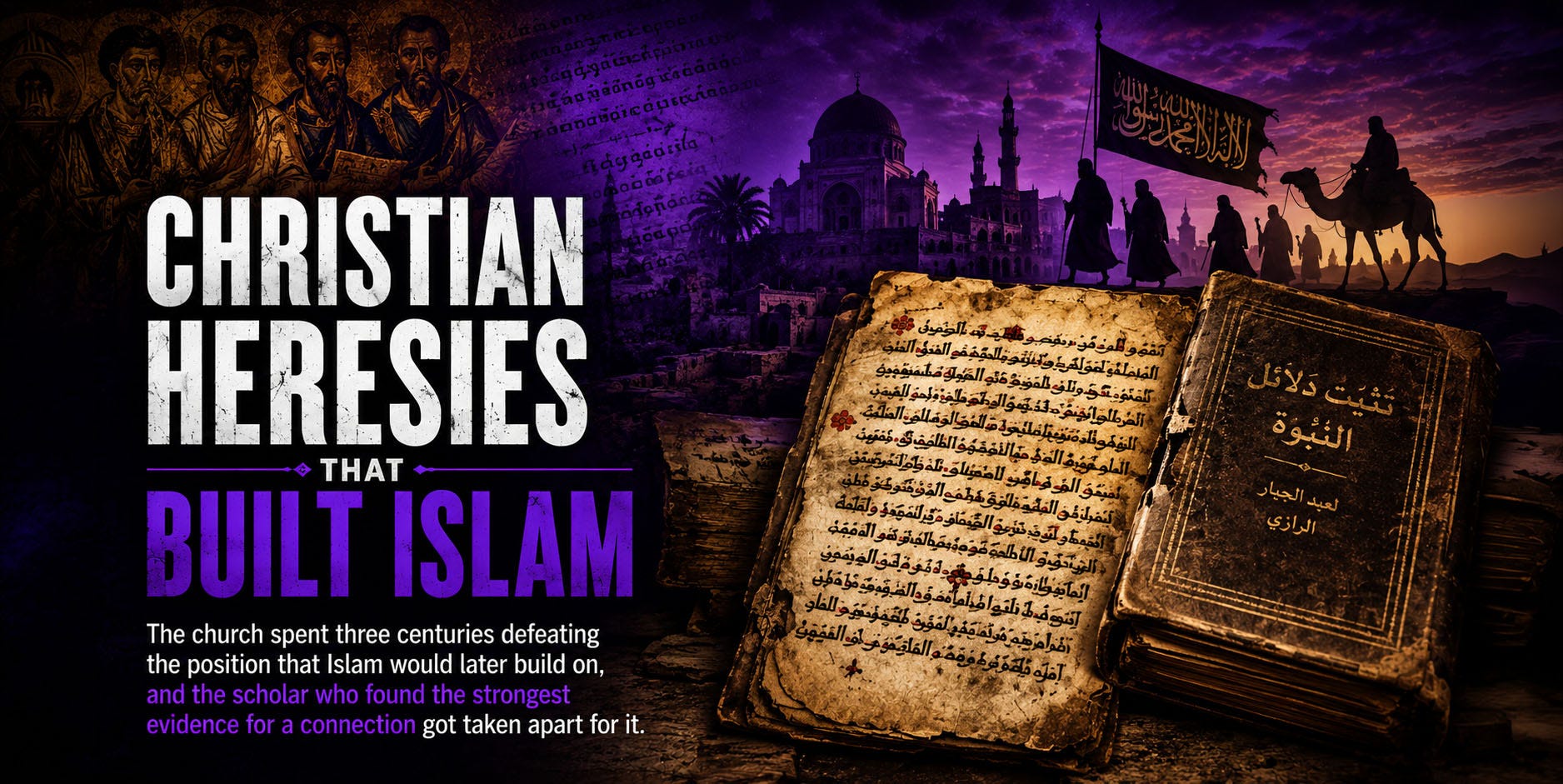
The book was the Tathbit Dala’il al-Nubuwwa, written around 995 by ‘Abd al-Jabbar, a Mu’tazili theologian in Rayy, and it’s a standard piece of anti-Christian polemic on its surface. Buried inside it is a long stretch of material describing the origins of Christianity that reads nothing like anything else in Arabic. It tells the story from the point of view of Torah-observant followers of Jesus who were pushed out by gentiles, and it makes claims about Paul, the gospels, and the abandonment of the law that line up with what the heresiologists tell us the Ebionites believed.
Pines argued that ‘Abd al-Jabbar was working from a genuine Jewish Christian source, translated into Arabic, that had survived somewhere in the East for centuries after everyone assumed those communities were gone. If he was right, the gap closes. There was a channel.
S.M. Stern went after the argument two years later and did serious damage, showing that much of the material could be accounted for by Muslim polemical invention and by ordinary anti-Christian arguments already circulating in Arabic. The consensus since then has landed closer to Stern than to Pines. The text tells us a great deal about what a tenth-century Muslim wanted to say about Christian origins, and much less about what a second-century Jewish Christian believed.
But the question refused to die, because the Ebionite parallels are not the only ones. The Pseudo-Clementine literature, a Jewish Christian body of writing surviving in Greek and Latin, teaches a True Prophet who appears again and again through history in Adam, Moses, and Jesus, and it holds that the scriptures contain false passages inserted by people who tampered with the text, which the informed reader has to identify and discard. Set that beside the Qur’anic doctrine of tahrif, the corruption of earlier revelation by its own custodians, and beside the chain of messengers running from Adam through Abraham and Moses and Jesus to Muhammad, and you have two systems performing the same operations with the same tools.
Patricia Crone spent part of her last years on this, publishing a two-part study arguing that Jewish Christian ideas were present in the environment the Qur’an addresses, without requiring a surviving congregation to carry them. Ideas travel in ways that leave no membership rolls. They move through stories, through arguments made in marketplaces, through what a Syrian merchant tells his Arab counterpart about why his neighbors’ church is wrong.
The direct-descent theory is too strong and the evidence won’t carry it. What the evidence does carry is harder for both sides to sit with: the positions the church had to destroy in order to become orthodox were still available to be thought in the seventh century, and one of them became the second-largest religion on earth. Christianity spent three hundred years and eventually the machinery of an empire making sure the Torah-keeping, non-divine Jesus lost. He lost inside Christianity. He won everywhere else.
Tomorrow I'm running the rest of it: Basilides and the empty cross, the clay birds in Surah 3, Mani calling himself the seal of the prophets three hundred years early, and the Baghdad bookseller whose catalogue preserved the religion Rome spent two centuries burning. This work takes weeks of reading per piece and it stays free because paid subscribers cover it. If you've been getting something out of these, that's what upgrading pays for.
Sources and Further Reading
Bart D. Ehrman, Lost Christianities: The Battles for Scripture and the Faiths We Never Knew (Oxford, 2003)
Bart D. Ehrman, The Orthodox Corruption of Scripture, 2nd ed. (Oxford, 2011)
Petri Luomanen, Recovering Jewish-Christian Sects and Gospels (Brill, 2012)
Annette Yoshiko Reed, Jewish-Christianity and the History of Judaism (Mohr Siebeck, 2018)
F. Stanley Jones, Pseudoclementina Elchasaiticaque inter Judaeochristiana (Peeters, 2012)
Shlomo Pines, The Jewish Christians of the Early Centuries of Christianity According to a New Source (Israel Academy of Sciences and Humanities, 1966)
S.M. Stern, “’Abd al-Jabbar’s Account of How Christ’s Religion Was Falsified by the Adoption of Roman Customs,” Journal of Theological Studies 19 (1968)
Patricia Crone, “Jewish Christianity and the Qur’an,” Journal of Near Eastern Studies 74-75 (2015-2016), in two parts
Gabriel Said Reynolds, The Qur’an and Its Biblical Subtext (Routledge, 2010)
Sidney H. Griffith, The Bible in Arabic: The Scriptures of the “People of the Book” in the Language of Islam (Princeton, 2013)
Jack Tannous, The Making of the Medieval Middle East: Religion, Society, and Simple Believers (Princeton, 2018)
Michael Philip Penn, Envisioning Islam: Syriac Christians and the Early Muslim World (Pennsylvania, 2015)
Fred M. Donner, Muhammad and the Believers: At the Origins of Islam (Harvard, 2010)
Fascinating material. I wonder if the Pines article is obtainable? I have read references before that hint that the Ebionites survived much later in lands where Christianity did not hold sway. Edit: I found the Pines paper.
Absolutely fascinating, particularly for me, the Ebonite connection. I always had an interest in their history but never really followed up on it. I never realized the extent of its influence upon Islam either. Your piece, Tanner, has stimulated my interest again!
There are a few modern offshoots of the sect located in the East, South Africa, and even in the U.S., but as you pointed out in your article, little is known of the true history so caution is advised on just how much to believe in the revivalist retelling of it all.
I guess they try to stick pretty close to the original beliefs though.
Anyway, still so very intriguing! Another winner! Thanks, Tanner!