


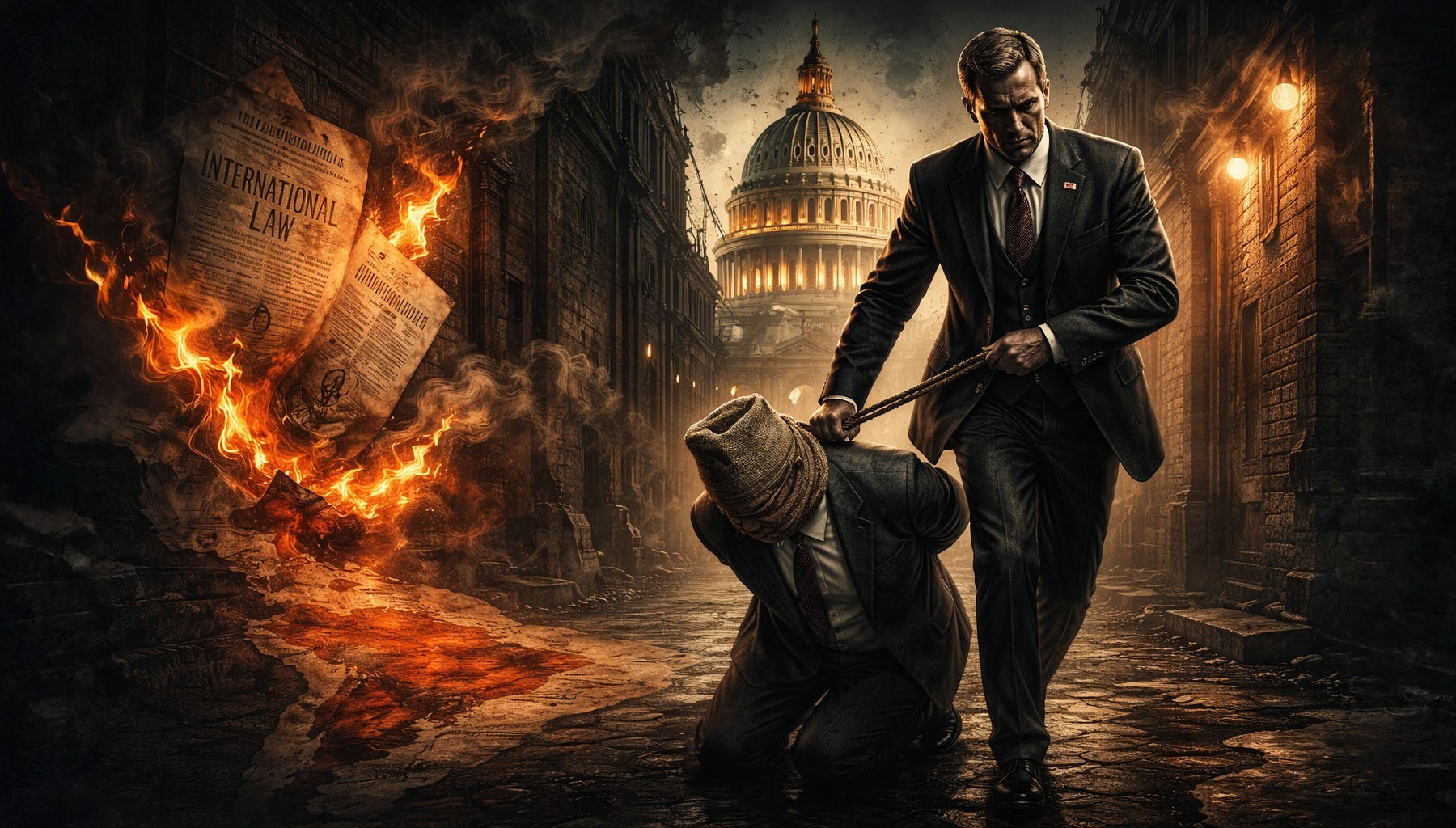
2026 started with the United States kidnapping the Venezuelan president to tighten its grip on the country—for pure financial gain. And they didn’t even try to hide it. Over the past few years, Washington had already recognized an unelected opposition figure, imposed sanctions so harsh they amounted to collective punishment, pushed regime-change propaganda, and treated Venezuelan sovereignty like it was optional. No dramatic arrest was needed to see how badly U.S. credibility had already tanked.
And yes, I used the word “kidnap” on purpose—because that’s exactly what the U.S. would’ve called it if Russia or Iran had done it. Not “capture.” Not “detention.” Kidnapping. And rightly so.
And never in my life did I think I’d be defending Maduro. Thanks, Trump.
What Happened
On January 3, 2026, the United States kidnapped Venezuela’s president as part of a longer pressure campaign:
• The U.S. continued to recognize an opposition figure as Venezuela’s legitimate leader, despite Maduro controlling the state.
• Sanctions remained in place, contributing to economic collapse and civilian hardship.
• U.S. officials reiterated that Maduro’s 2023 election did not count.
• Legal actions and indictments against Venezuelan officials were reaffirmed, including drug-trafficking charges filed earlier under U.S. jurisdiction.
The U.S.’s biggest legal ground is the legitimacy of the latest presidential election — and it was almost certainly rigged — a problem for Venezuelans to solve.
Trump forgets that, in his own words, millions of illegal immigrants voted in the closely contested 2016 election. Those immigrants might have chosen to vote for a man rather than a woman. By that logic, the 2016 election was illegitimate.
In 2020, illegitimacy was repeated, and the election was stolen. Biden would therefore have been an illegitimate president as of 2020.
Does this mean that between 2016 and 2024 the sovereignty of the United States was optional — and should be optional in the future whenever a foreign country isn’t satisfied with the legitimacy of a U.S. election result?
Venezuela: The Last Straw
The U.S. went full imperial mode and helped snatch Venezuela’s president—on foreign soil. Illegally. And it wasn’t the first time. The U.S. has a long habit of breaking the very international laws it proudly claims to uphold. Laws it helped write. But Venezuela feels like a last straw—because the world is starting to notice.
Don’t get me wrong. Nicolás Maduro isn’t exactly a hero. I’ve despised the man for years. He’s a corrupt, power-hungry strongman, and I genuinely believed Venezuelans deserved better. A part of me is secretly glad he’s gone.
But at what cost?
Yes, he rigged elections. Yes, he brutalized opposition. But that doesn’t give the U.S. the right to kidnap another country’s head of state like it’s an episode of 24. That’s gangster diplomacy.
There will be no consequences. No punishment. No apology. Just silence. The world’s loudest preacher of the “rules-based order” doesn’t think the rules apply to itself.
The Post-WWII Deal: Order for Obedience
Winning World War II was just one achievement for the U.S. Just as importantly, it also won the right to write the world’s moral script. It told the planet: follow our version of democracy, trade with our allies, and in return—we’ll keep the peace.
Unless you were socialist. Or Muslim. Or sitting on oil.
At least back then, the U.S. tried to keep up the illusion of legality. When it orchestrated a coup in Iran in 1953 to overthrow Prime Minister Mosaddegh for nationalizing the oil industry, it hid behind the Cold War. When it invaded Iraq in 2003, it lied about weapons of mass destruction to get cover. Messy? Yes. Illegal? Definitely. But it pretended to care about the rules.
Trump ended that.
Trump’s America: We Do What We Want
Trump didn’t invent American arrogance. He just handed it a microphone. No more sneaky CIA operations. No more half-baked justifications. Under Trump, it became open policy that America does what it wants—and if you don’t like it, too bad.
He even said it: “We should’ve taken the oil.”
No filters. No shame. Just raw piracy with a flag.
That’s what made Venezuela different. It wasn’t a secret mission or backroom deal. It was done openly, proudly, and stupidly. The mask was off.
Legitimacy Is a Fragile Thing
You don’t get legitimacy by declaring yourself the good guy. You earn it by acting like one.
The U.S. used to call out Russia and China for violating international law or invading neighbors. Now, China just points at Iraq. Russia brings up Venezuela. Nobody takes the lecture seriously anymore.
Every time the U.S. breaks the law, it hands those countries a free excuse to do the same. It lowers the bar for everyone.
History’s Graveyard of “Irreplaceable” Empires
Every empire believes it’s too important to fall.
The Romans believed they were eternal. So did the Ottomans. So did the British. All of them crashed. Not because they ran out of soldiers, but because they ran out of credibility.
The U.S. is no different.
It tells itself it’s the “shining city on a hill,” the beacon of democracy, the indispensable nation. But history doesn’t care about slogans. It only cares about what a country does when it thinks no one can stop it.
The Decline Is Already Here
Decline isn’t coming. It’s happening now.
China’s economy jumped from 2% of global GDP in the 1980s to nearly 20% today.
Russia isn’t respected, but it’s feared—and that still counts.
Europe is slowly backing away from U.S. dependence.
BRICS is growing. U.S. global influence is shrinking. Allies are hedging their bets.
America is still powerful. But it’s no longer seen as trustworthy. Without trust, power turns into isolation.
American Exceptionalism Is a Drug
The idea that America is chosen—by God, by history, by destiny—is baked into the national psyche. It’s why so many Americans act confused or offended when other countries criticize them.
But the idea that the U.S. is irreplaceable is not just false—it’s dangerous. It blinds the country to its own decline. It encourages arrogance and stops reform before it starts.
No empire is irreplaceable. Not Rome. Not Britain. Not America.
Even Allies Are Backing Off
Britain still clings to American power like a crutch, trying to stay relevant. But others aren’t so sure.
Germany, France, even Canada—countries that used to echo U.S. foreign policy—are distancing themselves. They won’t say it outright, but they’re watching closely. And they’re asking the same question:
Can we trust the U.S. again?
The answer, for now, is uncertain.
Last Thoughts
The U.S. still has a window to turn things around. But that window is shrinking. Fast.
The Trump years didn’t just bruise the country’s image—they smashed its mask of moral leadership. To regain trust, America has to stop talking about greatness and start proving it through action.
Empires don’t last forever. Especially not the ones that believe they will.
To be honest, only a small portion of subscribers are paid—most of my posts are free for everyone to read, with some exclusives. But reader support buys something priceless: time. Time to research, question power, and hold the powerful accountable. If you can afford it, your support helps keep this work alive.
Sources and Further Reading
American Empire: A Global History – A.G. Hopkins (2018)
The Jakarta Method – Vincent Bevins (2020)
The True Flag – Stephen Kinzer (2017)
Blowback – Chalmers Johnson (2000)
The Post-Cold War World – Michael Cox (2016)
The Doomsday Machine – Daniel Ellsberg (2017)
Legacy of Ashes: The History of the CIA – Tim Weiner (2007)