


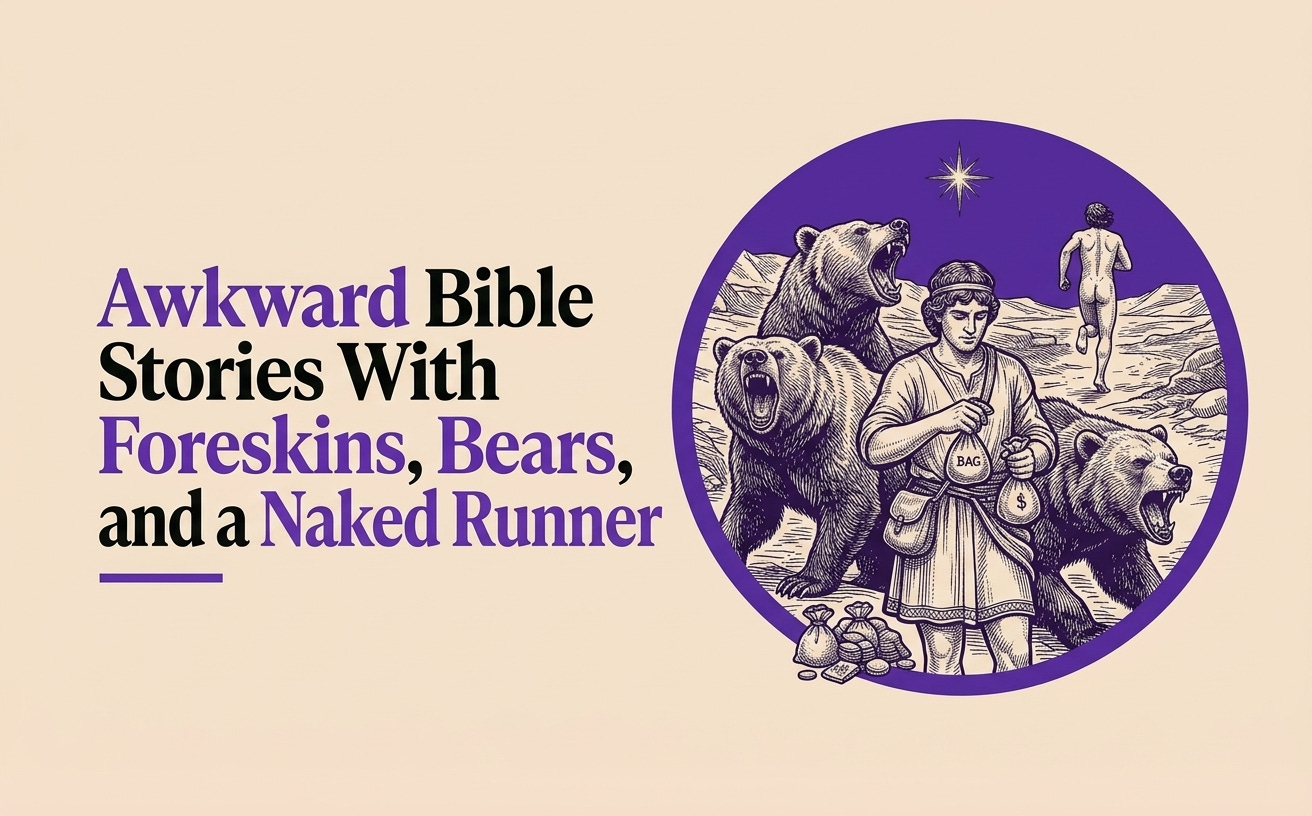
Today we’re talking about the stories that upset people the most, to the point where some readers decide I’m mocking the Bible just for bringing them up. The social courtesy is to pretend these passages don’t exist, which says plenty about the stories themselves.
The Bible is a list of approved books chosen by particular people at particular times, even though clergy like to defend it as an all-or-nothing package. Criticizing one story targets the book that story sits in, and every other book stays untouched. That makes the useful question one for the people who drew up the list: why did they decide these stories belonged in it? Some of them are awkward, some are funny, and some are indefensible.
God Tries to Kill Moses at a Roadside Inn
Moses has just been handed the biggest assignment in the Hebrew Bible, march to Egypt and take on the most powerful man alive, and he’s barely out the door when Exodus 4:24 says that at a lodging place along the way, God met him and tried to kill him. The text offers no warning and no reason.
Zipporah, Moses’ Midianite wife, grabs a flint knife, cuts off their son’s foreskin, touches it to somebody’s “feet,” and tells somebody “you are a bridegroom of blood to me,” after which God backs off. The word for feet doubles as a polite term for the genitals elsewhere in the Bible (Isaiah 7:20 threatens to shave the “hair of the feet”), and the pronouns are such a mess that nobody can say whose feet she touched or who the bridegroom is.
Commentators have been guessing at this passage for centuries because the story never names the offense, never explains why a bloody scrap of skin satisfies a deity who a verse earlier wanted Moses dead, and never mentions the incident again.
Guards Wait Outside Assuming the Fat King Is on the Toilet
Judges 3 gives us Ehud, a left-handed Israelite sent to deliver tribute to Eglon, the king of Moab, who the narrator takes care to mention was extremely fat. Ehud straps a homemade dagger to his right thigh, where nobody thinks to check because everybody expects a sword on the left, and asks the king for a private word. He says he’s got a message from God, and Eglon, who evidently likes his messages from God in person, stands up to receive it.
Ehud drives the blade in with his left hand, the fat swallows the handle, and the text goes on to describe what happens to a stabbed gut in a level of detail that translators have tiptoed around for centuries. Ehud locks the doors and strolls out. The servants find them bolted, decide the king is “covering his feet” (the same polite phrase the Bible uses when Saul, Israel’s first king, ducks into a cave in 1 Samuel 24), and wait around until, as verse 25 puts it, they’re embarrassed. When they finally fetch a key, they find their master dead on the floor.
Israelite storytellers were clearly happy to laugh at a foreign king, and somebody decided the scroll had room for the joke.
David Delivers 200 Foreskins as a Bride Price
Saul wants David dead but can’t be seen doing it, so he sets a bride price for his daughter Michal that sounds like a dare: 100 Philistine foreskins, a sum he’s sure will get the shepherd-turned-soldier killed. David, the overachiever he is, comes back with 200 (1 Samuel 18:27), and they’re counted out “in full number” for the king, which means somebody in Saul’s court stood over a pile of them doing arithmetic. Saul hands over Michal anyway and spends the rest of his reign trying to kill his new son-in-law.
Years later, when David demands Michal back from Saul’s surviving son Ish-bosheth, he reminds him that he paid 100 foreskins for her (2 Samuel 3:14). Two traditions, one wedding present, two different prices, and nobody in the editing room reconciled them.
Elisha Curses a Crowd of Boys for Mocking His Bald Head
Elisha, the prophet who succeeded Elijah, is walking up to Bethel in 2 Kings 2 when a crowd of boys comes out of town and jeers, “Go up, baldy!” (probably a jab at Elijah, who’d just gone up to heaven in a whirlwind). Elisha turns around, curses them in God’s name, and two she-bears come out of the woods and tear up forty-two of them. He keeps walking to Mount Carmel, and the narrator moves to the next paragraph without a word of regret.
Ezekiel Is Ordered to Bake His Bread Over Human Dung
In Ezekiel 4, God tells the prophet Ezekiel to lie on his left side for 390 days and his right side for another forty to act out the siege of Jerusalem, and to eat barley cakes baked over human excrement while the neighbors watch. Ezekiel, who has just agreed to spend more than a year lying on the floor without a word of complaint, draws the line at the fuel. “I have never defiled myself,” he protests in verse 14, and God, who a moment earlier was dictating the menu, says fine, cow dung it is.
A Naked Young Man Flees the Arrest of Jesus and Two Gospel Writers Pretend They Didn’t See Him
Mark 14 describes the arrest of Jesus at Gethsemane, the disciples scattering, and then, in two verses that do nothing for the plot, a young man wearing only a linen cloth who gets grabbed by the arresting party, slips out of the cloth, and runs away naked. Mark never says who he is or why he’s there. Matthew and Luke both used Mark as a source and copied the arrest scene closely, and both dropped the young man without comment.
Church tradition has long guessed that he’s Mark himself, the author of that gospel slipping in a cameo the way a director appears in his own movie, with considerably less dignity. Whoever he was, the earliest gospel preserved a detail that adds nothing to the story except embarrassment, and the writers who came after it trimmed him out.
What the Editors Left Alone
Every story above survived because somebody copied it by hand for generations, which means somebody decided it belonged. Matthew and Luke show what editing looks like when an editor wants something gone (the naked young man vanished in a sentence), so the rest of these stories made it through because the people holding the scroll found them funny, found them old, or found them too familiar to touch.
A book that had been scrubbed for polite company wouldn’t contain a roadside circumcision, a toilet-break assassination, or a pile of Philistine foreskins as a dowry, and anyone who tells you the Bible has always been a tidy moral instruction manual is counting on you never to open it past the children’s edition.
What gets to me most is that the same people who couldn’t help making fun of these stories if they appeared in the Quran will search them for deep meaning because they appear in the Bible, rationalizing them with details the Bible never mentions if they have to.
Don’t agree? Make your case in the comments.
If you’re enjoying these pieces, consider supporting The Unholy Truth to gain access to exclusive content on all paid stories.
Sources and Further Reading
Alter, Robert. The David Story: A Translation with Commentary of 1 and 2 Samuel. W. W. Norton, 1999.
Alter, Robert. The Art of Biblical Narrative. Basic Books, 1981.
Boling, Robert G. Judges. Anchor Bible 6A. Doubleday, 1975.
Cogan, Mordechai, and Hayim Tadmor. II Kings. Anchor Bible 11. Doubleday, 1988.
Ehrman, Bart D. The New Testament: A Historical Introduction to the Early Christian Writings. Oxford University Press.
Greenberg, Moshe. Ezekiel 1-20. Anchor Bible 22. Doubleday, 1983.
Haynes, Stephen R. Noah’s Curse: The Biblical Justification of American Slavery. Oxford University Press, 2002.
Hooker, Morna D. The Gospel According to St. Mark. Black’s New Testament Commentary. A&C Black, 1991.
Propp, William H. C. Exodus 1-18. Anchor Bible 2. Doubleday, 1999.
Stavrakopoulou, Francesca. God: An Anatomy. Picador, 2021.