


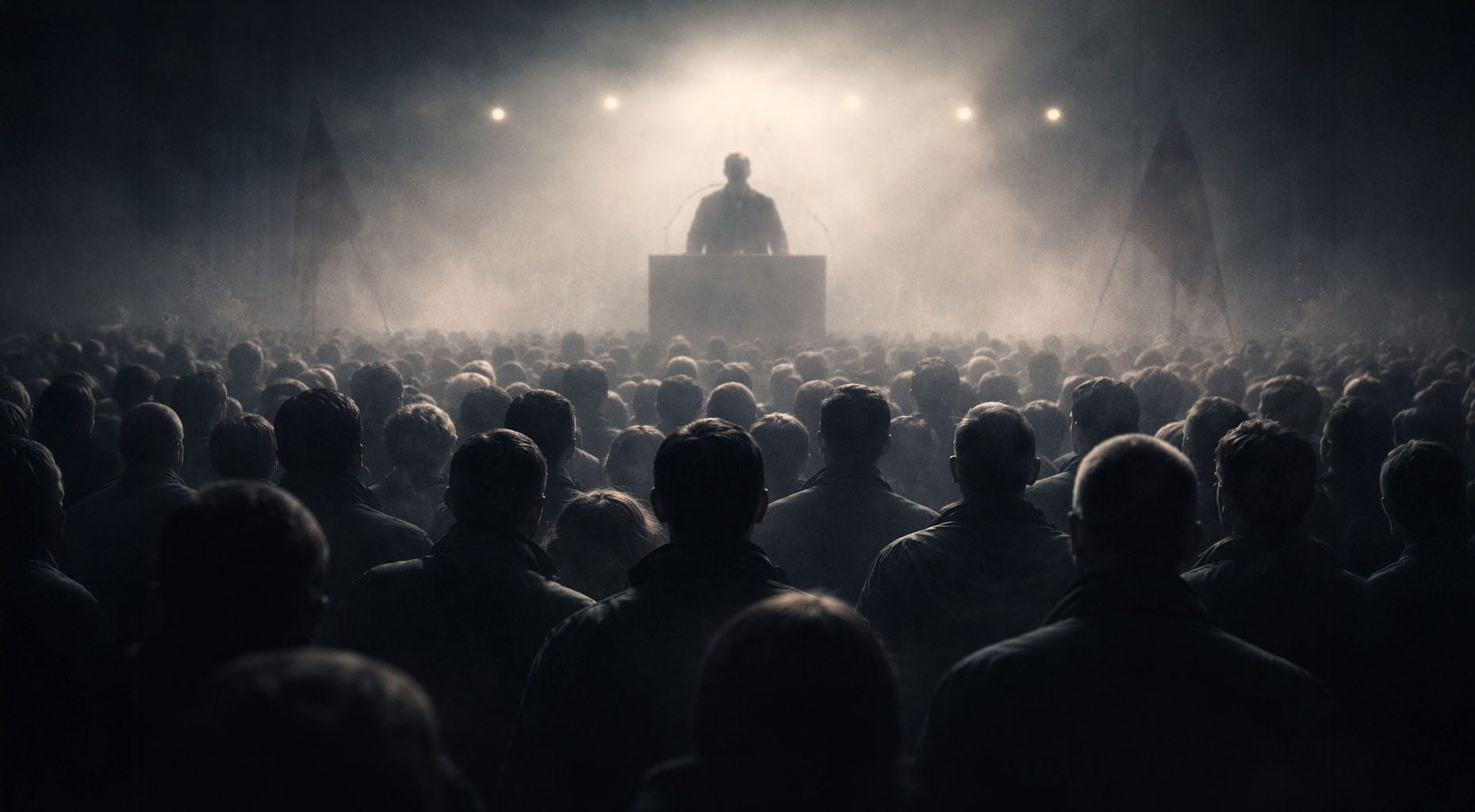
Before anyone panics, this is not calling every disliked politician “Hitler.” That lazy comparison helps nobody and usually shuts down the conversation. People stop taking you seriously the moment you drop the H-word. It’s overused, and it signals that you’re trying to insult someone rather than explain a pattern. After all, do people use the M-word because they think you and your mother have too close a relationship?
So this is about Hitler’s traits. Behaviors. Methods. Patterns that worked once and keep working again because people think history only repeats when it wears a mustache and a swastika, and not in modern times. The leaders we’ll be talking about were around, are around, and will be around.
History teaches us who Adolf Hitler was and what a horrible man he was, and that is a lesson worth learning if that is what history is for. We get to know people who won’t come back from the dead and run political campaigns. What we should learn is why Hitler was an electoral success and how he achieved this.
What they should teach us is the scariest part: Hitler wasn’t all that special. The traits he had that made him who he was are too common for comfort in certain leaders all around the world.
1. Everything Is Someone Else’s Fault
Nothing ever goes wrong because of bad leadership. It’s always outsiders, minorities, elites, immigrants, traitors, globalists, liberals, conservatives, academics, journalists, bankers, or some vague enemy that somehow controls everything while also being weak and stupid.
Hitler blamed Germany’s collapse on Jews, communists, liberals, and the “stab in the back.” Economic pain was never explained with policy failures or structural problems. It was personalized. Simplified. Moralized.
When your leader explains every failure with a villain and never with evidence or accountability, that’s not strength. That’s scapegoating. It’s emotional outsourcing. And it trains followers to stop asking hard questions.
If you catch yourself saying “they ruined the country” more often than “this policy failed,” you’re already halfway there.
2. Loyalty Matters More Than Competence
In healthy systems, leaders want capable people who challenge them. In authoritarian systems, leaders want loyal people who protect them.
Hitler purged institutions not because experts were wrong, but because experts didn’t worship him. Generals, judges, civil servants, academics, journalists—anyone who resisted personal loyalty was framed as an enemy of the people.
When a leader replaces professionals with loyalists and dismisses criticism as betrayal, they are not draining corruption. They are becoming it.
If you excuse incompetence as long as “they’re on our side,” you are helping dismantle the guardrails that stop power from going feral.
3. Reality Becomes Negotiable
Facts start to feel optional. Statistics are dismissed as fake. Courts are corrupt unless they agree. Elections are fair only when the leader wins. Science is political. History is rewritten on demand.
Nazi propaganda didn’t just lie. It flooded the space so aggressively that people stopped caring what was true. Exhaustion replaced skepticism. Emotion replaced verification.
When your leader constantly undermines shared reality, it’s not confusion. It’s strategy.
If you defend obvious falsehoods because “the media lies too,” you’re not being skeptical. You’re giving up.
4. The Leader Is the Nation
Criticizing the leader becomes indistinguishable from attacking the country. Flags, slogans, and national identity get welded to one person’s image.
Hitler didn’t just lead Germany. He became Germany in the public imagination. Disagreeing with him meant hating the nation itself.
When people say “if you oppose him, you hate the country,” that’s not patriotism. That’s hostage-taking.
If your sense of national pride collapses without one man at the center, you’re not defending a country. You’re defending a brand.
5. Violence Is Always Someone Else’s Fault
Supporters commit violence, intimidation, or threats—but somehow the leader is never responsible. It’s always “a few bad apples,” “provocateurs,” or “understandable anger.”
Hitler used street violence early and often. When it worked, he praised it. When it backfired, he denied responsibility.
When a leader winks at aggression, praises “strength,” and condemns violence only when forced, they are testing boundaries.
If you minimize threats because “they were emotional” or “they were provoked,” you are helping normalize intimidation as politics.
6. Fear Is the Main Fuel
Every speech sounds like the last warning before collapse. Crime is always exploding. Culture is always dying. Enemies are always at the gate.
Hitler didn’t offer calm leadership. He offered permanent emergency. Fear keeps people obedient. Panic short-circuits reason.
When leaders thrive on constant crisis, it’s not because the world is ending. It’s because fear keeps followers loyal and distracted.
If you feel exhausted but energized at the same time, angry but dependent, that’s not leadership. That’s emotional addiction.
7. Institutions Are Attacked One by One
Courts. Press. Universities. Elections. Bureaucracy. Any institution that limits power becomes “corrupt,” “elitist,” or “the enemy.”
Hitler didn’t abolish democracy overnight. He hollowed it out slowly while keeping the language intact.
When your leader claims to be the only legitimate authority and treats independent institutions as obstacles, that’s not reform. That’s demolition.
If you cheer the weakening of checks and balances because they frustrate your side, remember this: weakened brakes don’t care who’s driving.
8. You’re Asked to Excuse Everything Because the Alternative Is Worse
This is the most dangerous sign of all.
People didn’t follow Hitler because they loved everything about him. Many followed because they feared the alternative more. Chaos. Communism. Humiliation. Decline.
Once fear of the other side becomes absolute, anything becomes justifiable.
If you find yourself saying “yes, but the other side is worse” to excuse lies, cruelty, incompetence, or abuse of power, you are no longer choosing leaders. You are choosing enemies.
That’s how democracies rot without a coup.
Why This Comparison Makes People Angry
Because it hits close to home.
Nobody likes to think they’d fall for authoritarian tricks. Everyone imagines they’d be the brave resistor, not the cheering crowd. But history says otherwise. Ordinary people don’t support dangerous leaders because they’re evil. They do it because they feel threatened, unheard, humiliated, or afraid.
Hitler didn’t invent these tactics. He refined them. Others learned from him. And they keep working because people insist “this time is different.”
It usually isn’t.
Last Thoughts
Authoritarianism doesn’t belong to the left or the right. It belongs to anyone who thinks power matters more than truth and loyalty matters more than law.
Many people who read this will think I had a certain leader in mind. But no. This is a long list. From Russia to Hungary, from modern-day Germany to Iran. In many countries, fortunately, many of these leaders aren’t elected, but they are still creating their tribe: them against the world. They do this in the UK, France, the Netherlands, modern-day Germany—you name it.
You don’t need to hate a leader to recognize dangerous traits. You don’t need to abandon your values to admit someone is abusing them.
The real test is simple.
If your leader disappeared tomorrow, would your principles survive intact?
If the answer is no, you didn’t follow a cause. You followed a man.
And history has already shown where that road goes.
If this made you uncomfortable, good. That means you’re still thinking. Read it again, then say what you agree with, what you reject, and where you think the line actually is.
To be honest, only a small portion of subscribers are paid—most of my posts are free for everyone to read, with some exclusives. But reader support buys something priceless: time. Time to research, question power, and hold the powerful accountable. If you can afford it, your support helps keep this work alive.
I do not have enough sociological or historical knowledge to discuss this, but it seems to me that at least some of those points are properties of more general authoritarian systems than nazi, fashists or specifically Hitler's.
But as they match very well what is happening in at least one of big and important countries, and (maybe a majority of them not all) in many other countries partially (either with the government or one of the parties of significance in the local political scene) - they should better be attributes to authoritarianism not to Hitler.
Because people who support those governments (or parties) would immediately say "our beloved leaders are nothing like Hitler" and then just refuse to think about any of those things (argument "and Hitlerum" is usually making people angry, not thoughtful).
But if you stress that this is how authoritarianism is born and then how it gradually swallows benign political systems, and then mention that this is *also* what (gradually) happened in Hitler's Germany, then more people may think about your message and look at their reality.