


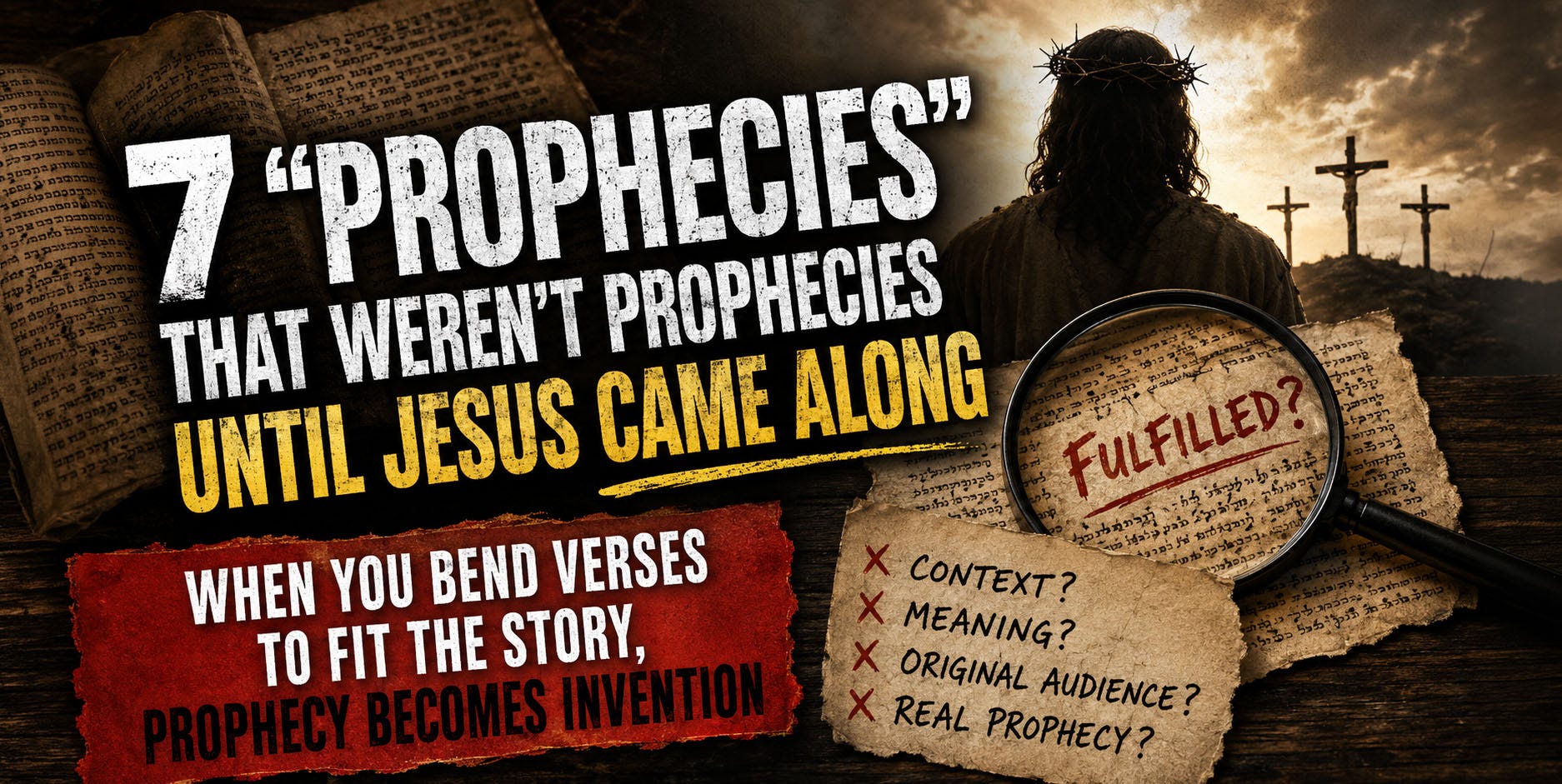
If you’ve spent any time around Christianity, you’ve heard the claim, delivered with the confidence of a closing argument. Jesus fulfilled dozens of Old Testament prophecies, and the details are said to line up with such precision that coincidence becomes impossible. A child born of a virgin, a messiah called out of Egypt, a king entering Jerusalem on a donkey, thirty pieces of silver changing hands before a betrayal. The argument writes itself, because nobody could have arranged all those details centuries in advance unless God was running the show.
For a lot of believers, fulfilled prophecy sits near the center of the whole case. Miracles can be debated and resurrection accounts can be questioned, theology gets complicated fast, but prophecy is supposed to be different. It is presented as objective in a way the rest of the apologetic apparatus isn’t. Either the prediction existed before the event or it didn’t, and either the target got hit or it didn’t. That clean, testable quality is exactly what makes the argument feel so strong to people who’ve never checked it.
The trouble starts when somebody opens the Old Testament and reads the verses in context, which nobody does, because the whole machine depends on them not doing it.
Many of the passages Christians point to weren’t prophecies in any ordinary sense of the word. They weren’t predictions about a future messiah, they weren’t descriptions of events centuries away, and several of them weren’t even talking about an individual person. They were references to contemporary politics, historical memories, national tragedies, poetic metaphors, and literary imagery that the original audience would have understood immediately. The New Testament writers inherited those texts, looked back at them through the lens of Jesus’ life, and found connections that made sense to them. What came out the other end wasn’t prophecy fulfillment in the way most modern people picture it. It was interpretation after the fact, dressed up later as prediction.
That distinction is the whole ballgame, so it’s worth being precise about it. A prophecy predicts something before it happens. If I tell you tomorrow’s lottery numbers today and they come up exactly as I said, you’ve got my attention and you’ve got a problem on your hands. But if I wait until after the drawing, flip through a stack of old notebooks, and point to some vague sentence I scribbled months ago that can be stretched into a rough match, you’ve got something completely different, and you’d be right to be unimpressed. The gospel writers were usually working in that second category, and the difference between the two is the difference between foresight and creative editing.
Have a Substack? Let’s collaborate. Email me at tanner@theunholytruth.com
1. Hosea Was Talking About the Exodus
Matthew opens his gospel with one of the most quoted prophecy claims in all of Christianity. After Jesus is born, Joseph takes the family to Egypt to escape King Herod, and when Herod dies they come back. Matthew explains that this fulfilled Hosea 11:1,
“Out of Egypt I called my son.”
At first glance, it sounds airtight. Jesus went to Egypt, Jesus came back from Egypt, Hosea mentioned somebody coming out of Egypt, so what’s left to argue about?
What’s left is the rest of the chapter, which Matthew is counting on you to skip. Hosea 11 opens,
“When Israel was a child, I loved him, and out of Egypt I called my son.”
Hosea isn’t predicting anything, he’s remembering. The whole passage looks backward at the Exodus, recalling how the nation was enslaved in Egypt, how God delivered it, and how Israel responded to that rescue by drifting into idolatry anyway. The complaint driving the chapter isn’t about some far-off messianic fulfillment, it’s about past national failure, and the “son” being called out of Egypt is the nation of Israel.
Throughout the Hebrew Bible, Israel gets described as God’s son over and over, and Exodus 4:22 puts it about as plainly as language allows, “Israel is my firstborn son.” The imagery was standard. Matthew took a verse about Israel’s past and pointed it at Jesus’ childhood, and the move only works on a reader who never flips back to Hosea to see what the chapter is discussing.
Some Christian theologians have a more sophisticated answer worth taking seriously. They argue that Matthew never claims Hosea consciously predicted Jesus, and reads the verse instead as casting Jesus in the role of a new Israel, going down into Egypt and being called back out of it the way the nation once was. As a literary and theological reading it holds together, and it's miles better than the version that gets preached from most pulpits. The problem is that it concedes the one thing the prophecy argument couldn't afford to concede, because the moment you admit Hosea wasn't predicting Jesus, the prophecy is gone and what remains is symbolism. Bart Ehrman states it with little room to wiggle: Hosea 11:1 refers to the Exodus, the verse carries no messianic prediction, and Matthew applies it to Jesus because the parallel serves his theology. Interpretation is doing all the work here, and interpretation is not prophecy.
2. Rachel’s Weeping Was About Babylon
Matthew’s next prophecy claim shows up right after Herod’s alleged massacre of the children of Bethlehem. According to the gospel, Herod ordered every male child under two years old killed across the region, and Matthew says the slaughter fulfilled Jeremiah 31:15,
“A voice was heard in Ramah, Rachel weeping for her children.”
The emotional logic lands instantly, since mothers are grieving and children are gone and Rachel weeps, and on a first read it feels like a natural fit.
The original context tells a different story, because Jeremiah was describing the Babylonian conquest of Judah centuries before any of this. The kingdom had been destroyed, Jerusalem had fallen, and large portions of the population had been hauled off into exile, with families torn apart in the process, and Rachel appears as a symbolic mother mourning the suffering of the whole nation. The detail that really matters is what comes immediately after the line Matthew quotes, because Jeremiah pivots hard toward restoration. The children come back, the exile ends, and grief gives way to hope. Matthew extracts the lament and quietly leaves the surrounding message of return on the cutting room floor, which turns into a recurring habit across his gospel. He isn’t interested in what Jeremiah’s chapter means as a whole, only in finding language that resonates emotionally with the scene he’s staging.
The second complication, and the most obvious one, is that outside of Matthew there’s no evidence the massacre ever happened. Ancient historians who covered Herod’s reign documented plenty of his atrocities, and Josephus in particular catalogued the man’s paranoia and brutality in exhaustive detail, yet says nothing about the killing of Bethlehem’s infants. Silence doesn’t prove an event never occurred, since ancient records are patchy and incomplete, but the absence is striking, and it gets more striking the longer you look at it. Bethlehem was a small town, so the number of victims would have been limited rather than enormous, which makes Matthew’s solitary preservation of the story hard to wave away. It doesn’t help his credibility that the same author happens to need a narrative echoing the infancy of Moses. The parallel almost builds itself, with Pharaoh killing Hebrew boys while baby Moses survives, and Herod killing Judean boys while baby Jesus survives, and the literary pattern sits a little too cleanly for comfort. Raymond Brown observed that Matthew consistently shapes his infancy narrative around scriptural themes, and whether any given detail started life as history is a separate question from whether it started life as theology. Either way, Jeremiah wasn’t forecasting a massacre in Bethlehem, he was mourning a catastrophe that had already flattened his country.
3. The Prophecy That Doesn’t Exist Anywhere
Most prophecy disputes are arguments about interpretation, where two sides read the same verse and draw different conclusions. This next one isn’t subtle like that, because the verse simply isn’t there. Matthew 2:23 says Jesus settled in Nazareth so that what was spoken by the prophets might be fulfilled,
“He shall be called a Nazarene.”
The flat problem is that no prophet ever said it. The line isn’t in Isaiah, it isn’t in Jeremiah or Ezekiel, it isn’t in Micah, and it isn’t tucked away in any other book of the Hebrew Bible that anyone has been able to locate. Generations of scholars have gone looking for the source, and they’ve come up empty because there doesn’t appear to be anything there to find.
That puts Matthew in an awkward spot that most prophecy debates never reach, since this isn’t a disagreement over meaning, it’s a missing citation.
Christian commentators have offered the usual range of rescues, with some connecting “Nazarene” to the Hebrew word netzer meaning “branch,” others arguing Matthew is gesturing at a broad prophetic theme rather than quoting a specific verse, and still others speculating about lost prophetic traditions that simply didn’t survive. The common thread running through all of them is that everyone is working very hard to account for a prophecy that doesn’t appear in the text. The Jewish Study Bible states the situation without ornament: there is no biblical prophecy that the messiah will be called a Nazarene. That ought to be the end of it, yet centuries of apologetic ingenuity have managed to turn a plain absence of evidence into a puzzle that demands creative solving. Sometimes the boring explanation is the correct one, and the boring explanation here is that Matthew wanted Nazareth to carry prophetic weight, the source material to support that didn’t exist, and the claim survived anyway because almost nobody goes looking.
4. The Prophecy That Put Jesus on Two Donkeys
Matthew’s handling of Zechariah 9:9 produces one of the oddest images in the New Testament, and it’s odd for a reason that exposes how the sausage gets made. The prophecy describes a king arriving “humble and mounted on a donkey, on a colt, the foal of a donkey.” Anyone familiar with Hebrew poetry recognizes what’s going on in that line, because the second phrase is just restating the first one. The colt is the donkey, and the verse is using parallelism, which is one of the most common features of Hebrew verse, where the same idea gets stated twice in slightly different words for emphasis. The Psalms lean on it constantly, Isaiah uses it, Jeremiah uses it, and once you know the convention the meaning of Zechariah’s line is obvious. One animal, described twice.
Matthew appears to miss it, and the result shows up in his version of the triumphal entry, where Jesus somehow ends up involving both a donkey and a colt. The picture turns absurd, with Jesus seemingly arranged across two creatures because the author read poetic repetition as if it were a literal inventory. It’s one of those moments where the machinery under the floorboards becomes visible, because the gospel writer clearly isn’t starting from a remembered event and reaching for a scripture that fits it. He’s starting from the scripture and shaping the event to match, with Zechariah supplying the template and Matthew supplying the fulfillment, and the seam between the two is showing. Amy-Jill Levine has pointed out that a lot of supposed New Testament fulfillments lose most of their punch once readers understand the Jewish literary conventions the original texts were written in, and this is as clean an illustration as you could ask for. The prophecy never called for two animals, and the only reason there are two is that someone built the scene out of a poem he took too literally.
5. Wrong Prophet, Wrong Story
The Judas episode hands Matthew another chance to reach into the Old Testament and pull out something that reads like a prediction. After betraying Jesus, Judas is overcome with regret, returns the thirty pieces of silver, and Matthew announces that this fulfilled what was spoken by the prophet Jeremiah. There’s a problem before you even reach the content, because the quotation isn’t from Jeremiah. It’s drawn mainly from Zechariah 11:12-13, and that misattribution alone should make a careful reader stop. If a modern writer cited Shakespeare and then quoted a passage that was plainly Dickens, every reviewer in the room would catch it, yet biblical discussions tend to extend the New Testament a courtesy that nobody grants ordinary literature.
Set the wrong-prophet problem aside, and the passage still has nothing to do with betrayal in its original setting. In Zechariah the prophet is performing a symbolic role as a shepherd, he grows disgusted with the people he’s been tending, and he asks them for his wages, which they hand over as thirty pieces of silver. The amount is meant as an insult, since it’s the value of a slave specified elsewhere in biblical law, so the payment is an act of contempt, a way of saying the shepherd has been rejected and isn’t worth much. God then instructs him to throw the money into the temple. That’s the scene Matthew lifts, taking the silver coins, the temple, and the theme of rejection while discarding the original meaning entirely, so the shepherd becomes Jesus, the insulting wage becomes betrayal money, and a piece of symbolic prophetic theater gets recast as history. The resemblance is striking because Matthew engineered it to be, and what looks at first like a prediction coming true looks on closer inspection like an author assembling a story out of the materials lying around in his scriptures.
Michael Fishbane’s work on inner-biblical interpretation showed how routinely later Jewish writers reused and reapplied earlier texts, treating scripture as a deep reservoir of images waiting to be drawn on rather than a set of statements locked to their first context. Ancient authors weren’t precious about original meaning the way modern scholars are, and Matthew belongs squarely to that world. The mistake isn’t theirs, it’s ours, and it happens when modern readers confuse this kind of reinterpretation with prediction, because one is a literary technique that any educated person of the period would have recognized and the other is supposed to be evidence of supernatural foresight. The Judas story shows how thoroughly the scriptural echoes drive the details, where the silver matters because scripture mentions silver and the temple matters because scripture mentions the temple, and the whole sequence feels predetermined because the author is arranging it around older passages rather than reporting it from memory.
The Unholy Truth’s paid subscribers made this article possible.
6. The Virgin Birth That Came Out of a Translation
If Christianity kept a hall of fame for prophecies, Isaiah 7:14 would have a plaque near the entrance. For generations believers have quoted it as one of the clearest predictions in the entire Bible, “Behold, a virgin shall conceive and bear a son,” and the case looks closed before it opens. The real history is messier, and most of it turns on a single Hebrew word.
That word is almah, and in ordinary Hebrew usage it means a young woman of marriageable age, full stop. It does not specifically mean virgin. Hebrew had a different word available for when virginity was the point, betulah, and Isaiah didn’t reach for it. The surrounding context makes the situation even clearer than the vocabulary does, because Isaiah wasn’t addressing future Christians, he was addressing King Ahaz during a military crisis, with enemy kingdoms pressing on Judah and the king terrified of being overrun. Isaiah shows up with reassurance, telling Ahaz that God will protect the kingdom, and he points to a child whose birth is either already underway or imminent as the sign of it, promising that before that child is old enough to tell right from wrong the threatening kingdoms will be gone. Everything in the passage is local, immediate, and tied to Ahaz’s political emergency, and a sign that doesn’t arrive for another seven hundred years would have been useless to a king staring at armies camped near his borders.
The famous virgin reading enters through the Septuagint, the Greek translation of the Hebrew Bible, where the translators rendered almah as parthenos, a word that often does mean virgin even if its usage wasn’t perfectly rigid. By the time Matthew came across the passage in Greek, the wording made a virgin interpretation possible, and possible slid quickly into preferred, and the consequences turned out to be staggering. A translation choice ended up helping to shape one of Christianity’s central doctrines, and the influence didn’t stop at Christianity’s borders, since Islam inherited the virgin birth tradition as well. Billions of people across two world religions eventually came to understand Jesus’ birth through a Greek rendering of a Hebrew term that originally carried a much broader meaning. The medieval commentator Rashi read Isaiah’s passage as referring to events in the prophet’s own day, and most modern biblical scholars read it the same way. That doesn’t resolve anyone’s theology, because doctrines routinely grow well beyond the original meaning of the texts that seeded them, but it does resolve the prophecy question. Isaiah wasn’t describing a miraculous birth seven centuries down the road, he was talking about something unfolding in front of King Ahaz, and the farther a reader drifts from that historical setting the easier it gets to miss the point, while the closer they move back toward it the harder it gets to avoid.
7. Isaiah’s Suffering Servant Was the Nation Itself
No passage gives Christian apologists more confidence than Isaiah 53, and it’s easy to see why, because the chapter reads as if it were written for a Good Friday sermon. The servant is despised, the servant suffers, the servant bears affliction, and the servant is led like a lamb to slaughter, and many Christians encounter that chapter and cannot understand how anyone could read it without seeing Jesus on every line. The answer arrives the moment you keep reading the rest of Isaiah, because the book tells you, repeatedly and without much ambiguity, who the servant is. The servant is Israel.
This is a pattern Isaiah hammers on. Isaiah 41:8 says “But you, Israel, my servant,” Isaiah 44:1 says “Hear now, Jacob my servant, and Israel whom I have chosen,” and Isaiah 44:21 says “Remember these things, O Jacob, and Israel, for you are my servant.” The servant language points to the nation again and again, and the experiences attributed to the servant track the national story closely, where Israel suffers, endures exile, lives through humiliation, survives conquest, and eventually receives vindication. Those themes dominate huge stretches of the book, so when readers reach chapter 53 and forget everything that came before it, they’re not reading carefully, they’re reading the way Christian tradition trained them to read, which is to lift the passage clean out of its surroundings. Isolated, the chapter starts to resemble a biography of one man, but slotted back into the larger narrative it reads like national poetry about a battered and surviving people. James Kugel notes that ancient Jewish interpretation didn’t treat Isaiah 53 as a straightforward messianic prediction, and that the servant was understood primarily in collective terms, which is the reading that fits the book it lives in.
The Christian interpretation emerged because the earliest believers had a serious problem on their hands. Messiahs weren’t supposed to get executed, and the messiah Jewish expectation described was a victorious ruler who would restore Israel, defeat its enemies, and usher in an age of justice and prosperity, none of which describes a man nailed to a Roman cross. Crucifixion looked like outright failure, and the first Christians needed some way to reinterpret that failure into something other than a refutation of their entire claim. Isaiah 53 supplied the raw material, because a suffering servant could transform a humiliating death into a divine plan, so the cross stopped being evidence against Jesus and became, through reinterpretation, evidence for him. As a piece of theology that’s ingenious, and it solved a problem that might otherwise have killed the movement in its cradle. As a piece of history it shows the process running in plain sight, where the event came first, the search through scripture followed, and the prophecy emerged at the end of that search rather than the beginning.
Which Way the Arrow Points
Most popular discussions of prophecy assume a tidy sequence in which the prediction comes first and the fulfillment comes second, with the gap between them serving as proof of foresight. The evidence keeps pointing toward the reverse order. Jesus lived and Jesus died, his followers became convinced he was the messiah anyway, and they then went searching through their scriptures for passages that could explain what had happened to them and to him. That process wasn’t unique to Christianity or even unusual for its time, since ancient religious movements were constantly rereading older texts through the lens of present events. The community behind the Dead Sea Scrolls did it, rabbinic interpreters did it, and the early Christians did it, and none of them would have found the practice strange. What set Christianity apart was that many of those after-the-fact interpretations got presented down the line as literal predictions, and once that reframing took hold, readers stopped asking where the verses had originally come from. The citations took on a life of their own, so Hosea became a prophecy about Jesus, Jeremiah became a prophecy about Bethlehem, Isaiah became a prophecy about the virgin birth, and Zechariah became a prophecy about Judas, while the original settings of all four faded into a background nobody bothered to check.
That dynamic explains why fulfilled prophecy stays persuasive even now, because most people never encounter the surrounding chapters and only ever hear the isolated quotations. The quotation sounds impressive on its own, the context stays invisible, and an impressive-sounding line with its context stripped away can be made to say almost anything. A newspaper headline pulled loose from its article can be made into a prediction, a poem can be twisted into a political manifesto, and a backward-looking historical reflection can be dressed up as a forecast, and scripture has no special immunity to the same treatment. The New Testament writers weren’t working with modern standards of historical method, they weren’t producing source-critical commentaries, and they weren’t trying to. They were proclaiming what they believed God had done through Jesus, and that conviction shaped how they read everything that came before, the Hebrew Bible very much included.
Free subscriber and finding value here? Become a paid one to keep The Unholy Truth alive.
Why a Broken Argument Refuses to Die
The prophecy argument survives because it appears powerful, and appearing powerful is often enough. People are drawn to the idea of a hidden plan running beneath the surface of events, and they love discovering clues that seem to point toward an inevitable conclusion, so a fulfilled prophecy delivers exactly that emotional payoff. The story it tells feels larger than ordinary history, with every event connected to every other, every apparent coincidence revealed as purpose, and every verse turned into a breadcrumb leading toward the same destination. There’s something deeply satisfying in a narrative shaped like that, and the satisfaction is real when the foundation isn’t. The catch is that satisfaction has never been evidence of anything except that a story is well told.
Once the original contexts get restored, most of the famous prophecies stop behaving like predictions and start behaving like reinterpretations, and that shift changes the entire conversation. A prediction demonstrates foresight, while a reinterpretation demonstrates creativity, and the gospel writers had creativity to spare. They inherited a vast collection of ancient texts and reread the whole inheritance through the lens of a teacher they were convinced had changed the world, and the interpretations that resulted helped build a religion, helped shape Western civilization, and helped produce some of the most influential literature ever written. What those interpretations don’t provide is good reason to think Isaiah, Hosea, Jeremiah, or Zechariah consciously foresaw the details of Jesus’ life centuries ahead of time. The farther you trace the citations back toward their sources, the harder that claim gets to hold, and once the original contexts swim back into focus, the miracle starts to look a lot less like prophecy and a lot more like skilled construction by writers who already knew how the story ended.
Sources and Further Reading
Bart D. Ehrman, Jesus: Apocalyptic Prophet of the New Millennium (1999)
Bart D. Ehrman, Jesus, Interrupted (2009)
Raymond E. Brown, The Birth of the Messiah (1993)
The Jewish Study Bible, 2nd Edition, Oxford University Press (2014)
Michael Fishbane, Biblical Interpretation in Ancient Israel (1985)
Geza Vermes, The Authentic Gospel of Jesus (2003)
Amy-Jill Levine, The Misunderstood Jew (2006)
James Kugel, How to Read the Bible: A Guide to Scripture, Then and Now (2007)
Tags: Christianity, Jesus, Bible, Old Testament, New Testament, Biblical Criticism, Religion, Theology, History, Skepticism
The more I study the history of Christianity and the surrounding movements, the more I realize that most of it is just made up or fabricated to explain our existence and account for what may be a field of consciousness that faintly connects us all.