


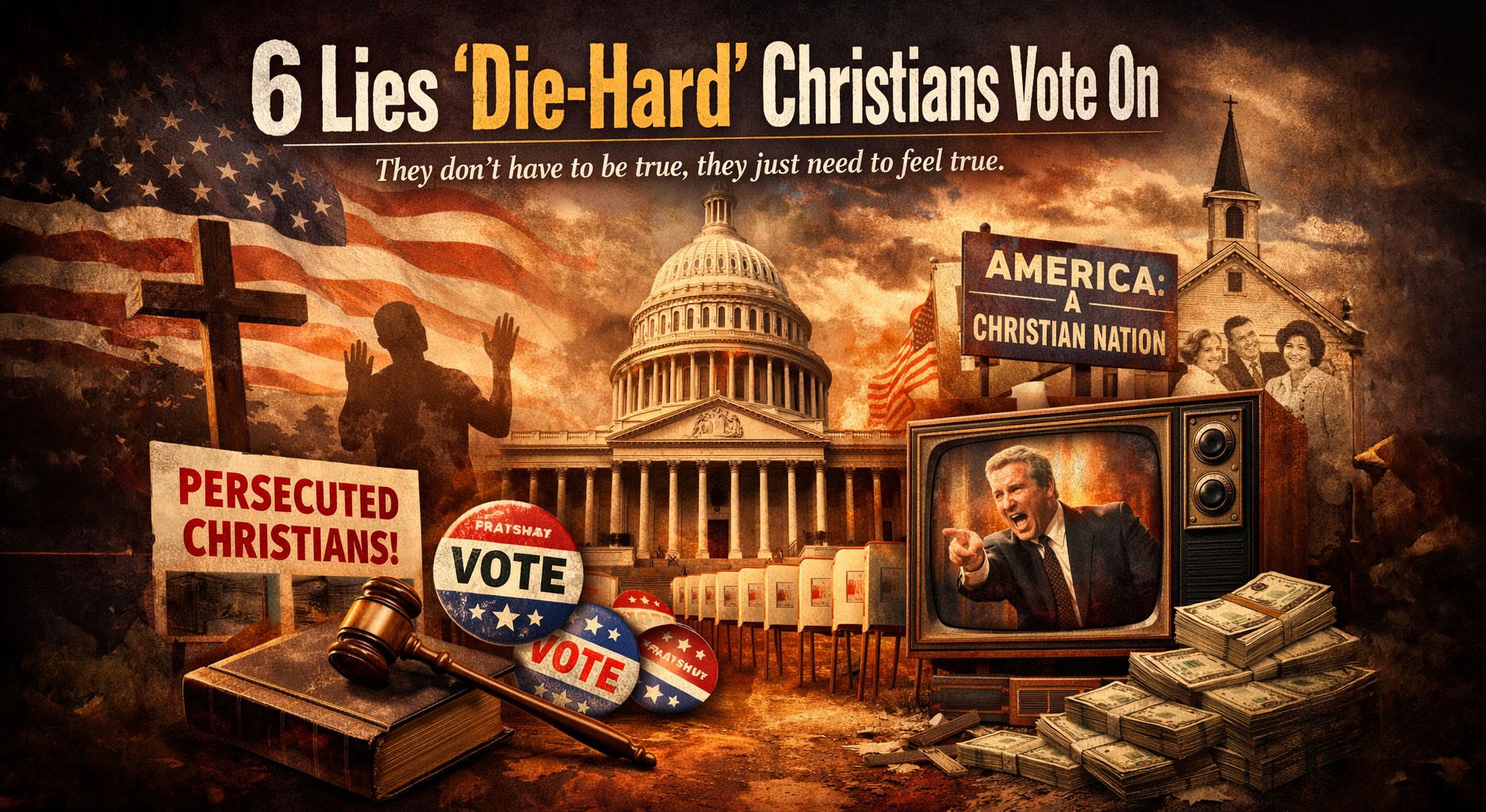
The political myths that conservative Christians build their entire identity around are designed to be wrong, which makes it all the more frustrating for anyone who sees through what’s happening. These myths are products. Manufactured grievances with a shelf life that stretches from one election cycle to the next, refreshed every November like a seasonal menu at a restaurant that only serves fear.
And the worst part? The people consuming them aren’t stupid. A lot of them are no less intelligent and no less well-meaning than anyone else — they’ve just been handed a rigged deck since childhood. When you grow up hearing that the world is out to get you because of your faith, you don’t question it. You look for evidence. And confirmation bias is a hell of a drug.
A quick note before we start
Most of what follows is America-focused, but it should land for readers elsewhere too — thanks to America’s unmatched skill at making its domestic problems everyone else’s.
That said, in the bonus section, we’ll take a quick look at other countries running the same playbook, picked from where The Unholy Truth subscribers live. Which, by the way, is 37 countries in total.
I expected the US to dominate and the UK to follow. What caught me off guard was how strong the numbers are in Canada and Australia. Didn’t see that coming, and I’m glad I was wrong.
Thanks for being here, wherever you’re reading from.
Now, let’s get into it.
1. The Persecuted Majority
The idea that American Christians are persecuted is widespread and backed by statistics. A 2017 PRRI survey found that 57% of white evangelical Protestants believe Christians face “a lot of discrimination” in the United States. More than half. In a country where Christians make up roughly 65% of the population, control the Supreme Court majority, dominate Congress, and enjoy tax exemptions estimated at $71 billion a year. And unlike every other nonprofit in America, churches don’t even have to file financial reports with the IRS (American tax agency). Zero oversight, zero accountability, nothing more than alleged faith that nobody’s skimming.
To be fair, the persecution claim goes all the way back to the early church itself. The first Christians mythologized their own suffering to build group identity, and martyrdom stories — many exaggerated or outright invented — became the community’s founding documents. What the persecution-complex crowd conveniently forgets is that almost all those accounts come from Christian sources describing Christian suffering. And once Christianity became the legal religion of the Roman Empire under Theodosius in 380 AD, the tables flipped hard. Pagan temples were demolished, pagan rites were outlawed, and pagans themselves were beaten, exiled, and in some cases killed for refusing to convert. The persecuted became the persecutors inside a single generation. You just don’t hear about those martyrs because the people telling the story were the ones holding the hammers.
Anyway, back to the main point: the persecution wiring never got disconnected. When a cashier says “Happy Holidays” instead of “Merry Christmas,” the old circuit fires automatically — they hate us, just like they hated the apostles. Ironically, the ideology that screams the loudest today is descended from the same Puritan strain that tried to ban Christmas celebrations in colonial America because they claimed the holiday was pagan.
Aren’t there Christians worldwide who are victims of real persecution? Of course there are. But they’re not worth talking about here because the real function of this myth is domestic. It turns every policy disagreement into spiritual warfare. Don’t want a Ten Commandments monument in a courthouse? Persecution. Think a baker shouldn’t refuse service to a gay couple? Persecution. Suggest creationism doesn’t belong in a biology class? Persecution. Stretch a word thin enough and it stops meaning anything — which, for the people manufacturing the outrage, is exactly the point.
2. The Origin Story They Improvised
Ask an evangelical what launched the religious right, and they’ll say Roe v. Wade.
The problem with that myth or narrative, depending on how kind you want to be, is that when Roe was decided in 1973, most white evangelicals didn’t care much about abortion. The Southern Baptist Convention, the biggest white evangelical denomination in the country, supported abortion legalization in 1971, two years before Roe, and reaffirmed that position multiple times through the decade. Jerry Falwell didn’t give his first anti-abortion speech until 1978. Five years after Roe.
What actually lit the fuse was race (surprise, surprise). The federal government moved to strip tax-exempt status from racially segregated private Christian schools — the “segregation academies” that had mushroomed across the South after Brown v. Board of Education. Green v. Connally in 1971 affirmed the IRS’s right to yank exemptions from schools that discriminated by race. When the IRS turned that standard on Bob Jones University, which banned interracial dating (seriously?), evangelical leaders lost their minds.
Historian Randall Balmer — himself an evangelical — spent decades tracking this down. Paul Weyrich, the operative who co-founded the Moral Majority, told him directly that Roe v. Wade had nothing to do with the movement’s rise. Ed Dobson, Falwell’s right-hand man, backed him up — he sat in the rooms where the Moral Majority was planned and doesn’t remember abortion coming up as a reason to organize.
But “we’re mad because the government won’t let our schools discriminate by race” doesn’t fit on a bumper sticker. So they pivoted. Abortion became the front-facing cause — morally urgent, emotionally potent, and infinitely more respectable than defending segregation. By 1980, Reagan opened his general election campaign in Neshoba County, Mississippi — where three civil rights workers had been murdered sixteen years earlier — and invoked “states’ rights.” The deal was done.
Is this the whole story? Probably not. Others argue the real trigger was federal overreach into Christian schools regardless of race, and that pro-life organizing was already happening on its own. That "overreach" line always makes me laugh, since half the policies these same folks want to enforce are textbook government overreach — banning books, policing bedrooms, writing their theology into state law. They're the muggers who scream "stop, thief!" after snatching the bag, hoping to slip away in the confusion.
3. The Country They Never Had
The research on Christian nationalism keeps turning up the same pattern: the “Christian nation” idea correlates with support for authoritarian governance, hostility toward immigrants and minorities, and opposition to religious pluralism. None of those are theological commitments. They’re cultural ones dressed in church clothes.
The historical claim collapses just as fast. The Constitution doesn’t mention Jesus, God, or Christianity. The First Amendment bans government from establishing religion. The Treaty of Tripoli, signed by John Adams in 1797, stated that “the Government of the United States of America is not, in any sense, founded on the Christian religion.” Adams signed it. The Senate ratified it unanimously.
Jefferson took a razor blade to the Bible and cut out every miracle and supernatural claim. What he kept was a book about a moral teacher, not a divine savior. Thomas Paine called organized religion a human invention designed to terrify and enslave. Benjamin Franklin said he doubted the divinity of Jesus. These are the men who built the country. Their own words are on record. Christian nationalists just don’t read them.
They don’t need to. The myth does something more useful than accuracy: it turns policy preferences into divine mandates. If America was founded as a Christian nation, then anything that moves away from a specific brand of Christianity isn’t a policy disagreement — it’s apostasy. And you don’t compromise with apostasy. You fight it.
That’s what makes it corrosive to democracy. It doesn’t just disagree with opponents — it strips them of legitimacy. If your politics are ordained by God, the other side isn’t wrong. They’re enemies of the divine order. And once that line gets crossed, democratic norms — compromise, pluralism, the basic idea that disagreement is legitimate — become obstacles, not values.
And here's the irony that never gets addressed. The same people who wrap themselves in the Founding Fathers conveniently skip over the part where those Founders built the country on Enlightenment principles — reason, religious tolerance, separation of church and state, government by consent rather than divine right. Every one of those values is the opposite of what Christian nationalism is selling. They love the flag, the wigs, and the parchment. They just don't love what the parchment actually says.
4. The Good Old Days That Weren’t
The nostalgia myth is the glue. America was once a godly, moral, orderly society — and liberals, secularists, and immigrants ruined it. That’s the story. It gives people a golden past to mourn and a villain to blame.
Which good old days, though? The ones where Black Americans couldn’t vote? Where women couldn’t open a bank account without a husband’s signature? Where children worked in coal mines? Where being gay could land you in prison? Where a child molested by a family member was told to shut up and stop making trouble because the family’s reputation mattered more than the child’s body?
White evangelicalism built its identity around warrior masculinity, Cold War anxieties, and a fantasized past that never existed. The movement didn’t just remember a golden age — it made one up, then sold it back to its own people as something that had been stolen from them.
Of course, the Good Old Days did work for some people — the ones with pale skin and the "right" genitalia. Black people knew their place, women knew theirs, and homosexuality was treated like a plague. That's who the nostalgia is really for. It's not a longing for a moral America. It's a longing for an America where the hierarchy was clear and nobody at the bottom was allowed to complain about it.
5. The “Moral Majority” That Was Neither
The Moral Majority — the movement that welded evangelical Christianity to Republican politics in the 1980s — sold itself as a grassroots uprising of decent Christians saving America from moral collapse. Its first organizing energy, as we just saw, came from defending segregated schools. The moral packaging came later, once the strategists realized they needed a cause that wouldn’t embarrass them in public.
That gap between branding and reality never closed. The same movement that screamed about family values backed politicians who cheated on their wives, lied under oath, and weaponized religion for votes. It still does. The “moral” part was always the label, not the product.
And it was never a majority either. White evangelicals are about 13% of the American population. Their political influence is wildly out of proportion to their numbers — which is exactly why the myths matter. When you can’t win on size, you win on intensity, and nothing generates intensity like the belief that God is on your side and the enemy is at the gate.
6. “Family Values” as a Brand Name
"Family values" has always been code, an extension of The Good Old Days gospel. It means one kind of family — straight, white, conservative, churchgoing — and everyone else can sort themselves out.
The divorce rate among white evangelicals is comparable to the national average, church abuse scandals have filled entire investigative series, and the politicians who campaign loudest on family values are routinely caught in the kinds of scandals that would get anyone else fired from a gas station. None of this slows the branding down, because “family values” was never meant to describe behavior — it describes membership. If you’re in the tribe, your failures are forgiven. If you’re outside it, your existence is the problem.
Bonus: Religious Nationalism Problem Is Worldwide
I promised a quick look at other countries running this same game, and it’s worth delivering because Americans tend to assume their religious-political dysfunction is uniquely American. Yet, the same myths show up in country after country, dressed in whatever local religion happens to be dominant, and most of them aren’t even hiding it.
United Kingdom
Britain doesn’t have an American-style religious right because it doesn’t need one. The Church of England is an official part of the state — bishops still sit in the House of Lords and vote on legislation. That arrangement has been in place for centuries, so nobody needs to organize a movement to put religion into government. It already is the government. But it’s worth pointing out that the House of Lords — the body the American Senate was modeled on — mostly plays an advisory role these days, and the Anglican Church has been thoroughly domesticated. It ordains women, has openly gay clergy, and blesses same-sex marriages. So the religious influence in British politics, while real, looks nothing like the version running in the US.
British conservatism deserves some credit here too. Same-sex marriage passed the UK Parliament under a Conservative PM, who told his own party, “I don’t support gay marriage in spite of being a Conservative. I support gay marriage because I am a Conservative.” His argument was that family values and marriage commitments belong to everyone, gay couples included. Most of his own MPs voted against him. But without the Conservatives who did vote yes, the bill would never have passed.
What Britain does have is American evangelical money flowing into British front groups that fight abortion access and LGBTQ rights in the courts. And the Brexit campaign pushed on the same emotions American evangelicals push on every November: a stolen past, sovereignty snatched by foreign bureaucrats, immigrants ruining the national character. The words were about Britain instead of God. The feelings were identical.
Australia
Australia recently had a prime minister who belonged to a megachurch, prayed on the campaign trail, and publicly thanked God for his election win. The biggest megachurch that Australia produced is now a global brand and has moved through the same cycle of abuse scandals and political embarrassments that American megachurches cycle through. The religious right there is smaller than the American version but uses the same tools — church networks that turn out conservative voters, laws that let religious schools and employers discriminate legally, and a steady campaign against LGBTQ rights sold as protecting children and families.
But Australia also gets some credit. Just a few years before the megachurch prime minister, the country was led by an openly atheist woman who wasn't married and didn't have kids — none of which ended her career or kept her out of office. Her 2012 speech tearing apart the opposition leader for misogyny went viral globally, and you might remember it even if the politics around it have faded. I'm not saying this because I want single atheist women to take over the world. I just want gender, marital status, and the religious views of politicians to be irrelevant in politics.
Canada
Canada’s religious right sits mostly in the prairie provinces, and over the last decade it’s been copying grievances straight from the American movement. The trucker convoy that blocked Ottawa in 2022 was full of evangelical protestors, prayer circles on Parliament Hill, and Christian nationalist flags and slogans lifted directly from the US. Canadian evangelicals are a much smaller slice of the population than their American cousins, but when they talk about persecution, a lost golden age, and elites trying to destroy their families, they sound almost exactly like American evangelicals talking about the same things.
Netherlands and Belgium
The Low Countries are supposedly the most secular part of Europe. Church attendance is in single digits, same-sex marriage has been legal for decades, and both countries allow medically assisted death. None of that has stopped the religious-identity politics from working. Far-right parties in both countries campaign on defending “Judeo-Christian civilization” from Islam, even though the parties themselves aren’t religious in any meaningful way. Their voters don’t go to church. Their leaders don’t go to church. The churches are nearly empty. And Christianity still functions as a tribal label — a way of saying who counts as one of us and who doesn’t — long after the actual faith has drained out.
Both countries do have political parties with the word Christian in them— Christian Democrats and similar — which is something illegal in others as part of separation of state and religion, but these parties are tame enough that some Americans would probably consider them far left. They believe in universal healthcare, strong labor protections, generous welfare states, and climate action. They’re socially conservative by local standards, but they’re not running culture wars. They make deals, accept compromises, and govern like adults.
India and Nigeria
India’s ruling party imposes a Hindu nationalism that treats past Muslim and British rule as a wrong to be avenged, going hand in hand with repression of critics, violence against Muslims, and an open fusion of religion and state power.
In Nigeria, on the other hand, Pentecostal churches play a direct political role, mobilizing voters and shaping policy. U.S. evangelical funding has helped drive harsh anti‑LGBTQ laws, showing how religious politics and foreign money combine to criminalize minorities.
And Everywhere Else
The rest of my readers are scattered across more than thirty other countries, and if you picked one at random, you’d find a version of this running somewhere in the politics. Pentecostal political movements in the Pacific. Christian-civilization parties in Scandinavia and southern Europe. American-funded anti-abortion groups in Ireland. Evangelical power brokers are reshaping the right in Latin America. The details may differ everywhere, but the story each movement tells itself is almost interchangeable.
Fear Is the Fuel
Every one of these myths does the same job: keeps people scared, angry, and loyal. Politicians get a voting bloc that doesn’t need policy results — just outrage maintenance. Pastors get full pews and streaming donations. Media gets clicks. The whole operation runs on manufactured fear, and everyone at the top gets paid while actual problems, such as poverty, healthcare, education, and infrastructure, sit untouched because they’re too boring for a culture war segment.
The biggest tragedy of all is that millions of sincere people have been trained to mistake political marketing for spiritual conviction — they think they’re defending their faith, their country, their identity.
This publication exists because readers like you choose to support it.
If you’re not already a paid subscriber and you’re finding value here, I’d love for you to consider becoming one to keep The Unholy Truth alive.
Sources and Further Reading
Randall Balmer, Bad Faith: Race and the Rise of the Religious Right (2021)
Andrew L. Whitehead & Samuel L. Perry, Taking America Back for God: Christian Nationalism in the United States (2020)
Kristin Kobes Du Mez, Jesus and John Wayne: How White Evangelicals Corrupted a Faith and Fractured a Nation (2020)
Andrew L. Seidel, The Founding Myth: Why Christian Nationalism Is Un-American (2019)
Candida Moss, The Myth of Persecution: How Early Christians Invented a Story of Martyrdom (2013)
Ryan T. Cragun, Stephanie Yeager & Desmond Vega, “How Secular Humanists (and Everyone Else) Subsidize Religion in the U.S.,” Free Inquiry (2012)
PRRI, “American Values Atlas” (2017–2025)
Open Doors, “2026 World Watch List”
I really enjoyed this article, especially the descriptions of religious nationalism in other countries. Sometimes it feels like we're the only country having a problem with these people trying to take over government. Don't forget Russia and its Eastern Orthodox version of Christian Nationalism, and until last week, Hungary, with its Catholic nationalism. And perhaps worst of all these countries, middle eastern countries under Sharia Law, like Afghanistan, Iran and Saudi Arabia, which push a harsh, fundamentalist form of Islam. The scary thing here in America is there are people high in the government who want a Christian fundamentalist version of Sharia Law here, in which women have no rights at all and LGBTQ are imprisoned or even killed.
I am glad you included a lot of history that few people are aware of. I bet 90% of Americans would say abortion is what started the Religious Right.
I appreciated the comparison with other countries. Do you have numerical data?
And speaking if Australia, we would have been happy if they hadn't exported Ken Ham to the US, though I am sure they are happy that he isn't still there.