


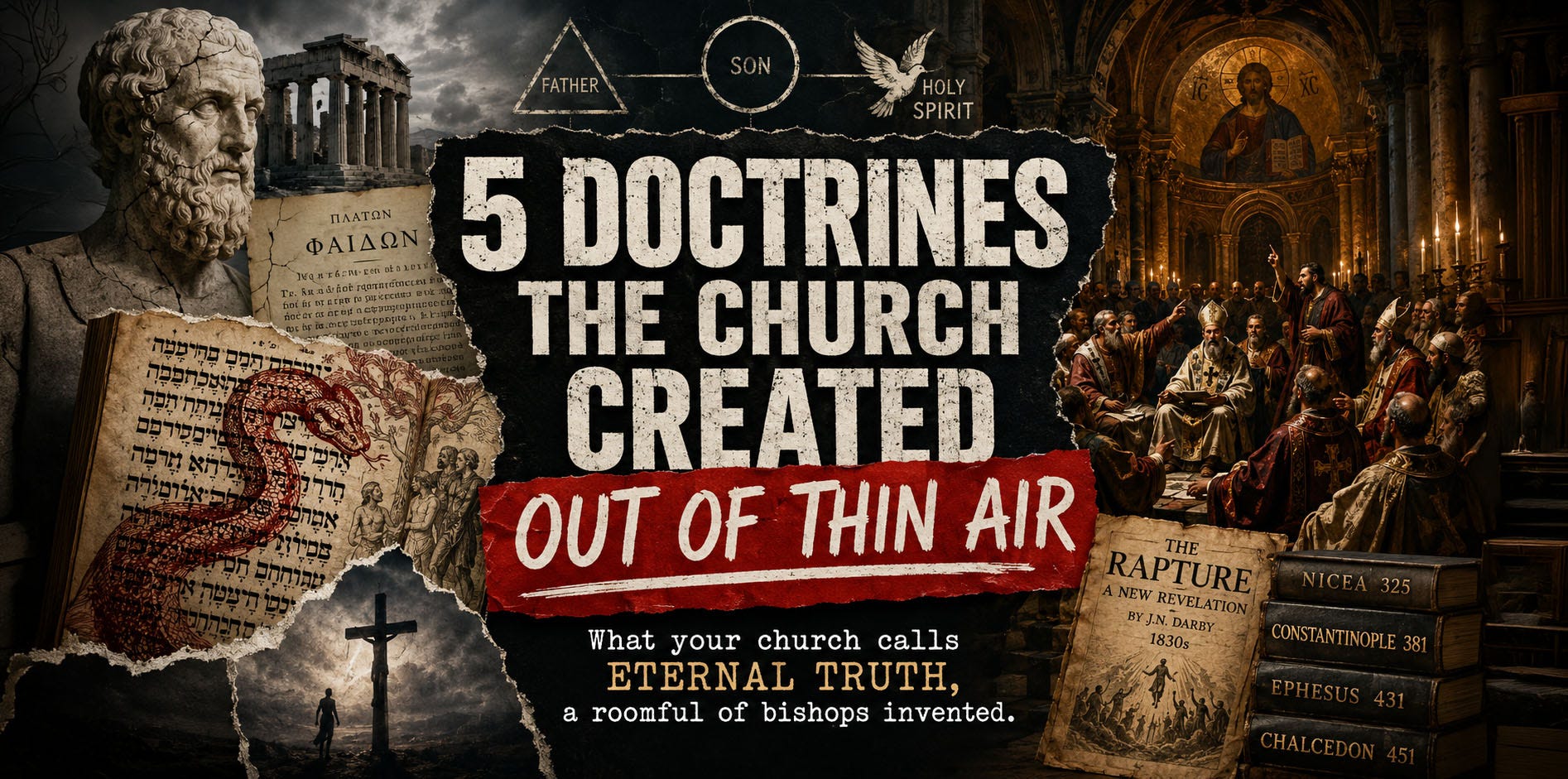
Christianity spent its first several centuries doing something it rarely admits to now: inventing its own foundations. Committees of men argued in sweltering rooms, hammered out formulas the actual texts never said, and declared them eternal and the very mind of God. The results were handed down to subsequent generations as though they were inherited from Jesus.
1. Original Sin Isn’t in the Old Testament
You won’t find the doctrine of original sin anywhere in the Hebrew Bible. The idea that all humans inherit a corrupted nature and guilt from Adam’s transgression, damned before they draw their first breath, is not a Jewish reading of Genesis. Judaism, which has been reading that text far longer than Christianity has, doesn’t derive that doctrine from it. The rabbis understood the Garden narrative as a story about human choice and consequence, not about a genetic inheritance of guilt spreading across every subsequent generation.
Paul gets the credit, or the blame, for the theological move. Romans 5:12 is the key text: “sin entered the world through one man, and death through sin, and in this way death spread to all people, because all sinned.” Augustine of Hippo in the early fifth century pushed this further than Paul had and cemented it as dogma in the Western church, partly through his fight against the Pelagian controversy. Pelagius held that humans had genuine moral freedom and could choose good without requiring divine grace to override a corrupted nature. Augustine called this heresy and won.
What Paul was actually doing was apocalyptic theology about the transfer of peoples into a redeemed community. The systematic doctrine of original sin is a fifth-century construction Augustine read back onto a first-century text. The two aren’t the same thing, and centuries of Augustinian tradition have made it easy to miss that.
How much structural weight this doctrine carries, and how little of it was visible to the people who wrote the texts it’s supposedly drawn from, is the part that should stop you cold. Jewish readers of Genesis for centuries before Christianity, and for centuries alongside it, didn’t find original sin in the story. It took a specific interpretive chain, Augustine’s reading of Paul’s reading of Genesis, to produce the doctrine. Then that doctrine became the reason humanity needed redemption, which became the explanation for why Christ’s death was necessary, which became the load-bearing architecture of Western Christianity’s soteriology. The whole structure rests on a reading that most people who knew the source texts never saw in them.
2. The Immortal Soul Came from Athens, Not Jerusalem
The Hebrew understanding of the human person isn’t that you have a body and an immortal soul. It’s that you are a living being, nephesh, the whole creature animated by the breath of God. Death in the Hebrew Bible is mostly exactly what it looks like: the end of the animated creature. The dead go to Sheol, a shadowy place of silence and near-nothingness. They don’t go to heaven or hell in any meaningful sense. They’re dead.
The idea of an immortal soul that survives the body, that is in some sense the “real you” existing separately from your physical form and continuing after death, comes from Greek philosophy, and particularly from Plato. In the Phaedo, Socrates argues at length that the soul is immortal and that death is the soul’s liberation from the prison of the body. This was Platonic theology, not Israelite theology.
Early Christian thought absorbed this model as Christianity spread through the Greek-speaking world. By the time Augustine was writing, the soul’s immortality was being read back into the Hebrew scriptures as though it had always been there. The scholar John Collins, whose work on apocalyptic literature in Second Temple Judaism is authoritative, has noted that the resurrection hope in late Jewish texts like Daniel is a hope for the restoration of the whole person, not a description of the soul going somewhere pleasant while the body waits for pickup.
What got built from this grafting is the popular Christian picture: you die, your soul goes to heaven or hell, and eventually your body is resurrected to join it. The problem is that this stitches two different anthropologies together. The body-soul dualism is Platonic. The resurrection is Israelite. They don’t fit particularly well, which is why theologians have spent enormous energy trying to hide the seams.
3. The Two Natures of Christ Were Decided by Fistfight and Exile
After Nicaea settled, more or less, the question of whether Jesus was divine in the same sense as the Father, a new question opened up: if he was fully divine, what was his relationship to his humanity? Was he really human? Did the divine and human natures mix together, or stay separate? Were they one person or two?
This is where it gets ugly fast. The Council of Ephesus in 431 condemned Nestorianism, which tended to keep Christ’s two natures more sharply distinct, and was partly a political operation run by Cyril of Alexandria against his rival Nestorius, the bishop of Constantinople. Cyril didn’t wait for the Eastern bishops to arrive before convening the council and issuing condemnations. When the Eastern bishops showed up and held their own counter-council, the whole thing descended into competing excommunications. The emperor eventually sided with Cyril’s faction.
Twenty years later, the Council of Chalcedon in 451 tried to clean this up and produced the formula still used in most mainstream Christian traditions: Jesus is one person in two natures, divine and human, without confusion, change, division, or separation. The four negative qualifications were each aimed at a specific error the council wanted to avoid. The formula is technically precise and tells you almost nothing about what it’s actually like for a single person to be simultaneously and fully two things that are normally opposites.
The churches that rejected Chalcedon, including what are now the Coptic, Ethiopian, Armenian, and Syriac Orthodox traditions, did so because they thought the two-natures formula slid back toward Nestorianism. These are not small Christian communities. They’ve existed continuously since the fifth century, and they lost this argument not because they were obviously wrong but because they were on the losing side of imperial politics.
What Chalcedon produced wasn’t a discovered truth. It was an agreed-upon formula that most parties could sign onto with different mental reservations, endorsed by the faction that had the emperor’s support, and rejected by millions of Christians who’ve maintained their own Christology ever since.
4. The Trinity Took a Roman Emperor to Finalize
Jesus didn’t teach the Trinity, nor did Paul. The word doesn’t appear in the New Testament. What you get in those texts is a Jesus who prays to the Father, calls the Father greater than himself (John 14:28), and gets described in ways that are exalted but not obviously co-equal-and-coeternal-in-substance. Early Christian communities held a dizzying range of views about the relationship between Jesus and God, and most of them would have failed a later orthodoxy test.
The theologian Bart Ehrman has written extensively on this. His work on early Christologies, particularly in How Jesus Became God, traces how views of Jesus ranged from adoptionism (he became divine at his baptism or resurrection) to a pre-existent but still subordinate heavenly being, to the fully co-equal divine figure that Nicaea eventually enshrined. These weren’t marginal positions. They were the water early Christians swam in.
Nicaea in 325 didn’t settle things so much as pick a winner with imperial backing. Constantine wanted unity, and unity required a formula. The formula they landed on, that the Son is of the same substance (homoousios) as the Father, was rejected by a significant chunk of the bishops in attendance, including those sympathetic to Arianism, which held that the Son was a supremely exalted creature but still a creature. Arianism wasn’t stamped out at Nicaea. It kept going for decades, got endorsed by subsequent emperors, and was arguably the dominant position in much of the empire for stretches of the fourth century. The historian Lewis Ayres, in Nicaea and Its Legacy, makes clear that what we now call Nicene orthodoxy was a construction that took most of the fourth century to consolidate, not a truth that Nicaea simply recognized.
The formula that settled things, the full Trinitarian creed most churches recite, wasn’t actually finished at Nicaea. The version associated with that council came from the Council of Constantinople in 381. That’s 56 years after Nicaea and requires a second council to finish what the first one started. The Holy Spirit’s divine status, full co-equality with Father and Son, was the piece that needed another few decades to nail down. It’s a doctrine built in stages.
If the Trinity is correct, the Christianity that spread across the Mediterranean for three hundred and fifty years was worshipping the wrong God. Not a slightly off version. The wrong one. And there’s nothing more fundamental to a religion than the identity of the thing it worships. Get that wrong, and you have built the whole structure on a false floor.
5. The Rapture Is Younger Than the American Civil War
Strictly speaking, this one isn’t the Church’s invention, but that doesn’t change the fact that millions of American Christians view the rapture as ancient prophecy, the plain meaning of Scripture, and something the early church simply understood. The idea that true believers will be physically snatched off the earth before a period of tribulation, leaving everyone else behind to suffer through apocalyptic catastrophe, was not a feature of Christian eschatology until the 1830s. John Nelson Darby, an Anglo-Irish minister who developed what became known as dispensationalism, invented it.
Darby’s schema divided history into distinct “dispensations,” periods in which God operated according to different covenants and principles. The rapture, as a pre-tribulation event distinct from the Second Coming, was his innovation. He spread it through extensive touring in North America in the mid-nineteenth century. Cyrus Scofield got it into millions of hands through the Scofield Reference Bible of 1909, which annotated the King James Bible with dispensationalist interpretations in the same typeface as the scripture itself, making the commentary easy to mistake for the text.
By the late twentieth century, through the Left Behind series and a cottage industry of prophecy teaching, this nineteenth-century invention had become what millions of Christians understood as the biblical expectation. When John Darby was born in 1800, no Christian tradition anywhere in the world taught the pre-tribulation rapture. It didn’t exist. Every church that teaches it now is teaching something invented within the last two hundred years and presenting it as timeless truth.
The passage usually cited is 1 Thessalonians 4:17, where Paul writes about believers being “caught up” to meet the Lord in the air. The scholar N.T. Wright, in Surprised by Hope, has pointed out that this imagery fits a different pattern entirely: the greeting of an arriving dignitary outside the city gates, after which the crowd accompanies him back in. It’s not an evacuation. The text was being read through Darby’s template, not the other way around.
This publication exists because readers like you choose to support it.
If you’re not already a paid subscriber and you’re finding value here, I’d love for you to consider becoming one to keep The Unholy Truth alive.
What This Actually Shows
The pattern is the same every time. A question gets argued, a faction wins, the winning position gets declared eternal, and the machinery of enforcement makes sure subsequent generations receive it as revelation rather than politics.
The standard defense is that the church was guided by the Holy Spirit into all truth, and therefore these developments, however historically contingent they look, reflect genuine divine disclosure. The problem is that this defense is unfalsifiable by design, and the losing side at every one of these councils would’ve offered it with equal conviction. Everybody thought the Spirit was on their side. The imperial army was on one side. That determined who won.
What you’re left with is an institution that built itself over centuries and told the people inside it the building had always been there.
Sources and Further Reading
Bart Ehrman — How Jesus Became God (2014)
Lewis Ayres — Nicaea and Its Legacy (Oxford University Press, 2004)
N.T. Wright — Surprised by Hope (2008)
Paula Fredriksen — Paul: The Pagans’ Apostle (Yale University Press, 2017)
Daniel G. Hummel — The Rise and Fall of Dispensationalism (Eerdmans, 2023)
I've been wanting all this information in one place. Thank you!
What a mess. What else can you say?